

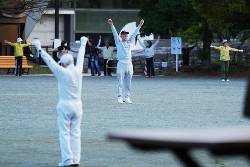
TOKYO (AP) — This is how Japan wakes up. It's called Radio Taiso — Exercise Radio in English — a simple yet dynamic way to start the day.
Japanese radio plays music every morning at 6:30 to accompany basic instructions for calisthenics, and millions perform in the choreography: in parks, workplaces, schools — and at home.
Radio Taiso has an almost 100-year history, formally introduced in 1928 and coinciding with the enthronement of Emperor Hirohito. The tradition endures because the exercises are suitable for all ages and capabilities, and easily accessible.
We're talking about basic exercise movements: reach to the sky to limber up, twist at the torso, bend at the hips, swing the arms and get the shoulders loose, or jump or run in place.
Exercisers can make it as strenuous as they wish, and it's over in just 10 minutes, all done to the rhythm of a soft piano melody. Japan has one of the longest-lived populations on Earth, and this ritual is credited for promoting physical and social well-being.
If you’re interested you can find Radio Taiso routines on YouTube in English and in other languages.
The basic moves for all
There are about a dozen basic moves that can be done standing or seated. The idea is to keep moving and, though the program runs early in the morning, many devotees repeat it on their own later in the day.
The routine features a trio of three-minute segments that get slightly more difficult — but not much. Most Radio Taiso followers know the sequences by heart, but beginners can join in and quickly pick up the routines. No equipment is needed.
The program begins with arms exercises — lifting the arms, circling the arms and stretching the arms side-to-side. It's followed by bending from the waist and twisting at the waist.
Shoulder raises are incorporated with a few mini-jumping exercises and marching-in place moves. Along the way you add in neck exercises, moves to stretch the chest and small squats for leg power.
Each movement is repeated four to eight times with instructions throughout to relax, breathe, and inhale and exhale slowly.
A social event, too
Mieko Kobayashi is 88 and goes to Kiba Park — an expansive layout in the east Tokyo area — almost every day, where a large group gathers without fail.
“If it's cold or raining, I don't go,” she said. “By moving my body, I feel better.”
She and her 77-year-old friend, Yoshiko Nagao, said that some who go to the park daily live alone, and this is an important social anchor — particularly for the elderly.
“Laughing and chatting while taking a walk after (the exercise) is also good,” Nagao added. “We come even on New Year's Day.”
Kenji Iguchi is 83 — he'd pass for 60 — and he's been a regular for about 20 years.
“It's for my joints, mainly the knees and back, because of my age,” Iguchi said.
“I get up a 5 a.m. anyway,” he added. “I come to the park about 6 and do a round of walking ahead of the Radio Taiso session. Most of the faces are familiar, and coming here and getting together with them is also one of the things I look forward to.”
Japan has one of the world's longest-lived populations, attributed to its diet, healthcare system and a lifestyle that encourages the elderly to be active. The average life expectancy is about 85, and only Hong Kong is reported to be slightly higher. By comparison, the United States life expectancy is about 79.
The Japanese government announced late last year that 99,763 people were alive in Japan at 100 or more, a new national record for the 55th straight year. The breakdown was 87,784 female (88%) and 11,979 male (12%). Japan holds the record for the most centenarians relative to its population, which is about 122 million.
American roots
Radio Taiso was inspired a century ago by a similar radio program in the United States sponsored by the Metropolitan Life Insurance Co. The Japan Radio Taiso Federation says officials of the postal ministry visited the United States in the 1920s and returned to Japan with the concept.
Within a decade, millions were participating. The federation says the program was led by postal workers who distributed pamphlets and organized training sessions.
Japan was under United States occupation after its defeat in 1945 in World War II, and the exercises were banned — largely because they were done in groups. The federation says the practice was seen as “totalitarian" with a possible air of militarism.
The group exercise were resumed in 1951, backed by popular demand as the American occupation ended in 1952.
According to a 2023 survey by the federation, more than 20 million people in Japan practiced a Radio Taiso session at least once a week.
Radio Taiso has caught on in many countries abroad, most notably in Brazil, which has the largest population of people of Japanese decent living outside Japan.
___
Mayuko Ono and Mari Yamaguchi in Tokyo contributed to this report.
___
Follow AP’s Be Well coverage, focusing on all aspects of wellness, at https://apnews.com/hub/be-well
... Copyright © 1996 - 2026 CoreComm Internet Services, Inc. All Rights Reserved. | View our