

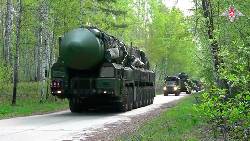
MOSCOW (AP) — Trucks carrying intercontinental ballistic missiles rumbled over forest roads, atomic-powered submarines set sail from Arctic and Pacific ports, and crews scrambled into warplanes as Russia and neighboring Belarus held the final stage of their joint nuclear drills Thursday.
Russian President Vladimir Putin discussed the maneuvers in a video call with his Belarusian counterpart Alexander Lukashenko.
“The use of nuclear weapons is an extreme, exceptional measure for ensuring the national security of our states,” Putin said.
Lukashenko earlier inspected Russian short-range nuclear-capable Iskander ballistic missiles at a military unit involved in the drills and declared: “I dreamed about this machine a long time ago.”
The three-day drills that began Tuesday come amid a surge in Ukrainian drone strikes. including on Moscow's suburbs that killed three people and damaged several buildings and industrial facilities. The strikes made it harder for officials in the Kremlin to cast the conflict in Ukraine — now in its fifth year — as something so distant that it doesn’t affect the daily routines of Russian civilians.
Drills involve wide array of nuclear weapons
Russia's Defense Ministry said the exercise involved 64,000 troops, over 200 missile launchers, more than 140 aircraft, 73 surface warships and 13 submarines, including eight armed with nuclear-tipped ICBMs. The drills focused on the “preparation and use of nuclear forces under the threat of aggression,” it said.
The maneuvers also practice cooperation with Belarus, an ally that hosts Russian nuclear weapons. Russian arsenals in Belarus include its latest intermediate range nuclear-capable Oreshnik missile system.
Along with nuclear-tipped ground- and submarine-launched ICBMs, the maneuvers featured a broad assortment of short- and medium-range weapons.
Unlike the intercontinental missiles that can destroy entire cities, tactical nuclear weapons intended for use against troops on the battlefield are less powerful. They include aerial bombs and warheads for short- and medium-range missiles and artillery munitions.
The Defense Ministry said the Russian armed forces carried out practice launches of Yars and Sineva ICBMs, as well as medium-range sea-launched Zircon and air-launched Kinzhal missiles. Belarusian troops test-fired short-range Iskander ballistic missiles.
Kremlin nuclear messaging
Putin has repeatedly reminded the world about Moscow’s nuclear arsenals after sending troops into Ukraine in February 2022 to try to deter the West from ramping up support for Kyiv.
In 2024, the Kremlin adopted a revised nuclear doctrine, noting that any nation’s conventional attack on Russia that is supported by a nuclear power will be considered a joint attack on his country. That threat was clearly aimed at discouraging the West from allowing Ukraine to strike Russia with longer-range weapons and appears to significantly lower the threshold for the possible use of Moscow’s nuclear arsenal.
The revised doctrine also placed Belarus under the Russian nuclear umbrella. Putin has said that Moscow will retain control of its nuclear weapons deployed in Belarus, which borders Ukraine and NATO members Latvia, Lithuania and Poland, but would allow its ally to select the targets in case of conflict.
Drills come as Ukrainian drones spotted in the Baltics
The maneuvers are held amid an increase in drone activity in the Baltic nations. On Tuesday, a NATO jet shot down a Ukrainian drone over southern Estonia. Ukraine apologized for that “unintended incident,” without specifying what had happened.
On Wednesday, an emergency announcement about a drone flying over Belarus prompted residents of the Lithuanian capital of Vilnius, including top officials and lawmakers, to take shelter and led to a brief closure of its airport.
Ukrainian drones targeting Russia's Baltic ports and energy facilities have recently crossed or come down in NATO territory on several occasions. Western officials blame apparent Russian electronic jamming of the drones.
Russia’s Foreign Intelligence Service said Tuesday, without providing evidence, that Ukraine is preparing drone attacks against Russia from the territory of the Baltic countries and warned of retaliation It alleged Ukrainian military personnel had been deployed to Latvia and warned that the country’s membership in NATO wouldn’t protect it from “just retribution.” Latvian authorities said the allegation was not true.
Last month, the Russian Defense Ministry published a list of factories in Europe that it said were involved in producing drones and their components for Ukraine. It warned that attacks on Russia involving drones manufactured in Europe are fraught with “unpredictable consequences.”
Some commentators interpreted the bellicose statements from Moscow and this week's exercise featuring short- and medium-range nuclear weapons capable of reaching targets in Europe as part of Kremlin efforts to discourage Western allies from bolstering support for Ukraine.
Asked what message the nuclear exercise was intended to send, Kremlin spokesman Dmitry Peskov responded that “any drills are intended to send a signal,” but wouldn't elaborate.
... Copyright © 1996 - 2026 CoreComm Internet Services, Inc. All Rights Reserved. | View our