

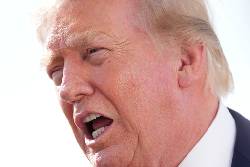
WASHINGTON (AP) — When President Donald Trump launched the war with Iran in late February, he initially forecast it would last four weeks to five weeks. Six months later, there still is no off-ramp in sight despite Trump's repeated assertions that the war has been won or a deal to resolve it was nearly complete.
A June memorandum of understanding was designed to pave the way to end the war but has fallen by the wayside. U.S. stockpiles of key weapons have diminished and the Republican administration has pivoted to pressuring Iran economically rather than conducting more strikes.
“No negotiations are happening right now, and this will continue until the president feels that maybe they come to the table in a meaningful way,” White House press secretary Karoline Leavitt told “Fox & Friends” on Thursday.
As the shape of the war has morphed over the past half year, so, too, have the goals.
One of the prime goals now — reopening the Strait of Hormuz — was not one of Trump's original objectives. The waterway, which had been a vital shipping lane through which about 20% of the world's oil passed, was open and free to all.
Iran seized on it as a chokepoint for the global economy. The strait has been largely closed since the war started, driving up prices for fuel and fertilizer needed for farms and creating economic and political pressure in the U.S.
The U.S. has had tactical success with its goals to degrade Iran's military capabilities. But some of the other key objectives Trump laid out at the start of the conflict remain unfulfilled and others have shifted.
Here is a look at the objectives and what we know about where they stand:
Stop Iran from having a nuclear weapon
In June 2025, Trump declared that the U.S. had “obliterated” Iran’s nuclear program. But when the war started, his aides justified the strikes by warning that Iran had been just weeks away from developing a bomb.
One of the most pressing questions has been what will be done with a stockpile of about 970 pounds (440 kilograms) of enriched uranium that Tehran could potentially use for a weapon. The material is believed to be buried under three sites bombed by the U.S. and Israel last year. Trump said in a May 29 social media post that it would be retrieved by the U.S. “in close coordination and conjunction with the Islamic Republic of Iran, plus the International Atomic Energy Agency, and DESTROYED.”
Iran has not said whether it would consent. Without permission from Iran, experts have said seizing it would be a dangerous mission requiring a sizable deployment of U.S. troops into the country.
Officials said that Tehran reaffirmed in the June memorandum of understanding that it would not procure or develop nuclear weapons. The deal called for Iran to dilute its stockpile of highly enriched uranium. But many other details about Iran's program were left for future negotiations, and it's unclear how much progress, if any, was made before talks quickly fell off.
Reopen the Strait of Hormuz
Trump has said that a proposed deal with Iran would include the reopening of the strait and the U.S. ending its blockade of Tehran’s ports, but at other times he has suggested the international waterway would somehow become American territory and indicated the U.S. could impose a toll on passing ships.
Trump also has repeatedly said that the strait is open, including during an interview on Wednesday on conservative commentator Glenn Beck’s radio show.
“It’s a functioning strait. Yes, every once in a while, there’ll be a drone or a rocket or something shot, but it is a very functioning strait,” Trump said.
Destroy Iran's ability to fire missiles
One of the prime objectives laid out by the administration was to “destroy their missiles and raze their missile industry to the ground."
Trump said in late March that Iran's missiles “are mostly decimated" and that 90% of their missiles and launchers were knocked out.
By mid-May, that shifted to a more conservative estimate, with the president saying that 82% of Iran's missiles were gone.
Iran has shown its ability to still launch attacks in the region, including drone strikes on ships sailing through the strait.
As recently as July, the U.S. military still had Iranian military targets to strike, with its Central Command announcing it was striking “Iranian military command centers, air defense and coastal surveillance sites, maritime capabilities, missile and drone launch sites and communications networks.”
Destroy Iran's defense industrial base
Early in the war, the president and his administration sometimes listed this as a standalone objective. Other times, it has fallen off their list.
U.S. Central Command has said its targets for strikes in Iran have included weapons production and missile and drone manufacturing facilities.
Secretary of State Marco Rubio told lawmakers in early June that Iran has had “massive destruction” of its defense industrial base and “80 to 90% of attrition. It will take years for them to rebuild it.”
Eliminate Iran's navy and air force
The U.S. and Israel quickly established air superiority in the skies above Iran, where they flew largely unchallenged.
Rubio told lawmakers that Iran still has drone capabilities, but it lacks the ability to use swarms of drones to attack targets, as it did at the start of the war. He also said Iran does not have a navy anymore, and relies on small craft outfitted with machine guns that harass ships and sometimes drop mines in the water.
Trump on Wednesday said that Iran's navy and air force are “totally gone."
Protect America's Middle Eastern allies
Trump, in a March social media post, added another objective for the U.S.: “Protecting, at the highest level, our Middle Eastern Allies, including Israel, Saudi Arabia, Qatar, the United Arab Emirates, Bahrain, Kuwait, and others."
The U.S. maintains thousands of troops on bases and other installations in the region, but Trump has been unclear on how far he would be willing to go to protect Middle East allies from threats in the long term. In June, when the U.S. said Iran fired missiles at Kuwait and Bahrain, the U.S. launched strikes on Iran in response.
But one ally — Oman — has notably not been feeling the warmth of Trump's offer of protection, and instead has grappled with Trump's wrath over the deal it was negotiating with Iran over the Strait of Hormuz. In mid-August, he threatened in an interview that the U.S. would bomb Oman if it “gets in the way," using an expletive for emphasis.
Cut off support for Iranian proxy groups
In March, Trump and his administration repeatedly said degrading Iran's proxy terrorist networks was a key goal.
As time has gone on, administration officials have offered fewer updates about this objective, which the president described as ensuring that “the region’s terrorist proxies can no longer destabilize the region or the world and attack our forces” and “ensuring that the Iranian regime cannot continue to arm, fund, and direct terrorist armies outside of their borders.”
Early on, the U.S. struck Iranian-aligned militia groups in Iraq. But the biggest focus has been Israel's war in Lebanon against Hezbollah, which Iran backs. Iran has insisted that the fighting in Lebanon must be stopped as part of any deal with the U.S. Israel and the Lebanese government announced a deal, which was mediated by the U.S., for Israeli forces to leave southern Lebanon in exchange for Hezbollah's disarmament — something an administration official described as a “huge step,” speaking on condition of anonymity because they were not authorized to address the issue on the record. But the militant group has refused direct talks and its leader has said it will not disarm.
___
Associated Press writer Konstantin Toropin contributed to this report.
... Copyright © 1996 - 2026 CoreComm Internet Services, Inc. All Rights Reserved. | View our