

BUNIA, Congo (AP) — Anxious healthcare workers in eastern Congo said Wednesday they are underprotected and undertrained in a rapidly spreading Ebola outbreak of a rare type of the virus in one of the world’s most remote and vulnerable places.
“It’s truly sad and painful because we’ve already been through a security crisis, and now Ebola is here too,” said Justin Ndasi, a resident of Bunia, site of the first known death that was announced last week after what experts call a worrying delay in detecting the virus.
The response unfolds in a region long threatened by armed groups that have kept a large part of the population on the run and control a major city where Ebola cases have been confirmed, complicating health workers’ catch-up efforts to trace the outbreak. The World Health Organization, which noted a low risk globally, has said “patient zero” has not been found.
In Bunia, where tons of health supplies have been airlifted, residents said masks are harder to find and some disinfectants that previously sold for 2,500 Congolese francs (about $1) now cost four times more.
‘He started bleeding and vomiting a lot’
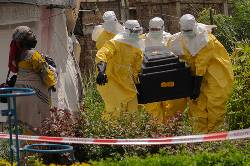
At a treatment center in Rwampara, healthcare workers in protective gear handled the bodies of suspected Ebola victims, in silence.
Families who tend to wash loved ones' bodies themselves watched helplessly as workers disinfected them and placed them into coffins for secure burial sites. Some relatives burst into tears.
The disease struck suddenly, they said, describing a rapid deterioration after symptoms were mistaken for illnesses such as malaria.
“He told me his heart was hurting, and I thought it was his stomach,” said Botwine Swanze, who lost her son. “Then he started crying because of the pain in his stomach. After that, he started vomiting. Then he started bleeding and vomiting a lot.”
The Ebola virus is highly contagious and spreads in the human population through contact with bodily fluids such as vomit, blood or semen. Symptoms include fever, vomiting, diarrhea, muscle pain and at times internal and external bleeding.
‘The scale of the epidemic is much larger’
WHO has declared the outbreak a public health emergency of international concern, and expressed worry over its “scale and speed." The WHO head in Congo says it would last at least two months.
The rare type of Ebola, known as the Bundibugyo virus, spread undetected for weeks following the first known death while authorities tested for another, more common Ebola virus and came up negative.
Investigations continued into where and when the outbreak started, but “given the scale, we are thinking that it has started probably a couple of months ago," said Anaïs Legand, a technical officer in the WHO emergencies program.
So far, 51 cases have been confirmed in Congo’s northern provinces of Ituri and North Kivu, and two cases in Uganda, WHO Director-General Tedros Adhanom Ghebreyesus said Wednesday. There are 139 suspected deaths and almost 600 suspected cases.
But "the scale of the epidemic is much larger,” he said.
This is Congo’s 17th Ebola outbreak, and the WHO has said its health ministry has experienced staff and capacity to respond. Most outbreaks, however, were of the more common Ebola type.
Any potential vaccine is months away.
Dr. Vasee Moorthy, a special adviser in the office of the WHO chief scientist, said a vaccine to address Bundibugyo would not be available for at least six to nine months.
He cited two candidates: A version of the Ervebo vaccine for the Ebola virus that would be specifically designed for the Bundibugyo virus, and another shot based on a vaccine developed by Oxford University.
Eastern Congo already faced “immense pressure from conflict, displacement and a collapsing health system,” said Dr. Lievin Bangali, senior health coordinator for the International Rescue Committee in Congo, adding that years of underfunding have weakened the response.
The outbreak highlights the effects of the Trump administration’s deep cuts in foreign aid. U.S. Secretary of State Marco Rubio has said the administration set a priority on funding 50 emergency clinics in affected areas. The U.S. pledged to contribute $23 million.
‘We have no protection’
Schools and churches remained open in Bunia. Some residents wore masks. At health centers, anxiety grew. In Bambu General Hospital elsewhere in Ituri province, suspected Ebola patients shared a ward with others injured or ill.
A Doctors Without Borders team identified suspected cases over the weekend at Bunia's Salama hospital but found no available isolation ward in the area, Trish Newport, an emergency program manager, said on social media.
“Every health facility they called said, ‘We’re full of suspect cases. We don’t have any space.’ This gives you a vision of how crazy it is right now," she said.
In Mongbwalu, where the body of the first known death was taken, the nearby border with Uganda remains open and gold mining continues, said Chérubin Kuku Ndilawa, a civil society leader, highlighting the difficulty of containing the virus.
“There’s no panic. People continue with their normal lives, but they’re also starting to spread the word,” said Ndilawa, and noted a lack of public handwashing stations.
At Mongbwalu General Hospital, Dr. Didier Pay said it was treating around 30 Ebola patients, and a student from the local medical technology institute died on Wednesday.
“The patients are scattered here and there in rather unusual conditions,” said Dr. Richard Lokudu, the hospital’s medical director. “We hope for the proper triage and isolation facilities to be installed today, and if that doesn’t happen, we will be completely overwhelmed.”
They are understaffed and not trained to handle suspected cases, he said, and if confirmed cases surge, “we have no protection.”
In the Ebola-affected city of Goma, meanwhile, Rwanda-backed M23 rebels are in control. “Indeed the situation is complicated there,” Dr. Anne Ancia, WHO representative in Congo, has said.
An American with Ebola is in isolation in Germany
A U.S. national who tested positive in Congo arrived in Berlin on Wednesday and was in a special isolation ward. A “comprehensive examination” was taking place to determine treatment, German Health Ministry spokesperson Martin Elsässer said.
He wouldn’t comment on the patient’s condition, whom German authorities and the U.S. CDC have not identified. The ministry later said it was taking the patient's wife and three children at the request of U.S. authorities. It was not clear whether any were infected.
___
Associated Press writers Jamey Keaten in Geneva, Jean Yves Kamale in Kinshasa, Congo, Wilson McMakin in Dakar, Senegal, and Geir Moulson in Berlin contributed to this report.
___
For more on Africa and development: https://apnews.com/hub/africa-pulse
___
The Associated Press receives financial support for global health and development coverage in Africa from the Gates Foundation. The AP is solely responsible for all content. Find AP’s standards for working with philanthropies, a list of supporters and funded coverage areas at AP.org.
... Copyright © 1996 - 2026 CoreComm Internet Services, Inc. All Rights Reserved. | View our