

CEUTA, Spain (AP) — Ceuta over the weekend no longer looked like a city on edge, but residents were still rattled by the events of the week.
Most of the 60,000 migrants who swam, scrambled and later charged into the tiny Spanish exclave in North Africa this week had walked back to Morocco by Sunday, but some stayed on in the hills surrounding the city. Spanish authorities continued searching for bodies in the waters near the stretch of urban beach that tens of thousand of migrants had breached days earlier.
Shops in Ceuta reopened, and the usual blend of residents and tourists in the city of 84,000 were filling the open-air terraces, restaurants and cafes.
At least 72 migrants died, including some who drowned and others who were killed in a stampede to cross a breakwater barrier, Spanish authorities said Sunday. Morocco reported 11 deaths on its side of the border, but it wasn’t immediately clear if these were in addition to those reported by Spain. The kingdom's authorities blamed misinformation and human traffickers for the breach, adding that they were opening an investigation into the events.
But the city that prides itself on being home to four cultures was still grappling with the aftermath of the border surge, with locals disagreeing on what caused it and who exactly is to blame.
“It's not the young men's fault,” said Mohamad Abdelkader Driss, 44, a waiter at a fish restaurant in town. “If you open the border, of course everyone comes in, but the young men aren't to blame. The authorities are responsible.”
Some migrants who returned to Morocco described a border that was effectively open and said authorities did little as they watched thousands of people cross.
The unauthorized arrivals on Thursday and Friday of 50,000 to 60,000, mostly young men, swelled Ceuta's population by more than half. Abdelkader lamented what happened, but said that those who breached the border behaved relatively well.
“It could have been much worse,” he said.
Far-right politicians call for remaining migrants to be expelled
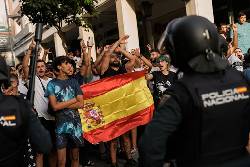
The humanitarian crisis caused by the sudden rush of people has reignited a debate around immigration in Europe and beyond. Over the weekend, far-right, anti-immigrant Spanish politicians and well-known right-wing influencers descended on the city, sparking counterprotests that included members of the Spanish city's large Muslim population, many of whom are of Moroccan descent.
Alvise Pérez, a far-right Spanish politician and member of the European Parliament, called on Saturday evening for migrants to be expelled as he faced an angry crowd of rival protesters. Pérez eventually had to shelter in a bar as residents banged on the windows, until police escorted him away.
Among the counter-protesters on Saturday was 20-year-old Ceuta resident and student Noor Ahmed. She denounced the protest and presence of figures like Pérez in her city as opportunistic.
“They just want to take advantage of the humanitarian crisis Ceuta is currently experiencing,” Ahmed said.
Santiago Abascal, the leader of the far-right Vox party, visited Ceuta on Sunday, slamming the Spanish government for the surge in migrant arrivals, which he called “an invasion.”
“The frontiers of Ceuta and Melilla are the walls of our home and homeland, and they are not being protected by a corrupt and traitorous government,” he said.
The Pope said he was alarmed
Pope Leo XIV on Sunday said he was “following with concern the alarming situation in Ceuta, asking God … that solutions of peace, stability and justice may be found.”
Migration has been one of Pope Leo’s priorities, which he underlined during a recent visit to Spain's Canary Islands, one of Europe’s main migrant entry ports.
... Copyright © 1996 - 2026 CoreComm Internet Services, Inc. All Rights Reserved. | View our