

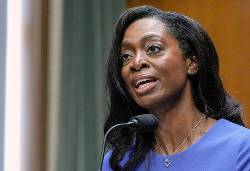
NEW YORK (AP) — Three months into her tenure as head of the Centers for Disease Control and Prevention, Dr. Erica Schwartz is being investigated by House Democrats, facing a call to resign, and drawing ire from both within and outside the agency.
What's been happening at the nation's top public health agency has alarmed outside health professionals. It also has alienated staff, leaving morale as bad as ever, employees say.
Schwartz, 54, took the helm of the CDC at a very challenging time: the worst U.S. measles epidemic in more than three decades, a large dengue fever outbreak in Florida and the fastest-growing overseas Ebola outbreak in history.
She reports to U.S. Health Secretary Robert F. Kennedy Jr., who is a longtime critic of vaccines and federal public health policy and who played a role in decimating CDC staffing last year.
“She has a tough job, at a tough time, and a tough boss,” said Noel Brewer, a University of North Carolina public health professor.
In an interview with The Associated Press on Tuesday, Schwartz defended her work, saying she's trying to restore trust in the CDC — including by changing how measles-associated deaths are being reported. She said some of the criticisms are based on misperceptions and argued she is making progress on her goals.
“I do understand why people have concerns," Schwartz told the AP from her home in Naples, Florida. “Have I made mistakes? Certainly. But I'm here to work on the behalf of the American people.”
Some experts say she has made the situation worse. And critics are seizing on the Pan American Health Organization’s declaration last week that measles is continuously spreading here, marking the re-establishment of a public health threat that was eliminated in the last century.
“I have no confidence that she will do what it takes to course-correct at the CDC, and she should resign immediately,” said U.S. Sen. Michael Bennet, a Colorado Democrat.
Schwartz has an impressive resume
When President Donald Trump nominated Schwartz to be the next CDC director in April, he called her “a STAR!” on social media.
She holds both medical and law degrees. She was chief medical officer for the U.S. Coast Guard, where she oversaw 41 clinics and 150 sick bays. She served as deputy surgeon general in the U.S. Public Health Service, helping to lead uniformed medical and health professionals posted at the CDC and government health agencies.
Many public health leaders were cautiously optimistic, noting the CDC badly needed steady leadership after enduring more than a year of turmoil and months of being led by interim directors.
Schwartz was the third Trump nominee for CDC director in less than 18 months. The first was a former Florida congressman whose nomination was pulled an hour before a Senate confirmation hearing. The second was Susan Monarez, who won Senate approval but then was ousted less than a month into the job when Trump administration officials said she was not aligned with the president’s agenda.
Under Kennedy, the agency has seen around 30% of its staff leave, mostly through layoffs, resignations and retirements.
At her nomination hearing, Schwartz pledged “radical transparency” to rebuild public trust in the agency, which she noted declined during the COVID-19 pandemic and which has eroded further under Kennedy.
“I will always stand on science and speak the truth, even in difficult moments,” she testified.
Meanwhile, public misperceptions about vaccines have persisted. A recent Annenberg Public Policy Center survey found that about 1 in 6 Americans said they believed that “vaccines given to children for diseases like measles, mumps and rubella cause autism” — even though dozens of studies have determined there’s no causal link. Roughly another 1 in 5 said they didn’t know whether it was true.
Schwartz hasn’t held a news conference
Schwartz started at the Atlanta-based agency in mid-August. A week later, she held her first “all hands” staff meeting, during which she promised to advocate for the agency and said she wouldn’t hesitate to disagree with Kennedy — but only privately.
Some say that’s when their optimism for Schwartz began to fade.
“I don’t have a clear sense of what is important to her, what are her red lines,” one CDC health scientist told the AP. “If we’re talking about radical transparency,” it is appropriate to know on what issues and what messaging she will not compromise, the scientist added. The employee spoke on condition of anonymity for fear of retribution.
Asked about that assessment, Schwartz said: “I would never do anything unethical or illegal. ... That is a red line.”
Despite that transparency pledge, CDC and HHS officials for months would not release Schwartz’s salary — even though it is public information. Schwartz is paid about $375,000 a year, CDC officials finally told the AP this week, above the typical range for previous CDC directors.
So far she also has been less visible than some predecessors. She has not held any news conferences, and has not used her bully pulpit to try to persuade more Americans to get vaccinations — including for measles, the flu and COVID-19.
Schwartz told the AP that, concerning measles, she doesn't believe a federal health official on TV will sway most of the unvaccinated.
But with the nation experiencing its worst measles epidemic in decades, many public health and medical leaders say Schwartz should be strongly urging Americans to get vaccinated.
“I hope to see her display independence from the vaccine rhetoric and challenges that have been part of this administration,” said Dr. Wendy Armstrong, president of the Infectious Diseases Society of America. “I don’t think we have seen that yet.”
Kennedy continues to back Schwartz. The Health and Human Services Department issued a statement in response to Associated Press queries, quoting Kennedy as saying she had his full support.
“Dr. Schwartz brings the judgment to make hard decisions and the courage to see them through. She is reforming CDC and sharpening its focus on its core mission: protecting Americans from disease,” the statement said.
Congressional Democrats are launching investigations
Some Democratic legislators accuse Schwartz and Kennedy of downplaying measles.
Kennedy has challenged health officials’ accounts of measles deaths. And the CDC has stopped quickly relaying state reports of measles deaths. It adopted a new policy requiring the review of death certificates, which has resulted in CDC counting only about half the measles-associated deaths that states are reporting.
Schwartz said that was her decision, and stemmed from her desire to have a uniform definition of what counts as a measles death.
Democrats on the House Energy & Commerce Committee have questioned why CDC changed the policy.
“As the crisis worsens, we are concerned that you continue to direct an effort at CDC to downplay the outbreak and artificially reduce the number of deaths that CDC reports,” according to a statement from Reps. Frank Pallone Jr. of New Jersey, Diana DeGette of Colorado and Yvette Clarke of New York.
“We are expanding our investigation to examine the threats your actions pose to Americans’ health and whether changes to your statutory authority are required,” they added.
The statement followed a briefing at which Schwartz was supposed to answer congressional staffers' questions about the measles data. The committee leaders described Schwartz as unresponsive and, at times, misleading.
Schwartz argued that she was “fully transparent. And I am really concerned that they think there is more to the story. There isn't.”
CDC employees see little sign of progress
The AP interviewed eight current CDC workers about Schwartz's tenure. They all spoke on condition of anonymity, saying they feared retribution for speaking frankly about what’s going on within the agency.
Some said they never had high expectations. Others said they initially were hopeful but lost confidence, some of them blaming her handling of the measles death count. One said it’s still too early to judge her.
Several said they had hoped for more improvements and stability. Announcements about leadership appointees coming, going and changing titles have continued in a blur, the employees told the AP.
Some mentioned Caroline DeBerry, a former vice president at a conservative think tank and author of independently published novels including one titled “Esther: The Woman Who Didn’t Know Her Place.”
DeBerry got a job as acting director of communications, starting in August. Employees said she gained notoriety within the agency when all CDC website updates ground to a halt while awaiting her approval.
Asked about it, Schwartz said: “There was a bit of clunkiness that happened one day.” She also said DeBerry is on “terminal leave” and her last day will be in December, but did not immediately offer additional detail.
None of the agency veterans interviewed by the AP said they have spoken with Schwartz. But some said they had seen her around the CDC campus accompanied by a group of security guards.
Security has been a sensitive topic at CDC, especially since an August 2025 shooting outside the entrance of CDC’s main campus. A Georgia man who had blamed the COVID-19 vaccine for making him depressed and suicidal opened fire, killing a police officer and spraying bullets into 150 windows.
(The slain officer, David Rose, is widely held up as a hero by CDC employees, and some expressed irritation that Schwartz referred to him as “Officer Stone” during a recent health summit appearance.)
Tom Frieden, who served as CDC director in the Obama administration, said he occasionally had an escort outside the CDC campus after he received death threats. But Schwartz moves with a large security team inside CDC, and agency staffers said they don’t recall seeing that before.
“It feels like they’re afraid of us,” one health scientist said.
Schwartz acknowledged that early in her time at CDC, she walked the halls accompanied by about a half dozen guards at the recommendation of security leadership. The security details have been reduced to one plainclothes guard, she said.
Confusion over the publication of scientific reports
A directive about research publications shows just how far apart CDC staff feel from the political leadership.
Two CDC scientists told the AP that they were directed in a recent meeting to stop submitting their research to journals run by organizations that have sued Kennedy. The prohibition would cover Pediatrics, one of the most-cited journals for doctors who specialize in children’s medical care, and Clinical Infectious Diseases, a highly regarded publication for doctors focused on germs.
The scientists said the directive was clearly stated but not written down in a memo or email.
HHS and CDC officials are adamant that neither Kennedy nor any other HHS or CDC official ever issued such a directive.
At the health summit, Schwartz acknowledged that CDC employees have lost trust in the political appointees who have been put in charge of the agency, “and I’m trying to earn that trust every day.”
She talked about work going on to stabilize the agency’s leadership and develop a “strategic hiring plan” for 2027.
CDC employees look around and see burned-out colleagues.
“I think everyone is just exhausted,” one health scientist said. “There’s just a sense that we can’t go on like this anymore.”
___
The Associated Press’ health and science coverage receives financial support from the AP Fund for Journalism and private foundations. AP is solely responsible for all content. Find AP’s standards for working with philanthropies, a list of supporters and funded coverage areas at AP.org.
... Copyright © 1996 - 2026 CoreComm Internet Services, Inc. All Rights Reserved. | View our