

BEIRUT (AP) — Normally, Lilian Jamaan would have been shopping for clothes for her daughter and buying meat and sweets in preparation for the Islamic holiday of Eid al-Fitr that marks the end of Ramadan.
But now, “there’s no joy for Eid or for Ramadan or for anything,” Jamaan said by phone from a school-turned-shelter in the Lebanese city of Sidon, where she’s been displaced with her family.
“Everything is difficult,” she said.
As the Islamic holy month of Ramadan draws to an end and Muslims worldwide prepare for the typically joyous holiday of Eid al-Fitr, Lebanon has crossed a grim milestone. Israel’s strikes have displaced more than 1 million people in the country, according to the Lebanese government.
Lebanon’s health ministry said 968 people were killed by the Israeli strikes in the country since the renewal of hostilities between Israel and the Lebanese militant group Hezbollah.
The Iran-backed Hezbollah entered the wider Iran war by firing rockets at Israel. That led to the heavy Israeli bombardment of southern Lebanon and Beirut’s southern suburbs, driving many from their homes.
Children wishing to spend Eid at home
“A lot of the kids that I at least spoke to, their biggest wish was to just spend Eid at home,” said Basma Alloush, a spokesperson for the International Rescue Committee. “Eid is a time where all families come together, people celebrate with their relatives, and it usually brings a lot of peace and joy to families. ... It could be that many of them just spend Eid in shelters, in displacement.”
The suffering has played out during Ramadan with scenes of people forced to flee their homes, reduced to sleeping in tents on the streets or in their cars. Some secured coveted spots in schools and other locations turned into shelters or stayed with relatives; many others scrambled to find makeshift arrangements. Only about 130,000 are in shelters.
For Jamaan, the harsh conditions in displacement meant she could no longer observe many aspects of Ramadan — a time for fasting, increased worship and usually festive communal gatherings with loved ones.
At home, she said she would fast, pray and read the Quran, the Muslim holy book.
Now, she said, she's stopped her fast and would make up for missed days when she returns home. “Some people fast and some are unable to fast; there’s psychological stress and we’re not sleeping well. ... Food is the last thing on my mind, but the circumstances are difficult."
She said she and her daughter sleep with others in the school while her husband sleeps in the car. “There’s no stability."
She misses her loved ones and her Ramadan routine. “We would break our fast, pray, make and drink coffee and I would go to the neighbors or they would come over after iftar,” the fast-breaking meal, she recalled.
Asmahan Taleb, who's also displaced in Sidon, said the run-up to Eid has been marred by hardship.
“How can we celebrate Eid when we’re displaced from our homes and our land? Where is the Eid? Where is the happiness?" she said. "It will be Eid when we can return to our homes.”
Humanitarian fallout and enduring one crisis after another
Like many others, this is not Jamaan’s first displacement. Her daughter, she said, was born during an earlier wave of displacement from a round of fighting that was halted with a tenuous ceasefire in November 2024. Israel continued to launch near-daily strikes in Lebanon after the ceasefire that it said aimed to stop Hezbollah from rebuilding.
“Lebanon for us is really now the epicenter of the more immediate humanitarian fallout of this broader regional crisis,” said Carl Skau, deputy executive director and chief operating officer of the U.N. World Food Program. “People here have endured crisis after crisis. They’ve been displaced before. But that doesn’t make it any easier.”
He said people he met were exhausted and hadn't yet recovered from the last time.
“There was this real sense of uncertainty this time. How is this gonna end? When is it gonna end?”
And that’s not all that’s different now.
“My concern is that the funding is not coming forward like it did last time,” he told The Associated Press. “We know there is less money available. We know there is also competing priorities. ... We will need to make an effort that really donors step up.”
As part of its response, WFP has provided more than half million hot meals to displaced people in shelters across Lebanon since March 2.
Response efforts and varied needs
Online, many volunteers, organizations and businesses have been sharing various initiatives to make, package and distribute hot meals for iftar and donate essentials from blankets and clothes to formula milk and medications.
The needs are varied and ample.
“There is a dire need for shelter,” Alloush said. “There was a massive thunderstorm. We’re just thinking about the people that were sleeping outside, sleeping in tents that are not waterproof, sleeping on the mud.”
She said IRC has been distributing mattresses, pillows and blankets as well as coloring books.
“People don’t have enough clothes. Children fled with no toys or no activities to kind of get their minds off of the war.”
Eman Abo Khadra, a hair salon owner in Sidon, said she tried to bring a bit of Eid cheer to some displaced children the way she knows best: giving them haircuts as a gift.
“It’s a morale thing. What does a child know about war or no war. … It’s just about planting some joy in their hearts.”
But despite her gesture, she felt the toll the tensions are taking on the young.
“I was telling them, ‘Come on, clap; be happy; laugh,’ but ... tensions are high,” she said. “People are tired.”
Sheltering in Sidon, Alia Ismail said it’s hard to properly observe Ramadan or tap into the Eid joy.
“We no longer can fast or buy anything for Ramadan," she said.
For Eid, her children tell her “We want clothes; we want to go out; we want sweets,” she said. “I tell them, ‘I can’t get you that. There’s no money.’"
In normal times, she said, she would have been cleaning her home, buying clothes, meat and sweets for Eid.
“Can you imagine that we are staying in a school corridor?” she said by phone, adding she puts clothes under her head when she sleeps as she has no pillows.
Striving to recapture a taste of Ramadan and Eid
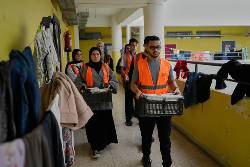
In a Beirut school sheltering hundreds of people, some tried to recapture a taste of Ramadan's traditions and the lives they left behind. Hallways between classrooms were adorned with decorations. One family placed a small gas burner and some meal packages from charities on a few desks lined up together.
At the school, Shaker Araqa lamented how his extended family has been dispersed. “We used to gather. We were in one building. Now, everyone is at a different place."
Nabila Hijazi said her children wonder about Eid, adding she'll buy them clothes.
“They want to live their lives," she said. “We tell them ‘God Willing, Eid comes and we return to our homes.’”
She said she’s been able to observe Ramadan normally at the school and is conscious of how much better her situation is than many others.
Back in Sidon, Jamaan said she prays “for God to stop the war, for us to return to our homes and for there to be peace.”
___
Fam reported from Cairo. Associated Press journalist Mohammed Zaatari in Sidon, Lebanon, contributed to this report
___
Associated Press religion coverage receives support through the AP’s collaboration with The Conversation US, with funding from Lilly Endowment Inc. The AP is solely responsible for this content.
... Copyright © 1996 - 2026 CoreComm Internet Services, Inc. All Rights Reserved. | View our