

HONG KONG (AP) — Asian shares were mostly higher and oil was trading below $80 a barrel on Wednesday as markets watched for details on the interim agreement between the U.S. and Iran to end the war.
U.S. futures edged higher ahead of the Federal Reserve’s policy decision announcement and after Wall Street closed mixed near their record highs.
Tokyo’s Nikkei 225 was 0.7% higher at 69,902.25 after briefly crossing the 70,000 mark for a second straight day following news that Japan’s exports jumped 17% in May from a year earlier, helped in part by strong demand for high-tech products.
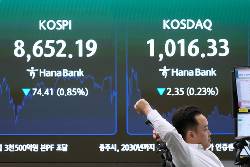
South Korea’s Kospi gained 1.6% to 8,864.24, closing at another all-time high, with big technology stocks climbing despite a sell-off of artificial intelligence-related shares on Wall Street. Samsung Electronics, the country’s most valuable company, was up 1%. Chipmaker SK Hynix jumped 5.8%.
Hong Kong’s Hang Seng lost 0.9% to 24,280.06, while the Shanghai Composite index rose 0.4% to 4,108.08.
Australia’s S&P/ASX 200 climbed 0.5% to 8,966.30.
Taiwan’s Taiex traded 0.2% higher. India’s Sensex rose 0.3%.
Oil prices stabilized after falling sharply earlier on optimism over a possible end to the war and reopening of the Strait of Hormuz, crucial for oil and gas transport worldwide. But challenges remain, including whether the deal includes Israel’s withdrawal from Lebanon.
Brent crude, the international standard, traded 1% lower at $78.19 per barrel early Wednesday after falling more than 5% on Tuesday. It was still above its roughly $70 a barrel level in late February, before the war started.
Benchmark U.S. crude was down 1.1% to $75.21 a barrel.
“Normalizing (oil) flows will take time,” economists at HSBC wrote in a note this week. “Hurdles include mine clearance, insurance reinstatement, emptying excess Gulf oil storage, repositioning ships, and restarting idled production fields.”
Later in the day the Federal Reserve will wrap up a two-day policy meeting, the first under its new chair Kevin Warsh. It is widely expected to keep its benchmark interest rate unchanged despite pressure from U.S. President Donald Trump to cut rates.
Countering that push are fresh worries over higher prices due to the Iran war. Lower rates could fuel higher inflation.
“With weak wage growth and rent growth, underlying forces are pointing to inflation falling sharply once the energy price shock recedes. We don’t expect the Fed to hike rates in 2026,” Preston Caldwell, chief U.S. economist at Morningstar wrote in a commentary. “We expect the Fed to resume cutting in 2027.”
On Tuesday, Wall Street's benchmark S&P 500 fell 0.6% and the Dow Jones Industrial Average added 0.6%, hitting another all-time high.
The technology-heavy Nasdaq composite dropped 1.2% to 26,376.34 following losses of some big tech stocks over renewed worries about an AI bubble.
Shares of Nvidia fell 2.4%. Chipmaker Broadcom dropped 4.4% and Micron Technology lost 6.2%.
SpaceX, Elon Musk’s rocket company, was up 4.8%, gaining for the third straight day since its Wall Street debut.
Yum Brands gained 1.9% after it announced it is selling Pizza Hut for $2.7 billion, with most restaurants purchased by U.S.-based private equity firm LongRange Capital.
In other dealings early Wednesday, the U.S. dollar fell to 160.26 Japanese yen from 160.42 yen. The euro was trading at $1.1607, down from $1.1608.
___
AP Business Writers Elaine Kurtenbach, Stan Choe and Matt Ott contributed to this report.
... Copyright © 1996 - 2026 CoreComm Internet Services, Inc. All Rights Reserved. | View our