

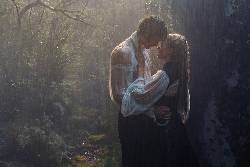
NEW YORK (AP) — If you're looking for someone to debate the new “Wuthering Heights” movie with, you might want to start with Lucasta Miller. She's a British author, editor and critic who has published an acclaimed study of the Brontë sisters and wrote the preface for the Penguin Classics edition of “Wuthering Heights.”
When she had the chance to see Emerald Fennell's adaptation of the Emily Brontë novel last week, she was well aware of the liberties taken by the director, but was otherwise unbothered.
“It would be meaningless to criticize it for that, just as it would be to criticize a grand opera that plays fast and loose with the plot,” Miller says. “I wasn't asking for a faithful adaptation of ‘Wuthering Heights,’ but whether it works on its own terms. And my sense is that it does.”
Fennell's “Wuthering Heights” was the box office leader last weekend, bringing in more than $34 million in North America alone, despite mostly negative reviews that found the movie both overdone and unsatisfying. Even before its release, Brontë obsessives questioned some of Fennell's choices: casting Jacob Elordi as Heathcliff instead of a dark-skinned actor closer to how Brontë described the character; making explicit the sexual attraction between Heathcliff and Cathy that is suppressed in the book; having the famously dark-haired Cathy, her coloring a literary signpost for danger and allure, played by the blond Margot Robbie.
“All adaptations choices in terms of casting that don’t always fit character or character descriptions — and this film has certainly been in the spotlight for that reason,” says Brontë scholar Claire O'Callaghan, a senior lecturer at Loughborough University in Leicestershire, England. “In terms of Cathy, I was skeptical initially, but having seen the film, it is a good performance, and Margot Robbie really brings out Cathy’s spoiled and selfish nature in ways that other adaptations have paid less attention to.”
The separation of book and movie
Authors have long lamented the fates of their books once filmmakers acquire rights. But countless adaptations have served as showcases for artful crystallization, or innovative license. “The Godfather” movies are widely regarded as superior to the original Mario Puzo novel, and differ notably from the book, even with Puzo assisting on the screenplays. Billy Wilder’s film version of the James M. Cain thriller “Double Indemnity” had the main protagonist, played by Fred MacMurray, tell his story through a dictation machine, a twist that Cain himself thought so ingenious he wished he had used it in the book.
Among current Oscar contenders, Paul Thomas Anderson’s “One Battle After Another” is the loosest of takes on Thomas Pynchon's “Vineland,” while Chloé Zhao's “Hamnet” departs from the Maggie O’Farrell novel of the same name in various ways common to adaptations, from compressing characters to altering the narrative structure. O'Farrell, who helped write the screenplay, has said her collaboration with Zhao was an education in how to condense a story for film.
“You know, the book is mine, it’s my baby, but the film is Chloé’s adaptation,” she told The Associated Press in December. “And the film feels not like my child, more like a kind of niece or nephew. And that’s exactly as it should be.”
Halving the ‘Heights’
“Wuthering Heights” fans are likely to care much more about fidelity to the novel than would the average reader of “The Godfather.” But as O'Callaghan and other Brontë experts note, you'd need a multi-hour streaming series to faithfully replicate the 1847 book, which runs some 400 pages and has a timeline extending beyond the lives of Cathy and Heathcliff. The best known versions, including Fennell's and the 1939 movie starring Laurence Olivier and Merle Oberon, essentially eliminate the second half of the book.
“Some TV versions have attempted to capture the whole book, as have some films, like the 1992 adaptation (starring Ralph Fiennes and Juliette Binoche),” O'Callaghan says. “But what film and TV can’t do is maintain the ambiguity in Emily’s novel — the fact that her book is both a tragic love story and a revenge novel and a tragedy. Film and TV tend to focus on one of those for clarity and to focus dramatic tension.”
Fennell told the AP during a recent interview that she was inspired by her early memories of the novel, how she responded to it as a teenager: “There are things I have added for my own needs, because I loved the book so much and I always desperately needed some kind of sense for it to go a little further,” she said.
Miller likened the movie to a fairy tale, “stylized and extravagant,” and thought Fennell “quite insightful about using the language of fairy tales.” O'Callaghan found it “quite Tim Burton-esque in its surreal perspective.”
“It radically departs from the book, but I still found it entertaining even if I’m unsure if I'd claim to like it,” she says.
___
Associated Press journalist Sarah Jones-Smith contributed reporting from Los Angeles.
... Copyright © 1996 - 2026 CoreComm Internet Services, Inc. All Rights Reserved. | View our