

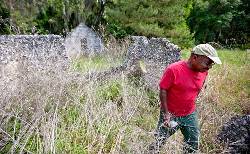
SAVANNAH, Ga. (AP) — Voters in a coastal Georgia county Tuesday rejected an ordinance allowing large homes on remote Sapelo Island, where Black landowners feared the change could saddle them with unaffordable property taxes in one of the South’s few remaining Gullah-Geechee communities founded by freed slaves.
The referendum organized by island residents succeeded in overriding McIntosh County commissioners’ 2023 decision to double the size of homes allowed in the tiny Hogg Hummock community.
Unofficial returns Tuesday night showed roughly 85% of voters who cast ballots voted for the referendum, according to figures from Doll Gale, the county’s elections supervisor. Only about 19% of the county’s 10,000 registered voters turned out.
The change adopted by the commissioners had weakened building limits that for decades helped keep property taxes low for one of America’s most culturally unique Black populations.
Tensions between Hogg Hummock’s Black landowners and county officials have been high for more than a decade, fueled by outsiders buying land in the community and building vacation homes. Island natives worry their taxes will balloon if wealthy buyers build larges homes, increasing property values. Commissioners have blamed the changing landscape on native owners who sold their land.
Black residents and their supporters brought the fight to voters after gathering more than 2,300 petition signatures and challenging commissioners before the Georgia Supreme Court to force a special election.
“I believe Sapelo is important to these folks and they’re sending a message to McIntosh County and saying, `Stop doing this,’” said Jazz Watts, a Hogg Hummock descendant and landowner who was among the referendum organizers. “It makes a significant statement that I hope the Board of Commissioners and the entire county pays attention to.”
Regardless, the vote wasn’t expected to settle the dispute.
Island may see land values spike in new tax assessment
Commissioners have said that if voters repeal their zoning changes, they will consider Hogg Hummock to be without any limits on development rather than go back to building restrictions that protected the community for three decades.
That could lead to another court fight. Dana Braun, an attorney for the Hogg Hummock landowners, accused county officials of “pushing this ludicrous argument” in an effort to defeat the referendum.
Commissioners could also try to push through a new zoning law for Hogg Hummock.
“I do believe there exists a willingness by the Board to consider a moratorium on zonings and building permits,” Commission Chairperson Kate Pontello Karwacki told The Associated Press in an email “However, the Board will have to collectively agree on next steps.”
Meanwhile, county assessors are weighing a proposal to recalculate the taxable value of Hogg Hummock properties for the first time since 2012. Their chief appraiser, Blair McLinn, predicts landowners could see painful increases, with values per half-acre possibly jumping from an average of $27,500 to $145,000.
McLinn said he plans to meet with island residents to hear their concerns. But given nearly 20 sales in recent years with half-acre lots fetching up to $210,000, he said, steep increases seem unavoidable.
“To leave it alone is not going to be an option, as far as revaluation goes,” McLinn said in a phone interview.
Recognized as a US treasure, island relies on local protection
Located about 60 miles (95 kilometers) south of Savannah, Sapelo Island remains largely unspoiled. The state of Georgia owns most of its 30 square miles (78 square kilometers), and there are no roads linking the island to the mainland.
Hogg Hummock, also known as Hog Hammock, sits on less than a square mile. About 30 to 50 Black residents still live in modest homes along dirt roads in the community.
Gullah-Geechee communities are scattered along the Southeast coast from North Carolina to Florida, where they have endured since the Civil War ended. Scholars say separation from the mainland caused these communities to retain much of their African heritage, including a unique dialect.
Hogg Hummock earned a place in 1996 on the National Register of Historic Places, the official list of treasured U.S. historic sites. But for protections to preserve the community, residents depend on the local government in McIntosh County, where 65% of the 11,100 residents are white.
“People worked hard to get this land on Sapelo and they worked hard to preserve who they are," said Maurice Bailey, an island native who runs a program aimed at boosting farming in the community. "Without this land, all of our descendants lose their connection.”
Dozens of the island's Black landowners protested after being hit with sharp property tax increases in 2012, and county officials rolled back their tax bills. Island residents followed up with a lawsuit accusing McIntosh County of taxing them while providing minimal services. A 2022 settlement froze island property assessments through last year.
Island residents said they were blindsided in 2023 when commissioners moved swiftly to weaken a special zoning ordinance enacted three decades earlier to protect Hogg Hummock landowners from unaffordable tax increases.
Commissioners voted to increase the maximum size of homes in Hogg Hummock from 1,400 to 3,000 square feet (130 to 278 square meters). They said the changes would allow more living space for families and denied seeking to displace Black landowners.
____
Associated Press writer Audrey McAvoy contributed to this report from Honolulu.
... Copyright © 1996 - 2026 CoreComm Internet Services, Inc. All Rights Reserved. | View our