

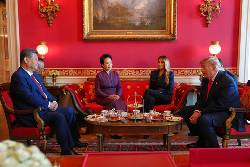
WASHINGTON (AP) — President Donald Trump disputed that he asked Chinese leader Xi Jinping if he wanted to buy weapons from the United States, contradicting an account from the U.S. ambassador to China.
Trump on Monday acted confused when a reporter asked him about Ambassador David Perdue's remarks over the weekend, suggesting the diplomat was confusing China with Taiwan. But then Trump said “maybe it’s a good idea” to make such an offer to China.
The whiplash over the prospect of arms sales from the U.S. to its ascendant geopolitical rival underlines the Trump administration's often uncoordinated and contradictory approach to China, including Xi's pomp-filled state visit to Washington last week during which Trump appeared to get little in return on key issues.
Perdue, speaking to Shannon Bream on Fox News Channel's “Fox News Sunday” days after the summit, didn’t specify when the offer was made. But such a proposal, if realized, would upend generations of U.S. policy toward China and Taiwan and expose U.S. technology to a potential foe.
China or Taiwan?
The State Department on Monday looked to distance the Trump administration from Perdue's comments, saying that “U.S. law prohibits arms sales to China and there is no offer or plan to sell arms to China.”
Hours later, Trump seemed to be doing the same.
“To China? You mean to Taiwan?” he said when a reporter asked him about Perdue's account.
“I never heard of that one. I’m going to have to ask him," Trump said.
He then mused that China would probably like to buy U.S. equipment, which he said was superior, and added: “So maybe it’s a good idea. But we didn’t discuss it. He may have been talking about Taiwan. I think he was probably talking about Taiwan.”
Perdue said Sunday that the Republican president was downplaying longstanding U.S. arms sales to Taiwan — which have drawn protest from Beijing for years — by couching it as just one of many sales Washington makes around the world, and even asking Xi if he’d be in the market for U.S. weaponry.
Bream had cited concerns from Republican and Democratic lawmakers over delayed aid packages and weapons orders to Taiwan, the self-ruled democracy that seeks to defend itself from China’s threat to invade the island. Bream asked if the U.S. is denying arms to Taiwan to appease the Chinese president.
Perdue pushed back on the suggestion, stating that Trump “is as strong on Taiwan as I’ve ever seen anybody” and has sold it plenty of weapons. Perdue also said Trump and Xi continue to talk about future U.S. weapons sales to Taiwan.
“But President Trump continues to say, ‘Hey, we sell arms to other people around the world,’” Perdue said. “He actually asked President Xi, would he like to buy some, at one point.”
‘Trump’s transactional worldview'
If so, that offer “speaks to (Trump's) treatment of China in almost exclusively commercial terms, even at the potential expense of the U.S. military position in Asia,” said Evan Sankey, an analyst focused on U.S. policy toward China at the libertarian Cato Institute.
He said the U.S. last sold arms to Beijing in the 1980s and resuming those sales would be “a shocking policy change.”
Craig Singleton, a senior fellow at the hawkish think tank Foundation for Defense of Democracies, said the anecdote that Perdue told offers “a revealing window into Trump's transactional worldview.”
“He tends to see weapons, tariffs and market access as instruments of leverage, even across the traditional dividing line between allies and adversaries,” Singleton said.
Such an offer to Xi also would come in contrast with U.S. obligations under a domestic law to provide Taiwan with the means to defend itself and deter invasion from Beijing, which has vowed to seize the island by force if necessary. While not recognizing Taiwan as a country, the U.S. is the island’s strongest informal backer and primary arms provider. But multiple U.S. leaders have left ambiguous whether they would commit military force to defend the island should China invade.
China has pressed Washington to halt the arms sales, most prominently during a previous summit in May between Trump and Xi in Beijing. After that meeting, the United States paused the sale of a record-breaking $14 billion package — and Trump described arms sales to Taiwan as a “very good negotiating chip” with China.
In their private talks at the White House last week, Xi pressed Trump to oppose Taiwan independence, according to Chinese state media.
In Beijing, China's foreign ministry spokesperson Guo Jiakun did not confirm Perdue's remarks when asked about the matter on Monday. But he told reporters that China has always strengthened its national defense capabilities based on its needs and is committed to maintaining world peace and stability.
... Copyright © 1996 - 2026 CoreComm Internet Services, Inc. All Rights Reserved. | View our