

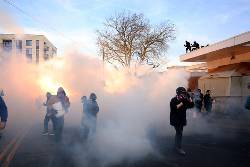
PORTLAND, Ore. (AP) — Multiple residents of an affordable housing complex in Portland, Oregon, have bought gas masks to wear in their own homes to protect themselves from tear gas fired by federal agents outside the immigration building across the street. Others have taped their windows or stuffed wet towels under their doors, while children have sought security by sleeping in closets.
Some told their stories to a federal judge Friday, as they testified in a lawsuit seeking to limit federal officers' use of tear gas during protests at the U.S. Immigration and Customs Enforcement building following months of repeated exposure.
The property manager of the apartment building and several tenants filed the suit against the federal government in December, arguing that the use of chemical munitions has violated residents' rights to life, liberty and property by sickening them, contaminating their apartments and confining them inside. They have asked the court to limit federal agents' use of such munitions unless needed to respond to an imminent threat.
“They’re simply trying to live their lives in peace in their homes," Daniel Jacobson, an attorney representing the plaintiffs, said during the hearing. "Yet our federal government is knowingly putting them through hell, and for no good reason at all.”
The defendants, which include ICE and the Department of Homeland Security and their respective heads, say officers have deployed crowd-control devices in response to violent protests at the building, which has been the site of demonstrations for months.
"The conduct at issue, law enforcement’s use of crowd-control tactics to disperse unlawful crowds, does not even come close to shocking the conscience," Samuel Holt, an attorney for the federal government, said during the hearing.
The case comes amid growing concern over federal officers using aggressive crowd-control tactics, as cities across the country have seen demonstrations against the immigration enforcement surge spearheaded by President Donald Trump's administration.
Residents share physical and psychological effects
In testimony, tenants of the Gray's Landing apartment complex described experiencing difficulty breathing, coughing, dizziness and other symptoms following exposure to chemicals from tear gas, smoke grenades and pepper balls. Gas canisters have hit apartments and been found in the building’s courtyard and parking garage, plaintiffs said.
A resident who used a pseudonym in court filings due to being a domestic violence survivor said she has a gas mask in her bedroom, in her living room and in her backpack, and that she has slept with one on. She described how the gas entered her apartment and triggered her post-traumatic stress: ”I could feel it, I could see it, I could taste it, I could smell it."
Erica del Nigro, another resident, said the chemicals have triggered her autoimmune syndrome and that her 12-year-old son has had hives, rashes and nightmares. Doctors have prescribed him multiple medications, including an inhaler, which he didn't need before the gassing began, she testified.
Diane Moreno, who said she has slept in her bathtub to avoid the chemicals seeping inside, said she has to have one of her adrenal glands removed due to the stressful environment exacerbating a disease that causes her to overproduce cortisol. “Not feeling safe and happy in your own home is a big stressor," she testified.
Other plaintiffs include a 72-year-old Air Force veteran who has been diagnosed with shortness of breath and mild heart failure, and a father who has taken his 7- and 9-year-old daughters to urgent care for respiratory symptoms. The girls sometimes sleep in his closet to feel safe, according to the complaint.
During the hearing, attorneys for the federal government questioned whether residents were trained in assessing imminent threats or unlawful behavior, and whether they were close enough to incidents to directly observe why officers may have deployed munitions.
The plaintiffs filed an updated request for a preliminary injunction limiting federal officers' use of tear gas late last month, after agents launched gas at a crowd of demonstrators including young children that local officials described as peaceful.
Of the affordable housing complex’s 237 residents, nearly a third are age 63 or older, according to court filings. Twenty percent of units are reserved for low-income veterans and 16% of tenants identify as disabled.
Federal government pushes back against claims of rights violations
The government said in court filings that federal officers have at times used crowd control devices in response to crowds that are “violent, obstructive or trespassing" or do not comply with dispersal orders.
It has also pushed back against the claims of tenants' constitutional rights being violated, saying that under such an argument, “federal and state law enforcement officers would violate the Constitution whenever they deploy airborne crowd-control devices that inadvertently drift into someone's home or business, even if the use of such devices is otherwise entirely lawful.”
The hearing will resume next week. It came after a federal judge in a separate Oregon lawsuit, filed by the ACLU of Oregon on behalf of protesters and freelance journalists, temporarily restricted agents' use of tear gas during protests at the building.
... Copyright © 1996 - 2026 CoreComm Internet Services, Inc. All Rights Reserved. | View our