

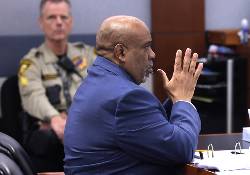
LAS VEGAS (AP) — In the first week of testimony at the trial of a man accused of orchestrating the killing of Tupac Shakur, the night of Sept. 7, 1996, has been run and rerun many times — through police who were at the scene, through the people near the hip-hop superstar, and through the recorded words of the suspect, Duane “Keffe D” Davis.
Many of the basic facts jurors have learned are not in dispute.
Shakur and Death Row Records co-founder Marion “Suge” Knight were in Las Vegas to watch a Mike Tyson fight at the MGM Grand Garden Arena. Just outside, Shakur, Knight and their entourage got into a brawl with Davis’ nephew, Orlando “Baby Lane” Anderson.
Later that night, Shakur and Knight were in a black BMW at a red light near the Las Vegas Strip, when a white Cadillac with four men inside pulled up beside them and someone opened fire. Shakur was shot multiple times and died six days later. Knight survived with minor injuries.
Years later, Davis would say he procured the gun and his nephew fired the shots. Davis' lawyers have disputed the statements and fought unsuccessfully to get them excluded. The other men in the Cadillace have since died, limiting eyewitness testimony.
The dispute had its roots in the long-running feud between the Mob Piru Bloods, a gang Knight and Shakur were affiliated with, and the South Side Compton Crips, for whom Davis was a prominent leader.
A jury of six men and 10 women — four are alternates — will decide whether Davis, 63, is guilty of one count of murder with a deadly weapon with the intent to promote, further or assist a criminal gang. He has pleaded not guilty. If convicted, he could get life in prison.
Here's a closer look at the first week of the trial that is expected to last about a month.
Is Keffe D admitting old truths — or as his lawyer says, ‘full of crap’?
A prosecutor said in his opening statement that Davis' own words — in interviews with police, podcasters and filmmakers — would prove he orchestrated the killing.
“Let’s be clear, Duane Davis did not pull the trigger. But he did plan the shooting in retaliation of the beating of his nephew,” Chief Deputy District Attorney Binu Palal told jurors. “Remarkably, you will learn that from Duane Davis himself.”
“Now, 30 years later, we’re going to ask you to finally hold Duane Davis accountable,” Palal said.
Davis' defense attorney Michael Sanft took the unusual approach of telling jurors his client's words were all bloviating and braggadocio, and did not represent the truth.
“What they are telling you, they are representing as fact, when it’s really fiction,” said Sanft. He said Davis wasn’t previously charged because law enforcement knew that he was “full of crap.”
Who are the witnesses and what have they said about the 1996 shooting?
Seventeen witnesses testified through the first five days, a little under half the number prosecutors said they plan to call at the trial.
They included a police officer, Garry Dale, who first responded to the scene, jumped into the ambulance with Shakur and asked him who shot him. “We'll take care of it,” was Dale's best memory of what Shakur said.
Brent Becker, a homicide detective from the initial investigation, said that despite being able to get probable identification on the men in the Cadillac from confidential informants, it was of little use because no witnesses would say anything solid on the record.
That included Knight. “I thought he lied to us,” Becker said.
Some of the case's most compelling witnesses — formerly gang-affiliated men who testified unwillingly under court order — essentially refused to help the prosecution that summoned them, but provided drama and humor that was absent from the more sterile official testimony.
They included James McDonald, a former Mob Piru member who helped Knight with security.
“I’m aware of a lot of things,” McDonald said on the stand, “things that was going on, people ain’t talked about them in 30 years. Today ain’t one of them.”
He directly addressed the defendant. “What you’re going through, brother, is what you’re going through,” McDonald said, adding “I didn’t want to be a part of it.”
Knight is on the prosecution's witness list, but will likely take a similar approach should he be called. He's in prison serving a 28-year sentence for an unrelated killing in California.
Leonard Jefferson, who took the last known photo of Shakur, also took the stand. Police developed Jefferson’s film and returned the photo negatives days after Shakur died.
In the frame, Shakur looks directly at the camera while Knight stares ahead, his hand on the steering wheel.
“The picture just took on a life of its own,” Jefferson told The Associated Press.
Jurors hear Keffe D's damning statements
Decades of interviews starting from the late 1990s were played for jurors.
Key was a 2008 interview with law enforcement looking into the 1997 killing of the Notorious B.I.G., Shakur’s rap archrival. Davis had briefly been a suspect in that shooting, but one detective testified that “everyone was a suspect” in that case at one point or another.
Davis shifted the conversation to the Shakur shooting, and admitted his involvement from the passenger side of the Cadillac.
“If we would have been on my side, I would have blasted,” Davis said. Instead, Knight’s car was on the other side, so Davis passed his gun back to the guys in the backseat, he said.
Davis said his nephew took the weapon and started firing.
Several people in the audience shook their heads when they heard detectives tell Davis that the interview would not be used against him. But authorities argue he negated that agreement when, years later, he spoke publicly about the shooting.
Davis, with bald head and gray goatee, sat stoically through most of the testimony, wearing a suit and tie. He occasionally whispered and exchanged fist bumps with his lawyer.
And he spoke to the judge on Friday, saying his family's safety is at risk because witnesses for the prosecution have shared his home address. “They keep giving out my address,” he said. “They broke into my house, vandalized my house, vandalized my wife’s car.”
“I’m not upset I’m being prosecuted,” Davis said, but “you’re endangering my family’s life.”
___
Dalton reported from Los Angeles and Boone from Boise, Idaho.
... Copyright © 1996 - 2026 CoreComm Internet Services, Inc. All Rights Reserved. | View our