

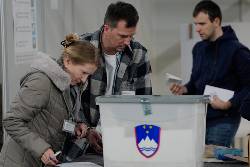
LJUBLJANA, Slovenia (AP) — Slovenia's a highly contested parliamentary election will decide whether the small European Union nation stays on its liberal course or sways toward the right.
An exit poll published immediately after the polls closed suggested a tight race between Prime Minister Robert Golob’s center-left Freedom Movement and the right-wing Slovenian Democratic Party, or SDS, led by three-time premier Janez Jansa, a populist-style politician and an admirer of U.S. President Donald Trump.
The poll by the Mediana polling agency and Slovenia’s public broadcaster RTV Slo showed Golob's party with a slight lead with nearly 30% of the votes and Jansa's SDS trailing with 27,5%.
Preliminary results by Slovenia's state election authority are expected later in the evening.
Slovenia’s top two parties have been running neck and neck in recent polls and analysts predict that no party will have a clear majority in the 90-member parliament, which would turn smaller parties into kingmakers.
Golob's government has been a strong liberal voice in the EU while a victory of Jansa — also a close ally of nationalist Hungarian Prime Minister Viktor Orbán — would strengthen Europe's surging populist groups.
Upon voting on Sunday, Golob warned that “democracy and sovereignty” of Slovenia can no longer be taken for granted. He urged voters to “not let others to decide instead of you, go out and vote."
Jansa said the election amounted to a "referendum on whether the people can take back the state.”
Slovenia has 1.7 million eligible voters.
The vote came after an election campaign marred by claims, first made by a group of activists and journalists, that a string of secret video recordings showing alleged government-tied corruption, aimed to sway the voters.
Authorities have opened a probe into the allegations that Jansa’s party and a private, foreign agency were linked to the recordings. Jansa has acknowledged having contacts with a Black Cube agency adviser but denied the allegations of election interference.
Black Cube didn't immediately respond to requests for comment.
The company, run by two former Israeli intelligence agents, has been involved in a number of controversies over the years, including an undercover operation on behalf of the film mogul Harvey Weinstein to discredit his accusers. It has said that all of its activities are legal and ethical.
Jansa, 67, a veteran politician and a former dissident during communism, has faced accusations of clamping down on media freedoms and undermining the rule of law in Slovenia during his latest term in office in 2020-22, which he has denied.
A former energy company manager, 59-year-old Golob and his party were seen in 2022 as a new hope for disillusioned voters. The government, however, has since been shaken by a series of reshuffles, problems with health care reform and frequent changes in tax policy that reflected an air of inconsistency.
Internationally, Golob’s government has taken a strongly pro-Palestinian stance, recognizing a Palestinian state in 2024 and banning top Israeli officials from entry. Jansa, on the other hand, is pro-Israel and has strongly criticized Palestinian recognition.
Slovenia routinely has switched between the two blocks since it broke away from the former Yugoslavia in 1991. The Alpine nation of 2 million people became a member of NATO and the EU in 2004.
___
Associated Press writers Jovana Gec in Belgrade, Serbia; Josef Federman in Jerusalem and Lorne Cook in Brussels contributed to this report.
... Copyright © 1996 - 2026 CoreComm Internet Services, Inc. All Rights Reserved. | View our