

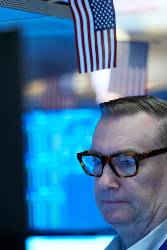
NEW YORK (AP) — AI stocks dragged the U.S. market lower after their surge from the day before quickly fizzled. The S&P 500 fell 0.5% Tuesday to its eighth loss in the last nine days. Tech stocks led the way lower and dragged the Nasdaq composite down a market-leading 1.5%. Anthropic’s stock dropped back below its IPO price. But outside of tech, the majority of stocks climbed on Wall Street. The Dow Jones Industrial Average added more than 400 points. They’re the latest swings for a U.S. stock market that’s been mostly sinking since setting its all-time high last month. Oil prices rose.
THIS IS A BREAKING NEWS UPDATE. Check back for updates. AP’s earlier story follows below.
NEW YORK (AP) — Stocks tied to the artificial intelligence industry are dragging the U.S. market lower Tuesday after their surge from the day before quickly fizzled. That's even though much of the rest of Wall Street is rising, along with confidence among Americans in the economy.
The S&P 500 fell 0.8% and is heading toward its eighth loss in the last nine days. Tech stocks once again led the way and yanked the Nasdaq composite down a market-leading 2%, with an hour remaining in trading. Stocks outside of AI held up much better, and the Dow Jones Industrial Average rose 284 points, or 0.6%.
They're the latest swings for a market that's been mostly sinking since hitting its all-time high last month. The worry is that prices for AI-related stocks shot too high into a possible bubble and need to deflate. That carries immense consequences for the broader market and workers’ 401(k) accounts because AI companies have grown into Wall Street’s most influential stocks.
While the surprise return of Jensen Huang as Nvidia's CEO announced Monday does bring back a charismatic leader who championed the entire AI industry, it does not settle the deep concerns dogging it. For one, doubts remain about whether AI can possibly produce enough profit and productivity to make the massive investments underway in data centers worth it.
At the same time, high interest rates make it more difficult to borrow money to pay for the industry’s growth. Sweeping victories for Democrats earlier this month in the U.S. midterm elections, meanwhile, have raised concerns about more regulation for AI, including possible halts to further construction of data centers.
To be sure, AI stocks and the broader U.S. market have been prone to extreme reversals since the summer, not only week to week but even hour to hour.
For now, at least, the momentum is back downward.
Nvidia fell 7.6% a day after soaring 31.5% to its biggest gain in more than two decades. Other stocks around the AI industry fell by similar amounts.
CoreWeave, which buys Nvidia chips and rents out access to them over the cloud, sank 12.7%. GE Vernova, which is helping to power AI data centers, dropped 5.5%.
And Anthropic, the company behind the Claude AI chatbot, tumbled 9.3% to drop below $83. That’s how much Anthropic first sold its stock for in its initial public offering last week. The stock had briefly jumped as high as $115 in its first day of trading amid a frenzy of hype.
Such drops were powerful enough to drag the S&P 500 index lower even though 2 out of every 3 stocks within the index climbed. They rose following the latest report to say confidence among U.S. consumers is improving by more than economists expected.
Confidence jumped sharply for Democrats and independents following the midterm election results, according to the Conference Board. That narrowed the wide gap between them and Republicans, whose confidence fell slightly. The results echo a preliminary report from the University of Michigan released earlier in the month, which also showed a jump in sentiment following the midterm elections and a drop in oil prices from late October.
Companies in industries across the economy, meanwhile, continue to report strong growth in profits for the summer.
Dollar Tree climbed 10.5% after reporting better earnings for the latest quarter than analysts expected. The average shopper spent slightly more in its stores during the three months than they did in last year's third quarter, and more of them came in than last year.
Kohl's rallied 15.3% after reporting a profit for the latest quarter, when analysts were expecting basically zero. It also gave forecasts for revenue for the final three months of its fiscal year that were better than expected.
Businesses in the S&P 500 are on pace to report overall growth in earnings per share of more than 25% for a third straight quarter, according to FactSet. That's a big deal because stock prices tend to follow the path of corporate profits and interest rates over the long term. But emotions of investors can also overwhelm them in the short term, as the last few weeks have demonstrated.
In the bond market, Treasury yields edged lower as investors moved into investments seen as safer bets. The yield on the 10-year Treasury fell to 4.90% from 4.92% late Monday.
That was despite a rise in oil prices, which tend to push upward on inflation and on bond yields. The price for a barrel of Brent crude oil rose 2.4% to $88.78. It’s been yo-yoing between $72 and $114 since the United States and Israel attacked Iran in February.
In stock markets abroad, indexes were mixed across Europe and Asia.
South Korea’s Kospi jumped 6.3%, and Japan’s Nikkei 225 rallied 3.9% for two of the world’s bigger moves, as they caught up to Monday’s surge from Wall Street.
___
AP Writer Elaine Lai contributed to this report.
... Copyright © 1996 - 2026 CoreComm Internet Services, Inc. All Rights Reserved. | View our