

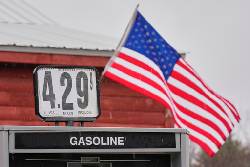
NEW YORK (AP) — U.S. gas prices jumped past an average of $4 a gallon for the first time since 2022 on Tuesday, as the Iran war continues to push fuel prices higher worldwide.
According to AAA, the national average for a gallon of regular gasoline is now $4.02 — over a dollar more expensive than it was before the war began on Feb. 28. That's the largest monthly jump the motor club has seen on record. And the last time U.S. drivers were collectively paying this much at the pump was nearly four years ago, following Russia’s invasion of Ukraine.
The price is a national average, meaning drivers in some states have been paying well over $4 a gallon for a while now. Prices vary between states due to factors ranging from nearby supply to differing tax rates.
Since the U.S. and Israel launched the war against Iran a month ago, the cost of crude oil — the main ingredient in gasoline — has spiked and swung rapidly. That’s because the conflict has caused deep supply chain disruptions and cuts from major oil producers across the Middle East. Both Brent crude, the international standard, and benchmark U.S. crude are now going for more than $100 per barrel, up from roughly $70 before the war.
Motorists around the world are coping with higher gas prices. In Paris, for example, gas is at 2.34 euros per liter ($2.68), which is about $10.27 a gallon.
Expensive gas could drag the economy and drive up other prices
Higher gas prices arrive as many households continue to face wider cost of living strains. And as drivers pay more to cover necessities like gas, or even utility bills impacted by soaring fuel costs, many may be forced to cut their budgets in other places. That threatens broader consequences for the economy overall.
Before launching the war, President Donald Trump bragged about keeping gas prices low. Consumer prices and the cost of living already have become flashpoints in this midterm election year. A recent AP-NORC poll found that 45% of U.S. adults are "extremely” or “very” concerned about being able to afford gas in the next few months, up from 30% shortly after Trump won the 2024 presidential election.
Beyond visits to the pump, analysts say high fuel costs will trickle into groceries, which have to be restocked frequently and could also see price hikes as businesses’ transportation and packaging costs pile up. Other cargo has also been impacted. The U.S. Postal Service is seeking a temporary 8% added charge on some of its popular products including Priority Mail.
U.S. diesel, used for many freight and delivery trucks, is now going for an average of $5.45 a gallon, up from about $3.76 a gallon before the war began per AAA.
“It’s going to mean more expensive bills for truckers, tractors and trains that move the U.S. economy with diesel fuel. It’s going to mean consumers are likely greeted by rising grocery prices — and broadly speaking, a rise in U.S. inflation," said Patrick De Haan, head of petroleum analysis at fuel-tracking service GasBuddy.
It’s possible those prices could jump even higher. To Trump's frustration, most tanker movement in the key Strait of Hormuz — where roughly one-fifth of the world’s oil once sailed through — remains at a halt. That’s led to cuts from producers in the region who have no way of getting their crude to market. Meanwhile, Iran, Israel and the U.S. have all struck oil and gas facilities, worsening supply concerns.
Drivers feel the pinch
“I think it’s outrageous,” Kelly Gravlin said of gas prices while filling up her Toyota 4Runner at a Costco in Commerce Township, northwest of Detroit. She paid about $3.95 per gallon for regular unleaded Tuesday, with a final cost of $70.73.
“We’re in a war that we shouldn’t be in that’s, therefore, hiking up our prices,” said Gravlin. “From a president who ran on getting gas prices low."
Alisa Howell, of Charlotte, North Carolina, normally fills up her tank entirely when she goes to the gas station. But now, she says just gets enough fuel to do what she needs to do each day.
Howell hopes gas prices will go down as Trump once promised, but stressed that the “foolishness with the government” continues to impact peoples' livelihoods. She blamed the administration for making the decision to attack Iran, adding that she doesn’t believe it was worth going to war.
“It’s just unfair to all of us. It doesn’t matter if you’re Democrat or Republican. It's everybody,” Howell said.
Many drivers are on the hunt for cheaper prices where they can find them. Danielle Ervin, of Novi, Michigan, stopped at a local Speedway station Tuesday morning because it offers an 11 cent per gallon discount.
Still, overall, Ervin said what she pays now is “terrible." She noted she's had to cut other parts of her budget.
“I had to cut back on some of my streaming services at home, so the kids are a little upset about that. I had to change which grocery stores I buy my fruits and veggies at," Ervin said. "And then, I’m not buying stuff for myself — sneakers and clothes and all that other stuff — because I have to maintain for the household.”
The road ahead
Despite some efforts from governments worldwide to boost supply, including tapping into emergency oil stockpiles, steep prices remain. Analysts like De Haan reiterate that all eyes are on the Strait of Hormuz — noting that if the waterway remains blocked for long enough, U.S. gasoline could climb toward $4.50 a gallon on average, or even approach the previous $5 record.
A lot of factors contribute to what consumers pay at the pump. While expensive oil is the leading driver behind today’s surge, U.S. gas prices typically tick up a bit at this time of year. More drivers are hitting the road for spring break and trying to fuel up while they can, so there’s higher demand. Warming weather brings a shift to summer blend fuel, which is more expensive to produce than winter blend.
And again, some states always have higher prices than others. On Tuesday, per AAA, California had the highest average at nearly $5.89 for a gallon of regular gas. Meanwhile, Oklahoma had the lowest at around $3.27 a gallon.
Geopolitical conflicts have contributed to soaring gas prices before. The U.S. average climbed to its highest level of just over $5 a gallon in June 2022, nearly four months after the Ukraine war began and world leaders imposed sanctions against Russia, a leading oil producer.
Prices at the pump later fell from that record. Before Tuesday, per AAA data, the national average had stayed below the $4 mark since mid-August of 2022.
Other parts of the world that rely more heavily on fuel imports from the Middle East, notably Asia, have seen starker energy shocks amid the Iran war. America's position as a net oil exporter gives it some more supply to fall back on — but that doesn't mean it's immune to price hikes. The U.S. still imports crude and refined products like gasoline. And overall, oil is a globally-traded commodity.
___
Associated Press journalists Corey Williams in Novi, Michigan, Erik Verduzco in Charlotte, North Carolina, Mike Householder in Detroit, Angela Charlton in Paris and Bill Barrow in Washington contributed.
... Copyright © 1996 - 2026 CoreComm Internet Services, Inc. All Rights Reserved. | View our