

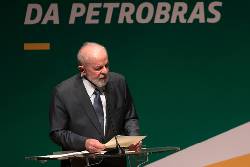
SAO PAULO (AP) — Brazil’s President Luiz Inácio Lula da Silva said on Monday that oil drilling in northern and northeastern coastal regions could be “a passport to the country’s future” after visiting a Petrobras offshore drilling vessel following a find announced last week near the mouth of the Amazon River.
Petrobras, Brazil's majority state-owned corporation, said on Friday that it had detected hydrocarbons during exploratory drilling about 180 kilometers (112 miles) off the coast of Amapa state. The country's coastal regions near the mouth of the Amazon are known as the Equatorial Margin.
The exploratory drilling began in October. Environmental and Indigenous groups have since sued the Brazilian government and Petrobras to halt exploration, arguing the licensing process failed to properly consult traditional communities, underestimated spill risks and did not adequately assess climate impacts. The company has long argued it has never caused spills in its drillings.
“When I say ‘passport,’” Lula said, “I’m not denying my commitment to the fight for a day when we no longer need fossil fuels, because Brazil will continue to be the king of biofuel innovation and will remain a major player in renewable energy.”
Lula, who faces what is expected to be a tight election in October for a fourth term as president, spoke at an official event in the municipality of Oiapoque in Amapa after visiting the vessel.
Lula has pushed both for drilling and alternative energy
Under Lula, Brazil has backed the need to transition away from fossil fuels such as oil, coal and gas that heat the planet and impact its climate.
The position was touted at the U.N. climate summit Brazil hosted last year, and also in other forums, such as an April meeting in Colombia that focused on shifting away from fossil fuels. At the same time, the country is ramping up new drilling investments.
The Equatorial Margin is believed to hold significant oil and natural gas reserves, and preliminary estimates suggest the basin could contain up to 10 billion barrels of oil, with a potential value of about 3.8 trillion reais ($720 billion).
“All of our studies indicate substantial potential. This discovery confirms our findings, and we will continue exploring,” the Petrobras president, Magda Chambriard, said Monday about the latest find. The company still needs to conduct further research to determine how much oil the area contains, she added.
Still, according to Shigueo Watanabe Jr., an energy expert with the Brazilian nonprofit ClimaInfo, commercial drilling remains a distant prospect at this stage. Determining whether extraction would be commercially viable would require further research that could take up to a decade.
Lula's announcement appears to follow a political calendar
Lula spoke in Oiapoque a day after kicking off his election campaign at the Vila Euclides Stadium outside Sao Paulo — a city where he rose to political fame 47 years ago as a metalworkers union leader during the country’s 1964-1985 military dictatorship.
The leftist leader, who is running against Sen. Flávio Bolsonaro — the lawmaker son of former far-right President Jair Bolsonaro — said Chambriard, the head of Petrobras, has told him the new-found oil is of high quality.
Lula, wearing the orange uniform of oil workers, held up a small bottle of black crude oil that he described as “blessed,” and said that he would like to keep it in a safe.
At stake, he said, are both “the interests of the country and the interests of the company,” referring to Petrobras.
“And Amapa’s right not to end up as merely an exporter of acai and tucunare,” he said, referring to the region's top products, the coveted berries and the freshwater fish.
Displayed behind him was a huge photo of Lula from his visit to the drilling vessel earlier Monday, showing the president holding up both hands stained with black crude — a gesture he famously made in 2008, when he announced the discovery of vast offshore oil reserves in southeastern Brazil.
Back then, Lula was at the height of his popularity. Now, he has become a polarizing figure, with opinion polls showing that nearly half of Brazilians approve of his administration, while a similarly large share disapprove of it.
Breno Rodrigues de Messias Leite, a political scientist and professor at the Federal University of Amazonas, said Lula's Monday trip sends an important message to voters, especially in northern Brazil and its state capitals, where he has faced criticism.
“For the Amazon, the possibility of gaining access to some of the world’s largest oil reserves changes the equation,” Leite said.
“Lula wants to be reelected, and he wants the states in the northern region, especially Amapa, to have an electorate that is favorable to him,” he added.
___
The Associated Press’ climate and environmental coverage receives financial support from multiple private foundations. AP is solely responsible for all content. Find AP’s standards for working with philanthropies, a list of supporters and funded coverage areas at AP.org.
... Copyright © 1996 - 2026 CoreComm Internet Services, Inc. All Rights Reserved. | View our