

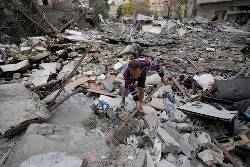
Israel’s military said early Friday it had conducted a wave of strikes “in the heart of Tehran” while smoke was seen billowing in the Beirut skyline after U.S. President Donald Trump delayed his threat to obliterate Iran’s energy plants over its effective closure of the Strait of Hormuz.
Israel has moved thousands of troops across the border into Lebanon, where Israeli officials said they want to take control of the entire area south of the Litani River — some 20 miles (about 30 kilometers) north of the border.
Facing a convulsing stock market, Trump on Thursday extended a deadline for reopening the Strait of Hormuz until April 6, saying Iran asked for the grace period and that talks were going “very well,” despite the fact Iran continues to publicly insist it is not negotiating with the White House on a 15-point proposal to end the conflict
The war has killed more than 1,900 people in Iran and nearly 1,100 in Lebanon. Eighteen people have died in Israel, while three Israeli soldiers have also been killed in Lebanon. Thirteen U.S. military members have died, as well as a number of civilians on land and sea in the Gulf region. Millions of people in Lebanon and Iran have been displaced.
Here is the latest:
Egyptian foreign minister holds talks with Turkish and Pakistani counterparts
Egypt’s Foreign Ministry says phone calls between Foreign Minister Badr Abdelatty with his Turkish and Pakistani counterparts dealt with their “intensive efforts” for direct talks between the United States and Iran. It offered no other details.
Mothers of Israeli soldiers call for a stop to the war in Lebanon
In a letter Friday to the Israeli military’s chief of staff, Lt. Gen. Eyal Zamir, mothers of soldiers called for an end to the further ground offensive into Lebanon.
The group, Parents of Combat Soldiers, includes 600 military parents. The letter said the military was receiving orders from politicians who are ready to “sacrifice” its children, and urged Zamir to focus on a political solution. “Four soldiers have already been killed in Lebanon, how many more will sacrifice their lives in vain?!” said the letter.
Norwegian aid group warns of devastating toll on Iranians
Jan Egeland, secretary-general of the Norwegian Refugee Council, said the humanitarian organization’s workers in Iran have reported to him that “countless homes, hospitals and schools have been damaged or destroyed,” and that nearly every neighborhood in Tehran has sustained damage.
“Civilians are paying the highest price for this war — it must end” he said in a statement.
“If this war continues, we risk a far wider humanitarian disaster,” he added. “Millions could be forced to flee across borders, placing immense pressure on an already overstretched region.”
Iran launches missiles toward Israel
Israel’s military said Friday morning that Iran launched a new wave of missiles toward the country.
Why Pakistan has emerged as a mediator between US and Iran
Islamabad isn’t often called on to act as an intermediary in high-stakes diplomacy, but it’s stepped into the role this time for a number of reasons, both because it has relatively good ties with both Washington and Tehran and because it has a lot at stake in seeing the war resolved.
Pakistani government officials have said that their public peace effort follows weeks of quiet diplomacy, though they have provided few details. They have also said that Islamabad stands ready to host talks between representatives from the U.S. and Iran.
According to Pakistani officials, U.S. messages are being passed to Iran and Iranian responses relayed to Washington. They did not specify how the process is being handled or who is directly communicating with whom. Pakistan’s Foreign Minister Ishaq Dar said this week that Turkey and Egypt are also working behind the scenes to bring the sides to the negotiating table.
Russia’s top diplomat denies that Moscow is providing intelligence to Iran
Russian Foreign Minister Sergey Lavrov said that Russia and Iran have a military-technical cooperation agreement, and Moscow “supplied Iran with certain types of military products.”
“But we can’t accept the accusations that we’re helping Iran with intelligence,” Lavrov said in an interview to France Television on Thursday night.
He added that “everyone knows” the coordinates of U.S. military bases in the region. “It’s public information. I’m not surprised that Iran is attacking them,” Lavrov said.
Saudi Arabia urges citizens to leave Lebanon immediately
The Saudi Embassy in Beirut said in a statement Friday that the decision is related to the “repercussions of the current events” taking place in Lebanon.
The embassy added that Saudi Arabia’s travel ban to Lebanon has been in place for years.
Israel has moved thousands of troops across the border into Lebanon, and Israeli forces and Iran-backed Hezbollah militants have been fighting on the ground for at least three weeks.
Missile alerts in Bahrain and Qatar
Bahrain sounded its missile alert siren late Friday morning over an incoming Iranian attack.
Qatar, which had not seen a major attack in days, also sounded its alerts Friday.
The main port in Kuwait damaged in an attack
Kuwait said Friday its Shuwaikh Port in Kuwait City came under attack and sustained “material damage.” It said no one was hurt in the attack but offered no other details.
Thai cargo ship reportedly runs aground after Iran attack
A Thai-flagged cargo ship that came under attack from Iran in the Strait of Hormuz and was abandoned by its crew has run aground, Iranian media reported Friday.
Thailand’s Foreign Ministry said Friday that the Iranian and Omani authorities were able to reach the Mayuree Naree on a rescue mission as three sailors remain unaccounted for. The ship came under attack March 11.
The semiofficial Tasnim and Fars news agencies, believed to be close to Iran’s paramilitary Revolutionary Guard, reported that the ship ran aground near the village of Ramchah on Qeshm Island.
New Zealand’s government unveils fuel scarcity response due to war
Finance Minister Nicola Willis outlined Friday a four-tier plan for future fuel shortages, which at its most severe levels includes limits on buying gasoline and its prioritization for life-preserving services.
Willis disclosed criteria, including export restrictions and the state of domestic fuel stocks, that would guide movement between the four levels.
Willis said that the current designation was phase one, the lowest level, but that it was important for New Zealanders to know the possible extent of future restrictions.
There are no restrictions currently enacted on gasoline use or purchasing in New Zealand.
... Copyright © 1996 - 2026 CoreComm Internet Services, Inc. All Rights Reserved. | View our