

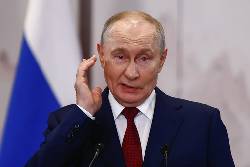
For Russian President Vladimir Putin, Thursday's three-way meeting with Donald Trump and Xi Jinping offered a much-coveted chance for the Kremlin leader to demonstrate that he heads a superpower on a par with the United States and China.
While dealing another blow to Western efforts to isolate Putin, it also gave him an opportunity to try to persuade Trump to lean into Moscow’s demands for a settlement in Ukraine at a time when Washington wants to broker a peace deal.
Putin said afterward that the meeting showed that the three-way format was “useful and substantive” and marked “serious joint work," including discussions on Ukraine. Earlier Thursday, Trump and Putin also met separately.
Kyiv and its European allies viewed the meeting on the sidelines of the Asia-Pacific Economic Cooperation summit in Shenzhen, China, with deep suspicion. German Chancellor Friedrich Merz has said Europeans feared another “Anchorage moment,” a reference to a Putin-Trump meeting in Alaska in August 2025 that produced proposals that were rejected by Ukraine and its partners.
Putin said Thursday that Russia accepted what he described as a U.S.-proposed compromise in Anchorage, declaring that Ukraine and its European allies would better accept it now or face tougher demands.
The 3-way meeting reminded some of the 1945 Yalta conference
The three-way meeting raised comparisons to the 1945 Yalta conference, where the wartime leaders of the U.S., Britain and the Soviet Union divided Germany and Berlin, carved out zones of influence in Europe, and agreed to establish the United Nations. The Kremlin, which long has courted the concept of a “multipolar world” offering an equal say to all nations, plays down the Yalta parallels, which also are unwelcome to China for similar reasons.
Asked about the analogies, Putin responded that just as Yalta conference cemented the “realities” at the time, "they will have to accept the realities in today's conflicts," an apparent reference to Moscow's demands to Kyiv and its allies.
Fyodor Lukyanov, a Moscow-based foreign policy expert, noted that the Kremlin seems to believe the leaders could “reach agreements and make decisions that will determine global developments.”
Of the three nations, "it seems that only Russia really believes in the possibility of global control,” he told a recent roundtable.
Chatham House director Bronwen Maddox said in a commentary ahead of the three-way meeting that “standing with Xi and Trump, Putin will look like one of the three main leaders of the world," even though “Russia is no superpower” and its economy, overloaded with military spending, is dwindling. She warned that “the danger for Ukraine is that Trump uses this summit to try to advance his notion of peace, including giving Russia territory it has not managed to seize by force.”
The meeting followed U.S.-mediated peace talks between Russia and Ukraine held in Abu Dhabi last week for the first time in nine months. The negotiations produced few visible results as the parties stuck to their sharply divergent demands.
Trump appears to lean toward Moscow
Putin welcomed a U.S. proposal to discuss broader European security as part of a possible settlement, an offer that hews to a longtime Russian demand for the West to take Moscow's security concerns into account. Kyiv and its allies oppose the idea, fearing it could allow Russia to divert attention from a Ukrainian settlement and try to pursue its demands.
Trump’s recent moves have appeared to favor the Kremlin. He has waived tough, new sanctions against Moscow and shocked Ukraine and the Europeans by striking a diesel deal that allowed Russia to resume fuel exports, reversing years of U.S. pressure. He urged Kyiv to halt its strikes on Russian refineries, blaming them for spiking diesel prices in the U.S. even though they largely were driven by the Iran war.
Ukraine also has reported a throttling of Starshield, the military-grade version of the Starlink satellite internet service owned by Elon Musk’s SpaceX, a move that was widely seen as an attempt by the U.S. to force Kyiv into making concessions in negotiations.
Both sides have escalated their long-range aerial attacks on each other, trying to seize the initiative as fighting largely stalls along the 1,200-kilometer (750-mile) front line.
In a major embarrassment to Moscow ahead of the Shenzhen meeting, Ukrainian drones and missiles seriously damaged the Kerch Bridge, Putin’s pet project and potent symbol of Moscow’s control over Crimea. Russia, meanwhile, continues to pummel Ukraine’s power grid and bridges in Kyiv.
Putin acknowledged the damage from Ukrainian strikes but argued that Russia has meted out much more punishment and will retaliate furthern after the bridge attack. He has rejected Kyiv’s push for a ceasefire, saying Moscow wants a comprehensive peace deal, not a temporary truce that would allow Ukraine to rest and rearm.
The agenda included trade and arms control
Trump, Xi and Putin wrapped up their meeting with a statement expressing their commitment to advance U.N. reforms, to increase the production and supply of oil products to ensure a stable flow of energy, and to work to reduce nuclear risks and prevent nuclear proliferation.
Trump had said before the summit that he would like to discuss “denuclearization” at the talks. Russia has signaled openness to discussing nuclear arms control but voiced understanding for China’s reluctance to consider any reductions in its atomic arsenals, which are much smaller than those of Washington and Moscow.
Just before the summit, Russia sent a pair of nuclear-capable Tu-95 bombers on a visit to Vietnam in a reminder of its nuclear might. And as Putin arrived in China, Russian TV zeroed in on an officer in his retinue who was carrying a briefcase with the codes for Moscow's nuclear forces.
... Copyright © 1996 - 2026 CoreComm Internet Services, Inc. All Rights Reserved. | View our