

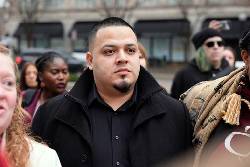
NASHVILLE, Tenn. (AP) — A Homeland Security agent testified in federal court on Thursday that the human smuggling case she initiated against Kilmar Abrego Garcia was strong even as his attorneys tried to persuade a judge to throw out the charges.
Abrego Garcia, whose mistaken deportation has galvanized both sides of the immigration debate, claims that the criminal prosecution is vindictive, pushed by officials from President Donald Trump's administration to punish him after they were forced to bring him back to the United States.
While Abrego Garcia is a Salvadoran citizen, a court order from 2019 prevents him from being deported to that country. That's because an immigration judge determined he faced danger in El Salvador from a gang that had threatened his family. Abrego Garcia, 30, immigrated to the U.S. illegally as a teenager but has an American wife and child. He has lived and worked in Maryland for years under the supervision of U.S. Immigration and Customs Enforcement.
After he was deported to El Salvador last year, the U.S. Supreme Court ruled the Trump administration had to work to bring him back. He was eventually returned to the U.S. only to face criminal charges of human smuggling based on a 2022 traffic stop in Tennessee. He has pleaded not guilty.
Body camera footage from a Tennessee Highway Patrol officer shows a calm exchange with Abrego Garcia after he was pulled over for speeding. There were nine passengers in the car, and the officers discussed among themselves their suspicions of smuggling. However, Abrego Garcia was eventually allowed to continue driving with only a warning.
Homeland Security Investigations Special Agent in Charge Rana Saoud, who ran the Nashville region at the time of Abrego Garcia’s deportation, testified Thursday that she first heard of the 2022 traffic stop in April 2025, when someone forwarded her a news article in the Tennessee Star, a conservative online publication. Saoud said she was aware of the publicity around Abrego Garcia, who at that point he was still in El Salvador.
Saoud testified that she initiated the investigation and was under no pressure from higher-ups.
“If the facts did not add up, we would have ceased to move forward,” she said. “The case just kept getting stronger.”
On cross-examination, Saoud agreed that the case was not high profile because of the nature of the criminal allegations but because of who the defendant was. “Mr Abrego was in the news all the time at that point,” she said.
U.S. District Judge Waverly Crenshaw previously found some evidence that the prosecution against Abrego Garcia, who arrived at the courthouse with his wife Thursday morning, “may be vindictive.” The judge said many statements by Trump administration officials “raise cause for concern.” He cited a statement by Deputy Attorney General Todd Blanche that seemed to suggest the Department of Justice charged Abrego Garcia because he won his wrongful-deportation case.
Abrego Garcia's attorneys have been sparring with prosecutors for months over whether officials like Blanche would be required to testify at Thursday's hearing and what emails Department of Justice officials would have to turn over to them. First Assistant U.S. Attorney for the Middle District of Tennessee Rob McGuire has argued that he alone made the decision to prosecute, so the motives of other officials were irrelevant.
Crenshaw reviewed many of the disputed documents. In an order that was unsealed in late December, he wrote, “Some of the documents suggest not only that McGuire was not a solitary decision-maker, but he in fact reported to others in DOJ and the decision to prosecute Abrego may have been a joint decision.”
... Copyright © 1996 - 2026 CoreComm Internet Services, Inc. All Rights Reserved. | View our