

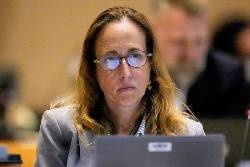
WASHINGTON (AP) — The Food and Drug Administration’s top drug regulator, Dr. Tracy Beth Hoeg, is working to hire a researcher and friend who wants the agency to add new warnings to antidepressants about unproven pregnancy risks, The Associated Press has learned.
Dr. Adam Urato, a maternal-fetal medicine specialist and critic of antidepressant safety, is pressing the FDA to add a boxed warning to SSRIs, the drugs most commonly prescribed for depression. Urato’s petition says the medications can cause pregnancy complications, including miscarriages and fetal brain abnormalities that may lead to autism and other disorders in children.
That proposed labeling change has become a top priority for Hoeg, who regularly consults with Urato and is working to bring him on as a full-time FDA employee, according to people familiar with the situation. They spoke to the AP on condition of anonymity to discuss confidential FDA matters.
Within the agency, Hoeg’s close relationship with Urato is viewed as a clear conflict of interest that, under normal FDA standards, would result in her recusing herself from any work on the petition. But Hoeg is actively working to speed up the agency’s review of her friend's proposal, according to the people familiar with the situation.
Outside experts say the petition relies on flimsy data, including animal studies and small trials in people. They fear a new FDA warning could cause pregnant women to stop medication unnecessarily, leading to serious health risks from untreated depression.
“A black box warning is a big red flag with both practitioners and patients,” said Dr. Jennifer Payne, a University of Virginia reproductive psychiatrist. “What’s missing in this petition is an understanding of the risks of maternal mental illness during pregnancy, not just to the woman, but to the pregnancy and ultimately the infant.”
SSRIs include most of the bestselling depression medications, including Prozac, Paxil, Zoloft and their generic equivalents.
More than 15% of U.S. women, or about 26 million people, take medication for depression, according to the latest federal figures. Professional guidelines state that antidepressants are generally safe during pregnancy and should be discontinued only after careful consultation with a doctor.
Last fall, Hoeg gave a talk on the SSRI petition to top FDA drug officials, presenting the work as her own. Staffers who reviewed her slides found they were created by Urato, according to the people who spoke to the AP. The incident was first reported by Stat News.
Urato said in an email Wednesday that Hoeg is “an excellent scientist,” and that they have known each other for several years.
“I am friendly with her, as I am with many colleagues, but we do not have a longstanding personal friendship that would in any way prevent her from reviewing the citizen petition,” Urato said.
A spokesman for the Department of Health and Human Services, which oversees the FDA, said that the agency would respond directly to Urato about his petition.
In January, Urato was named to the Centers for Disease Control and Prevention’s panel on vaccine recommendations, which has been completely reshaped by Health Secretary Robert F. Kennedy Jr. to include a number of anti-vaccine voices.
The latest COVID-19 contrarian elevated into FDA's leadership
The antidepressant review is the latest in a series of controversial topics taken up by Hoeg, a sports medicine physician with no previous government or management experience.
During the COVID-19 pandemic, Hoeg attracted attention as a critic of masking, vaccine mandates and other public health measures. She co-wrote papers with medical contrarians who would go on to join the Trump administration, including FDA Commissioner Marty Makary and FDA’s vaccine chief, Dr. Vinay Prasad. All three have become top surrogates for Kennedy.
Before the pandemic, Hoeg had published only a handful of medical papers, including one on health issues affecting ultramarathon runners.
A Danish American citizen and marathon runner, Hoeg was instrumental in the Republican administration’s recent decision to drop a number of vaccine recommendations for children. That is a change she has long proposed, to bring the United States more in line with Denmark.
Like many critics of vaccines, including Kennedy, Hoeg has also been skeptical of antidepressants, questioning their safety and benefits. Last July, she hosted a panel of outside experts at the FDA on SSRIs that included Urato and nine other critics of the drugs.
“Never before in human history have we chemically altered developing babies like this, especially the developing fetal brain, and this is happening without any real public warning," Urato said at the meeting.
On a podcast shortly afterward, Hoeg echoed many of Urato's points.
“I think women should be informed about the potential risks so that they have time to come off SSRIs if they want to when they’re trying to get pregnant,” Hoeg told the hosts of the Mom Wars podcast.
FDA officials typically avoid making public comments about matters under review because it could suggest the agency is basing its decision on individual opinions, rather than science.
But Hoeg has taken a hands-on approach to the SSRI petition, telling FDA staffers that their proposed review timeline of nine months needed to be shortened, according to the people familiar with the situation.
Reviewing a citizen petition involves detailed analysis of scientific references, legal issues and a number of other steps to ensure that the agency’s final decision can be defended in court.
“Apart from it serving FDA’s public health mission, there’s always going to be some concern about legal risk if the agency doesn’t take sufficient time to consider all the relevant data and arguments,” said Patti Zettler, a former FDA attorney now at Ohio State University's law school.
Hoeg was tapped to the lead FDA’s drug center in December, inheriting the job during a period of unprecedented upheaval, including layoffs, buyouts and leadership changes. She is the sixth person to lead the 5,000-person center in the past year.
Staffers did not hear from Hoeg directly until a town hall last month, where she voiced her concerns about the safety of SSRIs and injectable RSV shots for children, a class of drugs that FDA is reviewing at her request. RSV is a respiratory virus that sends thousands of children in the United States to the hospital each year.
Antidepressant questions clouded by other health factors
The safety of antidepressants has been scrutinized for decades, leading to several updates to their FDA label, including the addition of a black box warning about the risk of suicidal behavior in children.
For pregnant women, the current label lists a number of documented safety issues, including risks of excess bleeding after giving birth.
Doctors who treat women with depression say they discuss those risks with their patients, balancing the possible safety issues against the potential harms of relapsing into depression: self-harm, substance abuse and other behaviors that negatively impact women and fetuses.
Researchers who have reviewed Urato's SSRI petition say many of the studies claiming to show connections to disorders such as autism don't take into account other important health factors. For example, women with depression have higher rates of smoking, diabetes and family histories of mental illness that can all increase the likelihood of developmental disorders.
“So how do we say that these outcomes are a result of the SSRI when all of these other factors are at play?” said Dr. Amritha Bhat, a University of Washington perinatal psychiatrist.
Bhat and other researchers say they support more research into the effects of SSRIs, and they acknowledge possible downsides to their use.
“But in the meantime we need to provide options to people that are struggling with these symptoms during pregnancy,” she said. “We cannot just ask them to white knuckle their way through it.”
___
The Associated Press Health and Science Department receives support from the Howard Hughes Medical Institute’s Department of Science Education and the Robert Wood Johnson Foundation. The AP is solely responsible for all content.
... Copyright © 1996 - 2026 CoreComm Internet Services, Inc. All Rights Reserved. | View our