

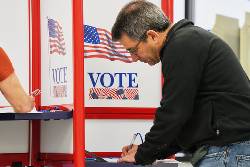
HENRICO, Va. (AP) — In-person voting for this year’s midterm elections began Friday, ushering in the final six weeks for Americans to decide which party they trust to lead Congress through a cost-of-living crisis, a prolonged war in Iran and other pressing issues.
Election administrators say they are prepared and confident the vote will be accurate and secure. Nevertheless, President Donald Trump has continued efforts to denigrate certain voting methods and reshape how elections are run, through court challenges, a federal hunt for noncitizen voters and a pressure campaign to force election officials to share sensitive voter data.
Friday was the start of early voting in Virginia. Voters in a few other states, including Minnesota and South Dakota, can cast absentee ballots in person, typically at a local election office or voting center. More expansive early voting is scheduled to begin in those and other states in the coming weeks.
At a voting location in Fairfax, Virginia, 18-year-old college student Sanya Singhal was among the first to vote early in person Friday morning, arriving well before the site opened to get in line.
“Why not just have a little fun in life, you know, try to be the first early voter?” she asked. “I really want to participate in my democracy.”
At a voting location in suburban Richmond, a poll worker rang a bell as the building opened and about a dozen voters in line began to file in. Stephen Gura was excited to be the first.
“This election is critical. We need to stop the Trump agenda,” said Gura, who added that he voted for U.S. Sen. Mark Warner, a Democrat, and Shannon Taylor, the Democratic nominee against Republican incumbent Rob Wittman in the 1st Congressional District.
The Nov. 3 election includes votes for governor and state legislature in most states and will determine whether Republicans maintain control of the U.S. House and Senate. If Democrats retake Congress, it will alter the trajectory of the final two years of Trump’s term, most likely leading to investigations and other oversight efforts.
Votes underway after redistricting and Trump's bid to control how elections are run
At the suburban Richmond voting center, a steady stream of voters flowed in and out. William Curry, a 74-year-old retiree who described himself as a libertarian-leaning independent conservative, voted for Warner’s Republican challenger, Bert Mizusawa, and Wittman. Curry said he generally approves of the job Trump has done, apart from the war with Iran.
“He’s in a mess he can’t get rid of,” Curry said of the conflict.
On a rainy day in Sioux Falls, South Dakota, Bill Goehring, 67, said he voted early at the county office because he will be traveling later. He voted for a mix of Democrats and independents, and said Trump’s “dictatorial tendencies are bad for America.”
John Thomas, a conservative retired police officer at the Sioux Falls office, said his biggest concerns were public safety and election integrity. He said he doesn't want to see votes in federal elections from immigrants living in the country illegally. Such fraudulent voting has been found to be extremely rare.
Trump’s immigration agenda is “spot on,” the 77-year-old said.
“We wouldn’t be a country that much longer if it had stayed the same for another four years,” he said.
The start of early voting comes at a time of deep angst and division among many Americans about issues including rising gas and grocery prices, the war in Iran, the looming risks of artificial intelligence and Trump’s aggressive immigration enforcement campaign.
It also follows an unprecedented spate of mid-decade redistricting for the House that began when Trump urged the Republican-controlled legislature in Texas to redraw its congressional map to help the party. California and other states followed.
The changes affect millions of people: Research shows 1 in 10 Americans this fall is a resident of a different congressional district than in 2024.
Those partisan efforts are expected to continue before the 2028 elections after a landmark ruling this year from the U.S. Supreme Court weakened the federal Voting Rights Act’s protections against racially discriminatory redistricting.
As the start of early voting approached, Trump was focused on efforts to assert federal control over election administration, even as the Constitution bestows the power to run elections on the states and, in some cases, Congress. The nation's highest court this week rejected Trump's bid to restrict mail ballots, but several of his administration's other efforts to influence the voting process and investigate state voter lists continue.
Virginia's Democratic attorney general warned Thursday that Trump's administration may have violated the state's laws after a whistleblower accused federal employees of misrepresenting themselves on voter lookup tools to hunt for noncitizen voters.
Trump for years has raised the specter of widespread noncitizen voting in U.S. elections, and this year is no exception. But research continues to show noncitizen voting is exceptionally rare.
David Becker, executive director and founder of the Center for Election Innovation and Research, said he wouldn’t be surprised if the Republican president continues “his disinformation campaign and his attack on election officials.” But he said he thinks "the process will hold as it has in past years.”
At least a few Friday voters were motivated to vote early in part because of Trump's actions.
In Minneapolis, 47-year-old business processing engineer Dragan Colakovic said he didn't want to wait until Election Day for fear of being stopped by immigration agents. He said Trump's surge of agents to Minnesota in an immigration crackdown earlier this year terrified him. He is a naturalized U.S. citizen who moved from Bosnia in 1997 and saw the horrors of war in the former Yugoslavia.
“This echoed what I saw in Bosnia,” he said of the heavily armed immigration agents who repeatedly swept through his neighborhood, which has many immigrants.
“These were my neighbors, my friends,” being arrested, he said.
Sixty-three-year-old Democratic voter Laura Bland in Virginia's Henrico County said she cast a ballot early to send “a signal that we're still here" despite Trump's efforts to curtail mail voting.
“Regardless of whether you vote for a Democrat, Republican, people are not going to be stopped or intimidated from participating in our elections,” Bland said, nearly moved to tears.
Advocates suggest voters cast their ballots early
Voting rights advocates have encouraged voters this year to cast mail ballots early, in part because of concerns about recent changes in U.S. Postal Service operations that could delay the application of postmarks to ballots.
Voting early "gives voters options, eases lines on Election Day and can even mean faster results,” said Hannah Fried, co-founder and CEO of the voting rights group All Voting Is Local.
The top official at the U.S. Postal Service also encouraged voters who cast ballots by mail to get them in a week before they're due.
“Everything is solved if people vote early,” Postmaster General David Steiner said in an interview.
In a news briefing Thursday, Minnesota Secretary of State Steve Simon urged people not to be swayed by stories they might have seen or read that cast doubt on election operations. They would be able to vote “just like they always have,” he said.
“I just want to reaffirm that Minnesota’s elections are fundamentally free, fair, accurate, honest and secure,” he said.
___
Swenson reported from New York and Raza from Sioux Falls, S.D. Associated Press writers Mike Catalini in Philadelphia, Tim Sullivan in Minneapolis, and AP video journalist Nathan Ellgren in Fairfax, Va., contributed to this report.
... Copyright © 1996 - 2026 CoreComm Internet Services, Inc. All Rights Reserved. | View our