

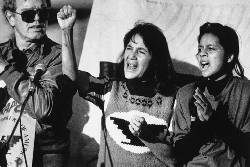
Dolores Huerta, the legendary labor organizer whose advocacy improved conditions for migrant farm workers in the nation’s fruit and vegetable fields and persuaded presidents to do more for women’s equality and immigrant rights, died Wednesday. She was 96.
Huerta, who co-founded the United Farm Workers union with César Chavez, was celebrated for her enduring rallying cry “Sí, se puede!” — which translates to “Yes, it can be done!”
She died of cancer at her home in Bakersfield, California, surrounded by family, said Erik Olvera, a family spokesperson.
Well into her 90s, Huerta was marching in protests and encouraging activists to keep speaking out about race, poverty and LGBTQ+ and women’s rights.
“It seems like history continues to repeat itself,” she told The Associated Press in August. “You see what’s happening right now in our country, and we know that people have to stand up.”
Huerta’s resolve cemented her place in history as one of the nation’s most influential labor leaders, civil rights icons and feminist activists. Her three-word Spanish-language slogan was grounded in the belief that people who take action can affect change.
Her accolades over the decades included the Presidential Medal of Freedom. When President Barack Obama presented her with the nation’s highest civilian honor in 2012, he praised Huerta as a tenacious leader. He said she was gracious when he stole her slogan for his 2008 campaign. “I’m pleased that she let me off easy ... ’cause Dolores does not play,” Obama joked.
Just days after President Donald Trump’s first inauguration, Huerta voiced concern about the rise of so-called “alt-right” groups.
“We cannot survive as a nation, as a democracy, if we continue with the racism, with the sexism and homophobia, with the militarization that we have in our society,” she told the AP in 2017.
Revealing a secret that shook Latino culture
This year, Huerta revealed a shocking chapter in her life story — that she was sexually abused in the 1960s by Chavez, the farmworker movement’s co-founder, leading to the birth of two children who were raised by others. She had kept the secret for 60 years, long after he died. Chavez's reputation immediately soured, his name removed from the holiday that had been a point of Hispanic pride.
Huerta said she had feared breaking her silence would compromise her life’s work and unravel the progress made for workers. From the early 1970s on, Huerta’s life partner had been Richard Chavez, César’s brother, and together they had four kids. She also had seven children from two earlier marriages.
“It was my personal pain, it was my personal problem and, you know, I think it was worth it because it was my cross to bear,” she told the news organization Latino USA.
Demonstrating a 'passion for justice'
Huerta's advocacy changed lives far beyond the farm fields, said former President Bill Clinton and former Secretary of State Hillary Rodham Clinton, who called Huerta “a stalwart champion of working Americans.”
“Dolores wore many hats: voting rights advocate, human rights champion, die-hard Democrat, self-described ‘born-again feminist,’ and co-founder of the United Farm Workers of America,” the Clintons said in a statement. “To see her in action was to witness a living legend who never stopped pushing for progress.”
Gov. Gavin Newsom said California would not be where it is without her “passion for justice and fairness.”
“Dolores’ fight for gender equity, workers’ rights, and civil rights paved the way for generations to come — teaching people what was possible with determination and heart,” the Democrat said.
United Farm Workers President Teresa Romero said Huerta “has left farm workers and the entire Latino community stronger and more organized than she found it.”
Becoming an activist well before meeting Chavez
Huerta was born Dolores Clara Fernandez in 1930 in Dawson, New Mexico. Her father was a miner and union activist who won a seat in the state Legislature. Her mother took her and her brothers to California after the couple divorced.
Immersed in a melting pot of Mexican, Filipino, African American, Japanese and Chinese working families, Huerta learned from her mother about independence, compassion and activism.
Huerta was teaching in an elementary school in the agricultural San Joaquin Valley when she grew frustrated by her students' poverty and decided to answer another calling.
“I couldn’t stand seeing kids come to class hungry and needing shoes,” she said in a 2017 PBS documentary. “I thought I could do more by organizing farmworkers than by trying to teach their hungry children.”
Huerta’s early civil rights work led to her meeting Chavez. In 1962 they started the National Farm Workers Association, which became United Farm Workers of America. She was a key leader and negotiator for years.
Their breakthrough came when they organized Filipino pickers in what became the five-year “Delano Grape Strike.” With Chavez, she negotiated collective bargaining agreements and contracts with big growers, winning precedent-setting health and benefit plans for farmworkers.
Chavez, who died in 1993, described her as fearless, committed to the cause and tough.
Campaigning for presidents and voting rights
Huerta met Sen. Robert Kennedy in 1968 and volunteered with his presidential campaign, registering Mexican Americans in California to vote. Kennedy publicly thanked her after winning the California primary, moments before he was shot.
The assassination devastated Huerta, but she kept organizing. She was jailed 22 times for union demonstrating.
In 1988, she was seriously injured while protesting Republican presidential candidate George H.W. Bush’s opposition to the UFW grape boycott. Caught in a crowd, she was struck by a police officer’s baton, suffered broken ribs and a pulverized spleen. She reached a settlement with the city of San Francisco to resolve her claims.
After a long recovery, Huerta focused on campaigning for women’s rights and encouraging Latinas to run for office.
She also campaigned for Democratic Presidents Clinton, Obama and Joe Biden.
Leaving a legacy of civil rights advocacy
Emilio Huerta, one of her 13 children, said his mother's courage drove her work.
“To dedicate your life to building a dream of a union for farmworkers, to take on agriculture, which to this day is still a powerhouse. ... That took a lot of guts,” he said.
Huerta secured financial aid for the unemployed and disability insurance for California farmworkers. She railed against toxic pesticides, pushed for amnesty for immigrants in the country illegally and opposed federal guest worker programs.
By directing nationwide boycotts of grapes and lettuce in the early 1970s, she helped create the economic pressure and political climate necessary for California to pass the first state law recognizing farmworkers’ right to collective bargaining.
Huerta's leadership in the labor movement made her name synonymous with civil rights in the U.S. and beyond. In “Seeds of Change: The Life and Legacy of Dolores Huerta,” she credited the 1970s women’s movement for providing her with the validation to take the stage with other labor leaders.
“We want to give our children an inheritance of justice, right, not jewels or property or money because they’ll just fight over it," she said in the 2025 documentary. "So the main thing to do is to give them this love for justice — and that is the greatest gift I think that any of us can have.”
___
Associated Press contributors include Ryan Pearson, Leslie Ambriz, Brian Melley, John Seewer and former AP journalist Russell Contreras.
... Copyright © 1996 - 2026 CoreComm Internet Services, Inc. All Rights Reserved. | View our