

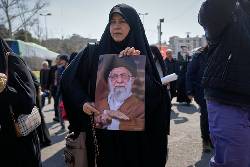
DUBAI, United Arab Emirates (AP) — Israeli warplanes pounded Beirut and Tehran on Friday as Iran launched another wave of retaliatory strikes against Israel and Gulf countries. There was no sign of the war letting up on its seventh day, as Defense Secretary Pete Hegseth warned the U.S. air campaign against Iran would “surge dramatically.”
The strikes in Lebanon were the heaviest since a 2024 ceasefire ended the last war between Israel and the Iran-backed Hezbollah, who fired rockets at Israel in the opening days of the latest conflict. Tens of thousands have fled Beirut’s suburbs and southern Lebanon after sweeping Israeli evacuation warnings.
The war has escalated to affect more than a dozen countries across the Middle East and beyond. The United States said it had struck an Iranian drone carrier at sea as it waged an unrelenting campaign against the country’s navy that earlier included the torpedoing of a warship in the Indian Ocean.
The U.S. and Israel have battered Iran with nationwide strikes, targeting their military capabilities, leadership and nuclear program. The stated goals and timelines for the war have repeatedly shifted, as the U.S. has at times suggested it seeks to topple Iran’s government or elevate new leadership from within.
Israel’s military said Friday morning it had begun “a broad-scale wave of strikes” on Tehran, Iran’s capital. Witnesses described the Israeli airstrikes as particularly intense, shaking homes in the area. Others reported explosions around the Iranian city of Kermanshah in an area that is home to multiple missile bases.
Iran meanwhile launched missile and drone attacks at Israel, as well as Kuwait, Qatar, Saudi Arabia and Bahrain, all countries that host U.S. forces. There were no immediate reports of casualties.
In addition to Israel, Iran’s attacks have targeted their Arab neighbors, disrupted oil supplies and snarled global air travel. The war has killed at least 1,230 people in Iran, more than 120 in Lebanon and around a dozen in Israel, according to officials in those countries. Six U.S. troops have been killed.
The United Nations high commissioner for human rights, Volker Türk, urged all countries involved to de-escalate, saying “the world urgently needs to see steps to contain and extinguish this blaze.”
Iran’s President Masoud Pezeshkian said Friday that “some countries” had begun mediation efforts in the conflict, without elaborating.
US says it struck an Iranian drone carrier
The U.S. military said early Friday that it struck an Iranian drone carrier, setting it ablaze.
The U.S. military’s Central Command released black-and-white footage of the burning carrier. The Iranian military did not immediately acknowledge the attack.
The drone carrier, the IRIS Shahid Bagheri, is a converted container ship with a 180-meter-long (yard) runway for drones. The vessel can travel up to 22,000 nautical miles without needing to refuel in ports, reports said at the time of its 2025 inauguration.
Adm. Brad Cooper, head of U.S. Central Command, described the carrier as “roughly the size of a World War II aircraft carrier.”
“And as we speak, it’s on fire,” Cooper told reporters.
Earlier in the week, an American submarine sank an Iranian frigate off the coast of Sri Lanka as it was returning from an exercise hosted by the Indian navy that the U.S. also joined. Sri Lanka's navy rescued 32 crew members and recovered 87 bodies.
Under cover of darkness Friday morning, B-2 stealth bombers dropped dozens of 2,000 pound “penetrator” bombs on deeply buried ballistic missile launchers inside Iran, Cooper said.
Iran targets countries hosting US forces
Qatar said early Friday it intercepted a drone attack targeting Al Udeid Air Base, which hosts the forward headquarters of the U.S. Central Command.
Saudi Arabia intercepted and destroyed three ballistic missiles fired early Friday toward Prince Sultan Air Base south of Riyadh, which also hosts U.S. forces, said a spokesperson for Saudi Arabia's Defense Ministry.
Air raid sirens sounded in Bahrain, where the Interior Ministry said Iranian strikes targeted two hotels and a residential building. It said there were no casualties. In Kuwait, where the six U.S. soldiers were killed Sunday, the army said air defenses were activated when missile and drone attacks breached its airspace.
The unified military command of the Gulf Cooperation Council was one of the facilities attacked in Bahrain, according to Qatar, which has troops assigned there. Qatar called the assault “a direct threat to its security and stability and the security of the region.”
The British ambassador to Bahrain said Friday that the United Kingdom would help defend the country with its fighter jets. Ambassador Alastair Long's announcement came the day after British Prime Minister Keir Starmer said he was sending four more Royal Air Force Typhoon fighters to Qatar following requests from allies for further help.
In Israel, the sound of explosions could be heard in Tel Aviv early Friday morning after a warning about missiles incoming from Iran, as air defense systems worked to intercept the barrage.
Trump again urges Iranians to ‘take back’ their country
In brief remarks at the White House, U.S. President Donald Trump again urged the Iranian people to “help take back your country.” This time he promised the U.S. would grant them “immunity” amid the war and ongoing dangers under the current Iranian regime.
“So you’ll be perfectly safe with total immunity,” Trump said, without giving any details about what that meant. “Or you’ll face absolutely guaranteed death.”
Cooper and Hegseth cautioned Iranians not to take to the streets while the conflict is still raging, however.
In an interview with the news website Axios, Trump said he should be involved in choosing Iran's new supreme leader to replace Ayatollah Ali Khamenei, who was killed in the opening strikes of the war. Trump spoke dismissively of Khamenei's son, Mojtaba Khamenei, being a front-runner to replace his father, calling him “a lightweight.”
“We want someone that will bring harmony and peace to Iran,” Trump said.
Iranian officials meet to discuss new leadership
Iranian state television reported Friday that a leadership council had started discussing how to convene the country’s Assembly of Experts, which will select the new supreme leader.
The leadership council includes President Masoud Pezeshkian, judiciary chief Gholam Hossein Mohseni Ejehi and cleric Ayatollah Ali Reza Arafi.
The statement provided no timeline on the selection of the supreme leader, nor information on whether the Assembly of Experts would meet in person or remotely for the vote.
Buildings associated with the Assembly of Experts, a 88-member clerical panel, have been attacked during the Israeli-U.S. airstrike campaign.
Israel hits Lebanon with multiple airstrikes around Beirut
Israel carried out at least 11 airstrikes late Thursday and early Friday, targeting the southern suburbs of Beirut. Fires broke out near a gas station.
Two hospitals evacuated patients and staff. No casualties were immediately reported.
Türk, the U.N. human rights chief, said he was “extremely concerned” about the situation, particularly what he described as “blanket, massive displacement orders” by Israel to civilians in Lebanon.
The Lebanese health ministry said the death toll has risen to 123 since the resurgence of hostilities between Israel and Hezbollah, which struck Israel in the opening days of the war.
Lebanon’s Prime Minister Nawaf Salam slammed both Israel and Hezbollah, saying the Lebanese state and people “did not choose this war.”
___
Metz reported from Ramallah, West Bank, Rising from Bangkok and Abou AlJoud from Beirut. Geir Moulson in Berlin and Bassem Mroue in Beirut contributed to this report.
... Copyright © 1996 - 2026 CoreComm Internet Services, Inc. All Rights Reserved. | View our