

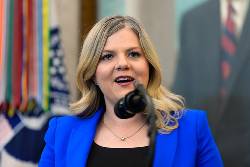
WASHINGTON (AP) — President Donald Trump’s nominee to take over the Food and Drug Administration is facing questions Thursday from Senate lawmakers focused on her plans for vaccines, the abortion pill and other products that have come under new scrutiny at the regulatory agency.
Dr. Heidi Overton, a physician and top White House aide, has spent most of her career working for Trump or conservative groups aligned with his agenda. That connection may prompt questions from some members of the Senate health committee, which is considering her nomination.
In her current role as a domestic policy adviser, Overton worked on several White House health initiatives, including the revamped food pyramid and an executive order aimed at reducing childhood vaccinations. Previously, she was an executive at the America First Policy Institute, authoring papers critical of abortion and transgender care. During Trump’s first term, she served as a White House fellow.
If confirmed by the Senate, Overton would inherit a raft of controversial projects, including a safety review of the nation’s principal abortion drug, a plan to break up combination vaccines and new rules that make it easier to sell flavored electronic cigarettes.
All three policies break from FDA’s longstanding positions, especially on the safety of childhood vaccines. Overton stood beside the Republican president and Health Secretary Robert F. Kennedy in the Oval Office last month when they falsely suggested that the use of combination vaccines could be a contributor to autism.
Overton's views on abortion could be key
In opening remarks Thursday, committee chairman Sen. Bill Cassidy said Trump's order “is based on zero scientific evidence.” Cassidy, a physician from Louisiana, said he would also ask Overton to unequivocally reject a remark from Trump that the measles, mumps and rubella vaccine is “quite lethal.”
“This committee needs to know whether you will be radically honest, whether you will use your authority to stand up for sound science and protect children’s health," Cassidy said.
But Cassidy and other Senate Republicans may find common ground with Overton on abortion. Cassidy and several colleagues have spent months urging the FDA to restrict access to mifepristone, the pill currently used in most abortions in the U.S.
The FDA first approved mifepristone in 2000 and has repeatedly affirmed its safety while broadening access, including allowing it to be sent through the mail. But Kennedy ordered a reevaluation of the drug’s safety last year, following calls from anti-abortion groups and lawmakers aligned with Trump.
FDA officials have said almost nothing about the review, except that it is ongoing.
While working at the America First Policy Institute, Overton blasted the FDA’s 2023 decision — under President Joe Biden, a Democrat — to allow mail delivery of mifepristone, referring to the practice as “chemical abortion on demand.” She was similarly critical of the Biden administration’s approach to transgender care for children, including providing access to puberty-blocking drugs and gender-affirming surgeries.
And she co-authored a 2024 article calling Minnesota a “sanctuary" for physicians who perform abortions and gender-affirming surgeries.
Overton’s abortion views could complicate her efforts to win over two moderate Republicans on the panel: Maine Sen. Susan Collins and Alaska Sen. Lisa Murkowski. Both have bucked their party on the issue, supporting federal access to abortion. Collins is currently locked in a tight reelection race in which abortion access is a central issue.
To become commissioner, Overton will need a majority of votes from the 21-member health committee, followed by a positive vote from the full Senate.
Headquartered in the suburbs outside Washington, the FDA oversees U.S. medical products plus billions of dollars in food, cosmetics, tobacco and vaping products.
Under the current administration, leading the agency has involved balancing Trump’s demands for slashing regulations — such as those for vaping products — alongside Kennedy’s interests in scrutinizing vaccines, drugs and food ingredients.
The previous FDA head faced numerous challenges before quitting
Those challenges dogged the tenure of the previous FDA head, Dr. Marty Makary, who resigned in May. Makary's time at the agency was defined by scientific disputes, leadership changes and a string of media stories detailing low morale and internal dysfunction among staffers. The FDA has lost about 20% of its employees to layoffs, buyouts, retirements or resignations since Trump took office.
Overton studied under Makary at Johns Hopkins University, where she received a doctoral degree in clinical research after earning her medical degree at the University of New Mexico.
Like Makary, Overton has no experience running a large bureaucracy, a critical skill for steering the FDA's 16,000 staffers spread across numerous U.S. and international locations.
In financial disclosure forms, Overton reported no investments in healthcare or food companies. That’s a stark contrast to Makary and other recent FDA nominees who have had to divest investments or cut other financial ties with companies regulated by the FDA.
Overton reported $50,000 to $100,000 in student loans.
___
The Associated Press’ health and science coverage receives financial support from the AP Fund for Journalism and private foundations. AP is solely responsible for all content. Find AP’s standards for working with philanthropies, a list of supporters and funded coverage areas at AP.org.
... Copyright © 1996 - 2026 CoreComm Internet Services, Inc. All Rights Reserved. | View our