

Kelly Rand's teenage twin boys playing hockey in St. Paul, Minnesota, are going through growth spurts that force the family to buy new equipment what seems like all the time.
The goaltender's $400 helmet in 2022 now runs $1,000. The chest protector they got last year for $465 now goes for $900.
For a sport that is increasingly expensive for everything from gear and ice time to travel and coaching, the latest round of 50% tariffs levied by President Donald Trump's administration against Canada was most unwelcome news as they threaten to ramp up prices even more.
“If a kid on the ice breaks a stick, every other parent is looking at that mom or dad going, ‘Ahhh oh, no!’” Rand said. “You feel for them. How many $400 sticks can you afford in one season?”
Hockey sticks and skates are among the more than 550 goods named in the tariffs by the White House. Custom equipment is also manufactured by True Hockey in Canada and imported into the U.S., according to B&R Sports Director of E-commerce John Merola, who said skates and goalie gear fit into that category.
An average stick is now $200, Merola said, with high-end versions ranging up to $400. He noted that Bauer, CCM and True still make many custom items in Canada.
“This not a minor blip by by any means,” Sports & Fitness Industry Association CEO Todd Smith said. “Even if manufacturers have moved over the last several years from Canada to other countries, there’s still healthy amount being manufactured in Canada and, yeah, this 50% tariff is a big deal.”
Rising prices and popularity amid production shifts
When Rand’s family bought custom goalie gear a couple of years ago, the entire setup cost $3,300. Skate pairs that in 2016 went for between $80 and $900 are now $200 to $1,230, according to HockeySkates DB, a database that charts the prices from various companies.
Inflation, as well as tariffs on other countries, are behind the price jumps in recent years. The Sports & Fitness Industry Association’s manufacturers sales report said the amount spent on hockey equipment increased 45.4% from 2020-25, up to $332.9 million from $228.9 million, dovetailing with increasing participation in the sport.
According to U.S. International Trade Commission data, which does not separate ice and field hockey equipment, gear from Canada made up roughly 8.5% of imports last year, fourth behind 52.7% from China, 13.2% from Vietnam and 9.5% from Thailand. Of the 2.1 million hockey sticks imported last year, trade data shows more than 1.5 million (74.1%) came from China and 268,000 (12.8%) from Mexico, compared to 18,909 (0.9%) from Canada.
Chris Douglas, a professor of economics at the University of Michigan-Flint, called it unlikely that stick prices will go up 50% across the board, noting Canada's modest market share, but wonders what will happen if demand increases.
“Maybe that causes the price of hockey sticks to rise somewhat — maybe by $50 or something like that,” Douglas said. "Hockey is expensive with the equipment, ice time and so forth, so maybe there’s a family right on the margin where $50 or $100 in additional cost causes them not to enroll their kids at hockey any longer.”
The question is how long the tariffs will last
When Trump imposed tariffs on China, Merola said that had a bigger impact on business but not right away.
“Bauer, CCM — the big, heavy hitters in the market — came in and said: ‘We’ll absorb these costs. Don’t worry about it,’” Merola said. “And then as nothing happened, they kind of came back and said, ‘We can’t cover this, so we’re gonna have to increase pricing.’”
That wait-and-see approach could happen again this time, delaying how long manufacturers and retailers pass on the increase to consumers. Canadian Prime Minister Mark Carney saidtrade talks could resume if Washington became serious about negotiations.
Douglas said it all comes down to expectations for how long the tariffs will be in place.
“It’s hard to form expectations of the current tariff regime where tariffs are changing basically every day, it seems like,” Douglas said. “But if there’s an expectation that tariffs are going to be permanent or at least in place for the long term, then I think prices rise pretty instantaneously because the cost of production has risen and that gets passed on to consumers via a higher price.”
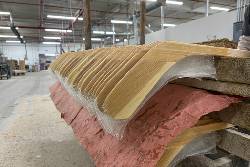
Merola thinks long-term tariffs will lead companies to move more production to the U.S., Asia or elsewhere. Roustan Hockey, the last major hockey stick factory in Canada, last week reaffirmed it will keep making them there, despite the challenges.
“We remain committed to our employees, our customers and our manufacturing operations here in Canada,” founder W. Graeme Roustan said in a statement after hosting federal minister Evan Solomon for a tour of the facility in Brantford, Ontario.
The Sports & Fitness Industry Association is advocating for the tariffs to go away, especially given what Smith said was a 7% increase in hockey participation in the U.S. over the past three years, a boom attributed to the 4 Nations Face-Off, Winter Olympics and more.
While pointing out the National Hockey League, USA Hockey and teams have contributed significant efforts with learn to play programs that include free equipment and ice time, Smith is concerned about the long-term impact of tariffs.
“This has, obviously, the potential to really stunt that growth," he said. "It couldn’t be a worse time for tariffs to hit in terms of really having the having the possibility to increase costs.”
___
AP Sports Writer Dave Campbell contributed to this report.
___
See AP’s full NHL coverage here
... Copyright © 1996 - 2026 CoreComm Internet Services, Inc. All Rights Reserved. | View our