

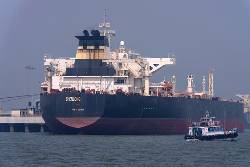
Wall Street lurched lower in premarket trading Friday and oil prices reached higher as Israel launched a new wave of attacks on Iran and President Donald Trump extended his deadline for Tehran to open the Strait of Hormuz.
Futures for the S&P 500 fell 0.3% before the opening bell, adding to the 1.7% decline a day earlier. The index is headed for a fifth straight losing week, the longest negative stretch in almost four years.
Futures for the Dow Jones Industrial Average also fell 0.3% while Nasdaq futures slid 0.5%.
With time running out on a deadline set by Trump for Iran to open the strait — after which he had threatened to destroy Iran’s energy plants — the president pushed his self-imposed deadline back to April 6 on Thursday, saying that talks on ending the conflict were going “very well.” Iran maintains it is not engaged in any negotiations.
Unlike earlier this week when Trump announced that talks with Iran were progressing and an end to the conflict was in sight, investors appear to be skeptical of Trump's latest claim.
On Monday, international benchmark crude prices tumbled 11% and markets rallied after Trump said on social media that he was postponing attacks on Iran's energy infrastructure because the two countries were engaged in “good and productive conversations."
Yet violence in the Iran war has not subsided this week and the latest proclamation from Trump did not elicit the same response. Markets sold off and oil prices marched higher.
“Any further statements by Trump about a deal are white noise to the markets. Only if the IRANIANS say the talks are going well will it impact markets,” wrote Jim Bianco, president and macro strategist at Bianco Research, in a social media post.
Brent crude futures, the international standard, rose $2.10 to $103.99 per barrel. Benchmark U.S. crude jumped $2.08 to $96.56 a barrel.
Doubts over a possible end to the war grew after Iran rejected a U.S. ceasefire proposal and issued a counterproposal, while the U.S. was sending more troops to the region. The war, now in its fourth week, is likely to fuel global inflation and impact economic growth of many countries amid rising energy costs and trade disruptions.
The Strait of Hormuz, where one-fifth of the world's oil passes, has been largely closed since the start of the Iran war, although Iran has said the strait is only closed to its enemies. It appears recently to have set up a “toll booth” for vessels transiting the strait, with Lloyd’s List Intelligence reporting that some ships are paying for passage in China’s yuan currency.
At midday in Europe, Britain's FTSE 100 fell 0.4%, France's CAC 40 declined 0.8%, and Germany's DAX lost 1.2%.
In Asia, Tokyo’s Nikkei 225 closed 0.4% lower at 53,373.07. South Korea’s Kospi also lost 0.4% to 5,438.87, narrowing the sharp drop earlier in the day at trading close.
Hong Kong’s Hang Seng was up 0.4% to 24,951.88 after dipping earlier in the day, while the Shanghai Composite index traded 0.6% higher at 3,913.72.
Australia’s S&P/ASX 200 fell 0.1% to 8,516.30.
Taiwan’s Taiex was 0.7% lower, while India's Sensex lost 2.1%.
In other trading early Friday, gold and silver prices rose less than 1%.
... Copyright © 1996 - 2026 CoreComm Internet Services, Inc. All Rights Reserved. | View our