

MINNEAPOLIS (AP) — The Trump administration's drawdown of its immigration enforcement surge in the Twin Cities area has been met with relief, but state officials and residents say its effects on Minnesota’s economy and immigrant communities will linger.
Thousands of officers were sent to the Minneapolis and St. Paul area for Operation Metro Surge, which the Department of Homeland Security called its “ largest immigration enforcement operation ever " and touted as a success. But President Donald Trump's enforcement campaign came under increasing criticism and pushback as the situation grew increasingly volatile.
The shooting deaths of U.S. citizens Renee Good and Alex Pretti by federal officers drew condemnation and raised questions over officers' conduct, prompting changes to the operation.
And despite the announced end to the surge, Democratic Gov. Tim Walz urged Minnesotans to remain vigilant.
Drawdown after improved coordination
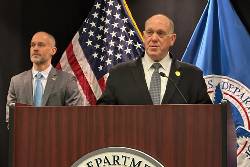
Border czar Tom Homan told reporters Thursday that “extensive engagement” with state and local officials allowed for a formal end to the operation.
Trump dispatched Homan to de-escalate tensions after the Jan. 24 killing of Pretti. Homan said a drawdown would be predicated on the level of cooperation the federal agencies received from state and local officials.
That cooperation came to pass, particularly with state and local law enforcement and jails' handling of deportable inmates, Homan said.
But he also said he made various internal changes since arriving, including changing certain personnel, deploying body cameras and communicating that misconduct by immigration officers would not be tolerated.
“There were some issues here. We fixed those issues,” Homan said. “We’ve had great success with this operation and we’re leaving Minnesota safer.”
Immigration enforcement will continue, but with a smaller footprint
Homan announced last week that 700 federal officers would leave Minnesota immediately, but that still left more than 2,000 in the state. He said Thursday that a “significant drawdown” was already underway and would continue through next week.
Homan said he would be on the ground for a “little longer” to oversee the drawdown, and that a small team would facilitate the transition and ensure the continuing cooperation of state and local authorities.
He did not specify how many officers would remain, but he said targeted enforcement would continue in the Twin Cities.
“President Trump made a promise of mass deportation, and that’s what this country is going to get,” Homan said.
Todd Lyons, Immigration and Customs Enforcement's acting director, said during a congressional hearing Thursday that the agency is still searching for about 16,840 people in Minnesota who have final orders of removal.
The operation leaves its mark on the Twin Cities
Following Homan’s announcement Thursday, some residents held a vigil at a makeshift shrine that went up where Good was shot in Minneapolis.
“I don’t even want one ICE person here, if they act the way they’ve been acting,” said local attendee John Schnickel. “Does it fade away if they leave here? Are they going somewhere else, or has the country and the White House learned a lesson?”
He also disagreed with remarks by Trump officials that the enforcement surge made Minnesota safer. “They talk about how the murder rate is down, and yet they’ve added two people to it,” he said.
Mark Foresman, an attendee from the suburb of St. Louis Park, said he is skeptical that the agents will leave.
“The Trump administration has created an atmosphere of distrust for government in general, so that’s caused citizens like myself to not believe what they say, because they’ve repeatedly been caught in lies,” he said, suggesting the Trump administration's tactics seemed designed to stir up publicity and sow fear.
Juan Uvera, who was visiting from New York City, said one thing that jumped out to him was the number of businesses that were closed or had signs barring ICE.
“From afar, on TV, it’s just like people are getting shot and killed. But you actually see the effect it has on the people over here," he said.
Anna Van Sice, an attendee who was wearing one of the commonplace whistles that have been used in immigration crackdown cities to warn that federal officers are nearby, said the Twin Cities area can’t let its guard down and that will keep responding to ICE's presence.
“We don’t have a lot, or any trust in the government right now,” she said. “I guess I’ll believe it when I see it.”
____
Fingerhut reported from Des Moines, Iowa. Associated Press reporter Sarah Raza contributed from Sioux Falls, South Dakota.
... Copyright © 1996 - 2026 CoreComm Internet Services, Inc. All Rights Reserved. | View our