

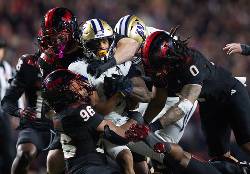
The addition of four former Pac-12 teams was supposed to bring some offensive firepower to the Big Ten and change its reputation.
It hasn’t quite worked out that way.
Scoring in the Big Ten did rise in 2024, the first year after Southern California, UCLA, Oregon and Washington joined a league known more for defense. Point totals went up again last year. But they’re dropping this year as three Big Ten teams already have fired their offensive coordinators.
Nebraska dismissed Dana Holgorsen and Michigan fired Jason Beck over the weekend, two weeks after No. 18 Oregon dumped Drew Mehringer.
“I felt like as I watched us play, it just isn’t working the way we want it to work,” Nebraska coach Matt Rhule said Monday. “For me, you think about what it takes to win in college football, you need to have an explosive offense. You need to have the ability to score points.”
Not enough Big Ten teams have shown that ability this season.
Sportradar says games featuring two Big Ten teams have averaged 47.3 total points this season, putting the league on pace for its lowest season-ending average since 2023 (45.0). Before then, the last time Big Ten games averaged fewer than 47.3 points was way back in 2006 (46.5).
The only league whose conference games have lower scoring averages this season is the Mountain West Conference with 45.5. Among Power Four conferences, the Big 12 averages 56.8, the Atlantic Coast Conference has 53.4 and the Southeastern Conference is at 50.7.
“When you think of Big Ten football at its core, you think of running the football and playing defense,” said Big Ten Network analyst Ryan Kerrigan, who was named the league’s defensive player of the year while playing for Purdue in 2010.
That was supposed to change once those West Coast schools arrived. For a while, it did.
Games featuring two Big Ten teams averaged 48.4 total points in 2024, the highest number since 2021. They went up in 2025 to 49.0 points per game, the most since 2020.
Quarterback issues hinder offenses
It would be easy to write off this year’s drop as a result of the flurry of Big Ten quarterback injuries, most notably to preseason Heisman Trophy contenders Dante Moore of Oregon and Julian Sayin of Ohio State.
Other quarterbacks simply haven’t developed as expected.
Bryce Underwood, regarded as the nation’s top overall recruit in his high school class, got benched midway through his sophomore season at Michigan. Tommy Carr took over and struggled to such an extent in a 15-6 loss to Michigan State on Saturday that Wolverines coach Kyle Whittingham fired Beck and reopened the quarterback competition.
Whittingham said he had intended to wait on any coaching evaluation decisions until after the season, but this game changed his mind.
“When I turned on the film and really dove into it, it just became apparent to me that we needed to make the change now,” Whittingham said. “There’s just too much regression in the offense in that particular game.”
While Big Ten offenses have struggled, the league’s defenses have generally stepped up. Five of the top 10 Bowl Subdivision defenses in yards allowed per play are Big Ten programs: No. 6 Indiana (1st, 4.08) No. 4 UCLA (5th, 4.25), Michigan (6th, 4.26), Wisconsin (7th, 4.30) and No. 16 Iowa (10th, 4.40).
Indiana, Iowa, UCLA and Wisconsin all rank in the top 10 in yards allowed per carry.
"Physicality is probably the operative word for defenses in the Big Ten," Whittingham said.
Defensive coaches provide more challenges
Wisconsin coach Luke Fickell struggled to come up with a reason for why the numbers have dropped this year.
“I can tell you this: There’s no better-coached conference in college football,” Fickell said. “I’m just telling you, the uniqueness of what has always been done in the Big Ten continues to get better. That’s why it’s difficult to be successful in this league offensively without having the ability to be balanced in what you’re doing, to run the football and throw the football, because I think it’s so well coached.”
Kerrigan and Minnesota offensive coordinator/quarterbacks coach Greg Harbaugh offered similar assessments.
Kerrigan cited the presence of outstanding defensive coordinators such as Indiana’s Bryant Haines and Iowa’s Phil Parker. Harbaugh said the defenses Minnesota faces each week are difficult to prepare for because they can attack teams in multiple ways.
“It’s just the players, and I think the coaching in this league is really, really good,” Harbaugh said. “There’s always an answer. You have to prepare. You have to go back and watch things that they’ve done in years past because you’re always attempting to put your guys in a position to succeed and be ready for something that could happen.”
That hasn’t stopped some staffs from making changes in a season that’s become notable for coordinator firings.
Illinois fired defensive coordinator Bobby Hauck after splitting its first four games of the season. Purdue fired defensive coordinator Kevin Kane on Sunday, the day after a 34-29 loss to Maryland that gave Terrapins interim head coach Aazaar Abdul-Rahim his first win. Abdul-Rahim took over after the firing of Mike Locksley in the Big Ten’s first head coaching change of the year.
But there have been even more staff moves involving offensive coordinators.
Oregon has revived its playoff hopes by beating Northwestern and winning at Ohio State with Jay Johnson calling plays after the firing of Mehringer. Michigan and Nebraska can only hope their coordinator changes produce similar results.
“We’re not scoring enough points,” Rhule said. “So I felt like the time was now.”
___
AP Sports Writers Dave Campbell and Larry Lage and AP College Football Writer Eric Olson contributed to this report.
___
Sign up for Top 25 poll alerts here. Visit the Top 25 here and see AP’s full college football coverage here
... Copyright © 1996 - 2026 CoreComm Internet Services, Inc. All Rights Reserved. | View our