

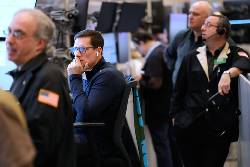
NEW YORK (AP) — A worldwide sell-off for stocks is slamming onto Wall Street Tuesday, and oil prices are leaping even higher as worries rise that the war with Iran is widening and may do more sustained damage to the global economy than feared.
The S&P 500 dropped 2% in morning trading. The Dow Jones Industrial Average was down 1,048 points, or 2.1%, as of 10 a.m. Eastern time, and the Nasdaq composite was 2.1% lower.
It was just a day ago that U.S. stocks opened with sharp losses, only to recover all of them and end the day with slight gains. But that was with the caveat that oil prices did not jump too high, like to more than $100 per barrel.
On Tuesday, oil prices got closer to that mark and raised more alarms. The price for a barrel of Brent crude, the international standard, leaped another 7.5% to $83.58. It was sitting near $70 less than a week ago. A barrel of benchmark U.S. crude, meanwhile, rose 7.6% to $76.64.
Oil prices made the leap as Iran struck the U.S. Embassy in Saudi Arabia, part of a widening of targets that also includes areas critical to the world’s oil and natural gas production. Worries are particularly high about what will happen to the Strait of Hormuz off the coast of Iran, a narrow passageway where roughly a fifth of the world’s oil passes.
Making things uncertain for markets are rising questions about how long this war may continue.
Strikes by the United States and Israel have already killed Iranian Supreme Leader Ayatollah Ali Khamenei, but President Donald Trump has suggested that fighting may continue for weeks.
Late Monday night, Trump said on his social media network, “Wars can be fought ‘forever,’ and very successfully” with the supply of munitions that the United States possesses.
The jump for oil prices will worsen inflation, which is already too high for nearly everyone, and put more pressure on U.S. households and businesses by raising bills for gasoline and to ship products. The average price for a gallon of gasoline in the U.S. jumped 11 cents overnight to about $3.11, according to data from motor club AAA.
That has the damage in stock markets so far centering on countries and companies that use a lot of oil, natural gas and other petroleum-based fuels.
In South Korea, a big energy importer, the Kospi stock index plunged 7.2% for its worst day since two summers ago as markets reopened after a holiday on Monday. It had been setting records recently.
Japan’s Nikkei 225 dropped 3.1%, even as analysts say Japan has a sizable stockpile of energy lasting more than 200 days. In Europe, where prices for natural gas have soared, Germany's DAX lost 3.8%.
On Wall Street, airlines continued to sink on worries about rising fuel bills. The war has also led to canceled flights and stranded passengers.
United Airlines fell 5%, American Airlines sank 4.4% and Delta Air Lines dropped 4%.
Among the few winners on Wall Street was Target, which rose 3.3% after reporting a better profit for the latest quarter than analysts expected. It also gave a forecasted range for profit this upcoming fiscal year whose midpoint was above analysts' expectations.
In the bond market, Treasury yields climbed as worries rose about inflation worsening. The yield on the 10-year Treasury jumped to 4.09% from 4.05% late Monday and from just 3.97% on Friday.
Higher yields can mean more expensive loans for U.S. households and businesses, for everything from mortgages to bond issuances. They also put downward pressure on prices for stocks and all kinds of other investments. Bitcoin dropped back below $67,000.
When Treasurys are paying more in interest, they can also undercut the price of gold, which pays its investors nothing. Gold fell 4.9% Tuesday to $5,053.30, halting a strong run that had taken it above $5,300 as investors looked for safer places to park their money amid the war.
High inflation could also tie the Federal Reserve’s hands and keep it from cutting interest rates. The Fed had lowered rates several times last year and indicated more cuts were to come in 2026. That would help boost the economy and inflation, but lower rates can also worsen inflation.
Traders are now pushing back their expectations further into the summer for when the Fed could resume cutting rates, according to data from CME Group. That's even though Trump has been calling for Fed officials in very angry and personal terms to cut rates now.
___
AP Business Writers Yuri Kageyama and Matt Ott contributed.
... Copyright © 1996 - 2026 CoreComm Internet Services, Inc. All Rights Reserved. | View our