

JERUSALEM (AP) — When Hersh Goldberg-Polin was in the tunnels in Gaza, fellow hostages say he often quoted a line from Holocaust survivor Viktor Frankl: “Those who have a ‘why’ to live, can bear with almost any ‘how.’”
Through his long months in captivity, family and friends hoped that, like Frankl, he would come back with a message of hope. Then, in August 2024, after nearly a year in captivity, he and five other hostages were shot dead by their captors deep underground, likely as Israeli forces were closing in.
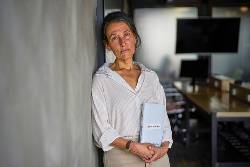
The quest for his why has fallen to his family, who led a high-profile campaign for his release. His mother, Rachel Goldberg-Polin, has a new book released Tuesday.
“When We See You Again,” has no narrative arc, no tidy uplifting message, no score settling with the Hamas militants who killed her son or the Israeli leaders who many blamed for his death — only a searing account of her grief.
She hasn’t yet decided whether the book is an exceptionally painful love story, or a love-filled pain story.
“I’m still trying to figure out with clarity what is my why, but it’s clear to me that my why is not done,” Goldberg-Polin said, a photo of a smiling Hersh behind her. “I just really wanted to tell the truth. It’s very ugly.”
A face of the hostage crisis
Hersh was among the 251 people abducted by Hamas in its Oct. 7, 2023, attack. His hand was blown off by a grenade before he was dragged into Gaza and eventually into the militant group’s labyrinth of tunnels.
The war sparked by the attack led to the killing of over 70,000 Palestinians and the destruction of much of Gaza before a ceasefire deal in October led to the release of all the remaining hostages. Hersh had been killed, along with five other hostages, more than a year earlier.
Rachel had campaigned tirelessly for her son’s release, appearing in countless media interviews, meeting with then-President Joe Biden and addressing the Democratic National Convention. She also joined mass protests in Israel accusing the government of failing to reach a deal sooner.
Her son was among the best-known hostages. Posters and graffiti with his name and face still appear across the country, often bearing the line from Frankl.
A human portrait
In her memoir, Rachel takes care not to mythologize him. She notes that he picked his scabs as a kid and was bad at doing dishes.
“Hersh has become a symbol to many,” Goldberg-Polin writes in the book. “I don’t know what to do with that. But it’s OK. If people need Hersh to be something, he will be that. That is the essence of service, being what is needed.”
Rachel grew up in Chicago and moved to Israel with her husband and three children when Hersh, the oldest, was six. She tells stories from the “before time”: of how Hersh as a child would wow people with his encyclopedic knowledge of U.S. presidents, and how he loved Jerusalem's local soccer team and their sister team in Bremen, Germany.
She only briefly touches on his capture and the details of his captivity, which have been widely reported. She writes about their desperate search for information in the chaotic and terrifying days after the attack, their long fight for his release and the news of Hersh's killing, along with five others, after 328 days.
The book is mostly a “very raw, peeled, oozing, throbbing pain,” Goldberg-Polin said. She describes “hundreds of sodden days dripping with anguish.”
“The book really started just as a way of taking this tremendous weight of suffering that was causing my soul to buckle,” she said in an interview in Jerusalem.
The writing came out in bursts, without a plan for a final project, just a question of “How do I survive the next 15 minutes?” she said.
A fellowship of grief
The book emerged in part from her frustration when people asked how she was. “I think, ‘Well, do you not see this dagger sticking out of my chest at my heart? How can you possibly be asking me that?’” she said. “But I realized they don’t see it. And it’s not because they’re mean or insensitive. They simply don’t see it.”
“Someone who’s born blind doesn’t know what blue is, and it’s very difficult to describe blue to someone who’s blind. But I’m desperate for people to see my blue, and I’m yearning for people to feel my pain,” she said.
Then there were those who wanted to share their own stories of death and loss, even during her son’s shiva, the traditional Jewish week of mourning after the funeral. It’s an experience that she describes as overwhelming and eye-opening, revealing the “surplus of suffering” in the world.
“They’re not trying to comfort me, they’re saying: ‘Let me stand next to you and we’ll be in this together,’” she said.
During the campaign to release the hostages, one of Rachel’s mantras was “Hope is mandatory,” even when it felt impossible. Now, wherever they go, people ask her and her husband for a bit of their creased and crumpled hope.
She has no easy answers, as she tells Hersh in a letter addressed to her dead son near the end of the book.
“I will carry your why,” she writes. “I'll do it, I’ll carry your why around the world.”
... Copyright © 1996 - 2026 CoreComm Internet Services, Inc. All Rights Reserved. | View our