

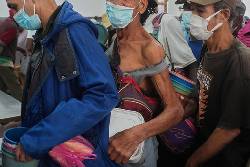
HAVANA (AP) — Every night, hundreds of people line up outside a charity-run food pantry in the heart of Havana, some sleeping on the sidewalk as they wait for what may be their only meal of the day.
When the doors open at 7 a.m., people hurry inside carrying numbered plastic containers. With so many mouths to feed, volunteers follow a carefully organized routine: They wash the containers, call out the numbers and hand out portions of food.
“We’re having a really rough time,” said Fernando Fernández, a 71-year-old retiree who regularly visits the Asociación Quisicuaba, a group that runs a community kitchen in Havana. “I have to arrive in the early morning. Sometimes I even have to get in line the day before.”
Fernández, a former cook and security guard, is among a growing number of Cubans struggling to feed themselves as the country’s prolonged economic crisis deepens, worsened by U.S. energy restrictions, inflation and dwindling government resources.
As the state struggles to provide subsidized food, charity-run kitchens and food pantries have become a lifeline for vulnerable Cubans, including retired doctors, teachers and former government workers. Supported by religious groups, international aid organizations and the United Nations, they provide what for many is their only reliable hot meal.
Centers such as Quisicuaba, often housed in religious buildings or affiliated with faith-based groups, have proliferated across the island in recent years.
Fernández, a former caretaker, once visited the soup kitchen with his 80-year-old wife, Josefa, but now goes alone because she is ill. The couple survives on her monthly pension of 3,200 Cuban pesos, a little more than $3, and assistance from Quisicuaba.
On a recent morning, Marelys Ponce, a 34-year-old single mother, joined the line with two of her children. Her other three attend school, where they typically receive lunch.
“I started coming here a little over a month ago because the situation is bad, and I don’t have the means to feed them,” she said, gesturing toward her children. “At least with this, they get something to eat.”
Alongside Ponce and Fernández were men and women from a wide range of professions. Few were homeless. Most had long work histories or were still employed, but told the AP that their earnings were no longer enough to live on.
‘A new dimension of vulnerability’
Inside a vast kitchen equipped with more than 20 giant cauldrons, volunteers at Quisicuaba prepare a mixture of rice, eggs and pasta, sometimes with a little chicken, and pour chocolate milk into bottles. At 7 a.m., the doors open and distribution begins.
The religious organization, supported by United Nations agencies and European aid groups, has identified about 12,500 vulnerable people in Havana.
“You only need to walk through the streets of Havana and Cuba to see a new dimension of vulnerability,” Enrique Alemán, a physician and president of Quisicuaba, told The Associated Press.
For decades, Cuba’s socialist system provided free education, healthcare and subsidized food, with most people employed by the state. Living standards were often modest, but basic needs — including food — were largely met.
“We don’t see illiterate people here or other forms of marginalization, but people who are products of Cuban society facing particularly vulnerable circumstances,” Alemán said, pointing to growing financial, food and healthcare insecurity among families.
The U.S. energy squeeze has severely disrupted life on the island, while tourism, once a major source of revenue, has declined sharply.
Meanwhile, private businesses have expanded, widening the divide between entrepreneurs, higher-paid workers and Cubans receiving money from abroad, and state employees, retirees and others struggling to make ends meet.
Private markets now offer imported goods that were scarce just a few years ago, but prices are beyond the reach of many Cubans. A carton of eggs costs 3,200 Cuban pesos, roughly a retiree’s monthly pension, while a bottle of cooking oil costs 2,700 pesos, or a bit less than $3.
A doctor’s monthly salary can reach 15,000 pesos, equivalent to about $18. Inflation, which reached 28% in September from a year earlier, has further eroded purchasing power.
Luis Carlos Battista, a Cuban American lawyer and analyst based in Spain, said growing poverty stems from domestic and external factors, including rising global food prices, the collapse of tourism during the COVID-19 pandemic and the impact of U.S. energy restrictions on food production.
Cuba previously spent about $2 billion annually on food imports to support its rationing system, which provided households with staples including rice, beans, powdered milk, chicken, cooking oil and eggs.
But authorities acknowledge that the economic crisis has left the government unable to maintain those imports, resulting in delayed or missing subsidized food rations.
“While official rhetoric speaks of advancing toward socialism, a growing part of daily life operates under an increasingly individual logic,” researcher Lisbeth Moya González wrote in a recent essay published by La Joven Cuba, a prominent critical online platform.
She said families increasingly must rely on private markets, remittances or community support to obtain what the state once guaranteed for all.
... Copyright © 1996 - 2026 CoreComm Internet Services, Inc. All Rights Reserved. | View our