

CAIRO (AP) — Iran and its ally, the Lebanese militant Hezbollah group, stepped up pressure on Israel on Sunday, with intense attacks on the country's north and south after the United States and Iran threatened to widen their targets in the war in the Middle East, now in its fourth week.
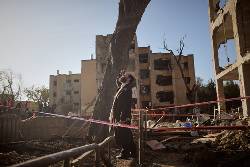
As Israel came under renewed fire, top Israeli leaders traveled to the Negev Desert, home to the country’s main nuclear research center and the site where Iran's barrages struck two towns on Saturday, shattering apartment buildings and injuring scores of people in Arad and Dimona.
Prime Minister Benjamin Netanyahu toured Arad and said it was a “miracle” no one was killed there. He claimed Israel and the U.S. were well on their way to achieving the war’s goals and implored the international community for support.
Earlier, President Donald Trump warned the United States will destroy Iran’s power plants if Tehran fails to fully open the Strait of Hormuz in 48 hours. Iran's parliament speaker said if the U.S. follows through on its threat, Tehran would retaliate against American and Israeli energy and wider infrastructure in the region.
The developments signaled the Iran war, which the U.S. and Israel launched on Feb. 28, was moving in a dangerous new direction, despite Trump's mention last week he was considering “winding down" operations. The war that has killed hundreds of people, rattled the global economy and sent oil prices surging.
Hezbollah claimed responsibility for an airstrike Sunday that killed a man in northern Israel while Gulf Arab states — including Saudi Arabia and the United Arab Emirates — said they were working to intercept new Iranian strikes.
Iran responds to Trump's threat over its Strait of Hormuz closure
Iran has practically closed the Strait of Hormuz, a critical chokepoint connecting the Persian Gulf to the rest of the world through which roughly one-fifth of the world's supply passes. Attacks on commercial ships and threats of further strikes have stopped nearly all tankers from navigating the strait, compelling some of the world's largest oil producers to make cuts because their crude has nowhere to go.
The blockade is a liability for both the U.S. and its allies in Europe and Asia, who rely heavily on the Persian Gulf supply to meet energy demand and power factories, vehicles and homes. The U.S. lifted some sanctions on Iranian oil at sea to relieve pressure on energy prices.
On Saturday, Trump said he would give Iran 48 hours to open the strait or the U.S. would destroy Iran's “various POWER PLANTS, STARTING WITH THE BIGGEST ONE FIRST!”
The Iranian parliament speaker, Mohammad Bagher Qalibaf, responded Sunday on X that if Iran's power plants and infrastructure were targeted, then vital infrastructure across the region — including energy and desalination facilities — would be considered legitimate targets and “irreversibly destroyed.”
Separately, Iranian officials on Sunday said they would keep providing safe passage through the strait to vessels from countries other than its enemies.
Nuclear concerns as the war rages
Iran said its strikes in the Negev Desert were in retaliation to an earlier attack on Iran’s main nuclear enrichment site in Natanz, according to state-run media.
Tehran hailed the attack as show of strength — even as Israel's military asserts that Iranian missile launches have gradually decreased in frequency since the start of the war.
“If the Israeli regime is unable to intercept missiles in the heavily protected Dimona area, it is, operationally, a sign of entering a new phase of the battle,” said Qalibaf, the Iranian parliament speaker.
Dimona is about 20 kilometers (12 miles) west of the nuclear research center and Arad around 35 kilometers (22 miles) to the north.
Soroka, southern Israel’s main hospital, received at least 175 wounded from Arad and Dimona, the hospital's deputy director Roy Kessous told The Associated Press.
Israel is widely believed to possess nuclear weapons, though it doesn’t confirm or deny their existence. The U.N. nuclear watchdog said on X it had not received reports of damage to the Israeli center or abnormal radiation levels.
Israel denied responsibility for hitting Natanz on Saturday while the Iranian judiciary’s official news agency, Mizan, said there was no leakage. The Pentagon declined to comment on the strike at Natanz, which was also hit in the first week of the ongoing war and in the 12-day war last June.
The U.N. watchdog — the International Atomic Energy Agency — has said the bulk of Iran’s estimated 972 pounds (441 kilograms) of enriched uranium is elsewhere, beneath the rubble at its Isfahan facility.
Iran says strike on Natanz also hit a hospital
Iran said Saturday’s strike at Natanz also hit a hospital in nearby Andimeshk. The health ministry reported patients and doctors were evacuated from there.
“Patients in the city of Andimeshk were forced to leave the only hospital in the city,” Health Ministry spokesman Hossein Kermanpour wrote on X.
He posted images showing a ward with a partially collapsed ceiling, a corridor strewn with broken glass, and said patients had been transferred to another city.
In Iran, the death toll in the war surpassed 1,500 on Saturday, state media reported, citing the health ministry. In Israel, 15 people have been killed by Iranian strikes. More than a dozen civilians in the occupied West Bank and Gulf Arab states have been killed in strikes.
The war has also seen noncombat related accidents, including a U.S. refueling plane crash in western Iraq that killed six U.S. service members and a Qatari military helicopter crash on Saturday that was blamed on a technical malfunction. All seven aboard the helicopter were killed, Qatari authorities said Sunday.
Hezbollah strike on northern Israel claims first fatality there
The Israeli civilian was killed in the northern town of Misgav Am in what Israel's military said “seemed to be” a rocket attack. Israeli medics said they found the man in his car and released a video showing two vehicles ablaze.
Hezbollah, an ally of Iran, launched strikes on Israel soon after the war erupted, saying it was in retaliation for the killing of Iran's Supreme Leader Ayatollah Ali Khamenei. Israel struck back, bombarding Lebanon and targeting Hezbollah in deadly airstrikes, expanding its presence in southern Lebanon and amassing more troops near the border.
Lebanese authorities say Israel's strikes have killed more than 1,000 people and displaced more than 1 million.
___
Metz reported from Ramallah, West Bank. Associated Press writers Melanie Lidman in Tel Aviv, Israel, Koral Saeed in Abu Snan, Israel, and Isabel Debre in Beirut contributed reporting.
... Copyright © 1996 - 2026 CoreComm Internet Services, Inc. All Rights Reserved. | View our