

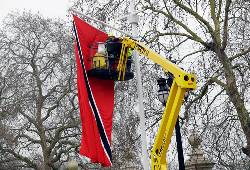
SAN JUAN, Puerto Rico (AP) — A final court of appeals in England struck down a centuries-old gay sex ban in Trinidad and Tobago in a ruling on Tuesday that activists around the world celebrated.
The ruling ended a nearly 10-year battle for gay rights in the twin-island nation and cannot be appealed.
“Those laws cannot be regarded as reasonably justifiable in a society that has a proper respect for the rights and freedom of the individual,” said Judge Philip James Sales of the Judicial Committee of the Privy Council.
In February 2017, Jason Jones filed the case, arguing that so-called “buggery” laws dating from when Trinidad and Tobago was a British colony are unconstitutional. The laws that call for up to five years in prison have not been enforced in recent history, but critics say they still send a message.
In an interview with The Associated Press on Tuesday, Jones said he was celebrating what he called a “stunning victory.”
He described himself as “a very angry gay man” and said he used that anger to power himself through the case as it made its way through the courts for almost a decade.
“Society has treated me worse than a criminal,” he said. “There is a real sense of vindication with this judgment. Finally, the courts are seeing that they need to step up because our politicians are so toothless.”
Encounter with Nina Simone inspired Jones
Jones, who has been openly gay since age 16, left Trinidad and Tobago in 1996 because of what he described as homophobic violence and discrimination. He said he was a singer in church as well as an actor and a dancer.
“Anybody along those lines who was not following the macho rules was treated as a pariah,” he recalled.
He told the AP that he was inspired to speak out after losing friends to HIV/AIDS and after meeting Nina Simone, the American singer, songwriter, composer and civil rights activist, who had traveled to the twin-island nation in 1984 for Carnival. He said he was 19 and spent three weeks with her.
“Nina was the one who said, ‘Jason, get off this rock and go see the world,’” he recalled, calling it a defining, life-changing experience.
Tuesday's ruling was live-streamed, with Sales reading part of the unanimous decision.
“The current understanding of the fundamental individual right to respect for private and family life is that it protects such a core part of human identity, as one’s sexual orientation and the sexual activities carried on in private between consenting adults to give expression to that identity,” Sales said. “Laws which seek to criminalize such activities cannot be justified.”
Jones said he loves his country and is not angry with its people, but rather its laws.
“To discriminate against somebody simply because of who they choose to love is simply ridiculous,” he said by phone, adding that the ruling is a stepping stone in the fight for equality. “Why do people feel they have the right to pass judgment on anybody else?”
Gay sex still banned in some Caribbean nations
Those who opposed Jones include Trinidad and Tobago’s government, the country’s Council of Evangelical Churches and its largest Hindu organization, Sanatan Dharma Maha Sabha.
Trinidad's attorney general did not immediately return messages seeking comment. Meanwhile, the Council of Evangelical Churches said it did not have immediate comment.
In April 2018, Trinidad’s High Court found the laws unconstitutional, but a local appeals court partially reversed that ruling in March 2025. Trinidad’s Court of Appeals later allowed Jones to seek a ruling from the Privy Council in England. Trinidad and Tobago is a sovereign republic within the British Commonwealth and still uses London’s Judicial Committee of the Privy Council as its highest court of final appeal. However, the country has pushed for the Trinidad-based Caribbean Court of Justice to replace the Privy Council.
Trinidad and Tobago’s government sought a ruling that would uphold the March 2025 ruling. A majority of justices in 2025 found that the High Court erred by allowing judges to change a law. A provision in some Caribbean constitutions protects colonial laws from legal challenges, including in Trinidad and Tobago.
Caribbean nations with so-called buggery laws still on the books include Grenada, Jamaica and St. Vincent and the Grenadines.
Meanwhile, the Bahamas decriminalized homosexuality in 1991, and the U.K. government repealed such laws in 2001 in Anguilla, the British Virgin Islands, the Cayman Islands, Montserrat and the Turks and Caicos Islands. Elsewhere in the Caribbean, judges have recently struck down similar laws in Barbados, Dominica, St. Lucia and Antigua and Barbuda.
___
Associated Press reporter Anselm Gibbs in Port-of-Spain, Trinidad contributed to this report.
... Copyright © 1996 - 2026 CoreComm Internet Services, Inc. All Rights Reserved. | View our