

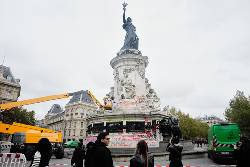
PARIS (AP) — Thousands of protesters took to the Paris streets on Thursday while other cities banned demonstrations following a weekend of clashes and widespread looting that marked France’s most violent unrest in years.
Organizers of the Paris protest said an administrative court in the city overturned a ban issued by police after they challenged it. The Paris police prefecture previously said the ban was necessary, given the risk of street violence after groups of masked youth clashed with police forces, looted shops and torched cars over the weekend.
The Paris court ruling was not immediately made public. Protesters, including many youngsters, gathered peacefully and chanted in the southeastern part of Paris, amid heavy police presence.
“We don’t need tear gas for our future to look bleak,” read a banner unfurled by protesters.
Organizers signed a police document stating that the protest would remain stationary due to the risk of violence.
More bans were expected in the coming days. French President Emmanuel Macron said such measures aim to protect city centers, businesses and public buildings.
The right to demonstrate in France is protected by the French Constitution, and the ban on demonstrations planned for Thursday in Paris, Lyon, Lille and Grenoble was seen by some as an infringement on French people’s right to protest.
High school and university student groups said they will continue to mobilize, even though the autumn school break started this week.
Macron said the strategy adopted for the coming days is to ban protests requested by “individuals or groups with no legitimate authority.” His remarks came after a special security meeting at the Elysée Palace.
“Where trade unions submit requests to hold demonstrations, prefects will examine them in accordance with the law, but alternative routes will be proposed” to protect city centers, businesses and public buildings, Macron said.
“The rules are simple, and I think they’re just common sense. The general recommendation is that there should be no demonstrations in the coming days," he said. “For those who still want to protest, if they are trade unions, prefects will propose alternative routes."
Macron blamed the weekend's violence on “actions led by radical far-left groups who aimed to bring the Republic down," in addition to criminals who came to loot.
The turmoil in Paris and other French cities has prompted a strong security response from the government. Night curfews have been implemented in some areas of the French capital, as well as in other cities where calm has been restored.
Authorities are bracing for another big protest day
Thursday's planned protests were seen as a prelude to Saturday's big demonstration, when activists from the “ yellow vest ” movement, whose demonstrations over fuel prices shook France in 2018 and 2019, and the CGT labor union, are expected to join.
Some of those protests, including marches in Lyon, will also be banned, local authorities said. Cities outside Paris have been hit hard by the unrest, including Limoges where a fire nearly destroyed the 19th century city hall.
Prime Minister Sébastien Lecornu, who met union representatives on Wednesday, said a “massive” security operation was planned for Saturday to prevent a repeat of the violence by small groups of rioters that had exposed shortcomings in security measures.
Union representatives said their meeting with Lecornu did not result in concrete proposals. They are now focusing on another big day of action scheduled on Nov. 5, and called on private and public sector employees to join.
From student protests to a broader social movement
The demonstrations first erupted last month in a high school in Creteil, southeast of Paris, over a lack of staff. From there, class strikes, blockades and demonstrations spread to other Paris suburbs and then nationwide, even in smaller towns.
High school students have raised concerns about underfunded schools, dilapidated facilities and staff shortages, particularly in lower-income neighborhoods. Some also called for a reform of the university admissions system, seen by many as complex and unfair.
With the government unable to respond to students' demands, the school demonstrations and blockades have morphed into larger protests over soaring living costs, just months before next year's presidential election to choose Macron's successor.
___
Nicolas Garriga and Boubkar Benzabat in Paris contributed to this report.
... Copyright © 1996 - 2026 CoreComm Internet Services, Inc. All Rights Reserved. | View our