

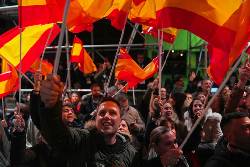
MADRID (AP) — Conservative and far-right parties were poised to end Pedro Sánchez’s eight-year tenure as Spain’s prime minister after scoring a victory in Sunday’s national elections, joining a wider European trend toward demands for tighter immigration restrictions.
With 98% of the votes counted, the conservative Popular Party, or PP, and the far-right Vox party are closing in on a combined total well over the threshold of 176 seats needed to form a government.
"Besides winning the election, we have managed to tear down the wall," PP leader Alberto Núñez Feijóo told a large crowd of supporters gathered in front of party headquarters in Madrid.
Feijóo will become Spain’s next prime minister as long as PP and Vox can agree, as is widely expected, to form a coalition when the new parliament meets next month. The result must be upheld by the new Parliament.
“Mission complete!” Vox leader Santiago Abascal shouted to a thrilled crowd of supporters. “We have kicked them all out!”
The PP will return to power for the first time since 2018. Junior partner Vox would make the incoming administration the first to feature a far-right, nationalist party in power for the first time since dictator Francisco Franco’s death in 1975.
Sánchez conceded electoral defeat in a short speech to party members.
“Today is a sad day for our country,” Sánchez said. "We haven’t achieved our goal of being able to keep together a progressive government,” he said at the Socialists' headquarters, as they prepare to move into opposition. He did not mention what his role would be.
Sánchez said he called Feijóo to congratulate the Popular Party leader for his victory.
Trump welcomes Sánchez's defeat
U.S. President Donald Trump on Sunday welcomed the defeat, saying it was “great news” that Sánchez was on track to be unseated.
“That’s a good thing,” Trump told reporters in Washington. “He did a terrible job. He deserves to lose.”
Sanchez has been one of Trump’s loudest critics in Europe and the two have frequently clashed over topics including the Iran war, Venezuela and NATO spending.
“This result signifies a strengthening of the axis between the traditional right and the far right on a European scale—most notably within European institutions,” said Steven Forti, professor of political science at the Autonomous University of Barcelona.
The election is seen as a referendum on Sánchez. The left-wing leader of the Socialist party has governed Spain for eight years through numerous crises, but also a period of economic growth that, for many voters, has been eclipsed by cost-of-living concerns.
No issue has galvanized Spaniards in recent years quite like access to affordable housing. Soaring home and rental costs in cities and tourism hot spots have caused widespread discontent, especially among the young.
Sánchez announced an early election in October after right-wing parties in parliament voted down measures his government introduced to alleviate housing pressures. Nationwide protests sprang up after the dramatic eviction of an 87-year-old woman from her apartment in Madrid.
Sánchez warned voters that a conservative government wouldn't make their lives more affordable, and frequently has said that his opponents would take the country of 50 million backward.
Sánchez's opponents heavily scrutinize his record
Feijóo promised voters more stability and better governance, frequently pointing to the many crises that took place under Sánchez.
He criticized Sánchez not just for his government's failure to alleviate Spaniards' housing woes, but also for two fatal train crashes this year on Spain's high-speed rail network, a nationwide blackout in April 2025 and a border crisis in Spain's North African exclave of Ceuta.
Feijóo also pilloried Sánchez — who relied on backing from far-left and separatist parties to cling to power in 2023 — for not being able to pass a budget in nearly four years, lacking parliamentary support.
“I ask Spaniards not to vote with fear, but with memory,” Feijóo said in Madrid after casting his ballot. “Today is a day when the Spanish people take the helm and will decide the future, the destiny, and the direction of Spain.”
Europe is closely watching the vote
Spain has welcomed millions of people, mainly from Latin America, but also from Africa and elsewhere in Europe. One in five residents was born outside Spain, according to census data. Earlier this year, the Spanish government legalized the status of nearly 1.2 million immigrants living in the country without authorization.
Feijóo and Abascal have portrayed Sánchez's immigration-friendly policies as harmful to ordinary Spaniards, pointing to the country's insufficient housing stock and strained public services. Both candidates have condemned the migrant legalization measure.
The result will also be closely watched across Europe before an election-packed 2027, in which voters will head to the polls in France, Italy, Greece and Poland.
In France, the far-right National Rally is aiming to take power, while in Italy, Premier Giorgia Meloni's right-wing coalition is expected to seek another term.
Late Sunday, Meloni congratulated the PP and Vox for their victory, writing on X that she looked forward to working with them “for the benefit of our nations.”
EU Commission President Ursula von Der Leyen also congratulated the PP leader on X.
39 million people were eligible to vote
About 39 million people were eligible to cast ballots. Voting took place in schools, community centers, town halls and other municipal facilities. Spaniards also voted by mail.
A Spanish prime minister will be elected in a vote held by the new parliament next month. A candidate needs the support of an absolute majority — or at least 176 lawmakers — in the first parliamentary vote, often relying on coalition agreements or support from other parties.
Sánchez became a star of the global left, opposing Trump and Israel
Sánchez, a Madrid native and former economics professor, became a hero to the global left for his government's opposition to the Israel-Hamas war in Gaza, and his resistance to Trump. He has criticized the U.S. and Israel over the Iran war, and was one of Western Europe’s first major leaders to formally recognize Palestinian statehood.
Sánchez's government turbocharged Spain's climate commitments, pledging to source all its energy from renewable sources by 2050. The country already generates more than half its electricity from noncarbon sources. But his critics say that his overreliance on renewables was responsible for the 2025 blackout.
He's the first Spanish prime minister to speak comfortably in English.
Sánchez's party, including members of his inner circle, has been dogged by legal cases involving corruption. The cases have implicated a former minister and top officials, eroding voters' trust.
Feijóo, in contrast, is a lifelong civil servant-turned-politician from rural northwestern Galicia who doesn't speak English and projects himself as a sensible, moderate and effective administrator.
Feijóo governed the region of 2.7 million people for 13 years. He is expected to mend bridges with the United States and Israel if he wins.
Israeli Foreign Minister Gideon Saar congratulated Feijóo and Abascal on their victory, writing Sunday night on X: “I believe that we can now work together to restore Israel-Spain relations ___
Wilson reported from Barcelona, Spain.
... Copyright © 1996 - 2026 CoreComm Internet Services, Inc. All Rights Reserved. | View our