

WASHINGTON (AP) — The Supreme Court on Monday rejected the Trump administration’s push to force California to set aside thousands of ballots from people the federal government claims are noncitizens, a decision that came hours before the final day of voting in the pivotal midterm elections.
The high court refused to immediately intervene in a case involving 20,000 people the Republican administration flagged as likely noncitizens on the largely Democratic state’s voter rolls.
The swift rejection capped a string of losses for the president’s effort to intervene in the election before the counting of ballots to decide who controls Congress in the last two years of his second term. No justices publicly dissented.
“The Court rejected Trump’s emergency request without even asking the other side to respond,” California Gov. Gavin Newsom, a Democrat, posted on X. “Democracy won.”
Several lower courts also rejected the Justice Department's push to set aside the challenged California ballots until the voters’ citizenship status could be verified. In Alaska, a judge did not even hold a hearing before dismissing a Trump-ordered suit to prevent a possible Democratic Senate win.
The high court did not detail its reasoning, as is common in emergency decisions. The justices previously rejected Trump’s push to restrict mail ballots around the country in September, even though the justices have sided with his administration in a series of other emergency docket appeals.
California's Attorney General, Rob Bonta, also a Democrat, noted the administration's legal losing streak in a statement.
“Courts have now rejected the Trump Administration’s attempts to interfere in California’s elections not once, not twice, not three times, but four times — from the district court to the Ninth Circuit to the U.S. Supreme Court,” Bonta said. “This latest decision should put an end to the Administration’s attempt to disrupt California’s elections through emergency court orders."
The Republican administration has prioritized identifying noncitizen voters this year, despite them being rare. California officials said the administration's list appeared to be filled with errors and that setting the ballots aside could effectively disenfranchise legal voters.
Also on Monday in Washington, another federal judge ruled against the administration’s efforts to make last-minute demands of California election officials, finding they violated the U.S. Constitution.
“The Executive Branch has likely violated the Constitution’s Elections Clause, which commits authority over election rules to the states and Congress alone,” Chief Judge James Boasberg wrote.
The administration, for its part, said segregating the ballots was a modest request that would eventually allow legal votes to still be counted.
The administration's push has faced not only the remarkable series of losses in court, but criticism for waiting until a few weeks before the election to make its demands of California election officials with a list that even the Department of Justice admits is not entirely reliable.
During a hearing over whether to lift her own order forbidding the administration from threatening to prosecute election workers who let potentially illegal voters cast ballots, District Court Judge Trina Thompson drilled down on reports of widespread inaccuracies in the Justice Department's data.
“Would you agree there's a high error rate?” Thompson asked Kenneth Kao, a Justice Department attorney.
“That's a fair statement,” Kao said. “That's why we ask for the registrars' aid in verifying these are all valid voters.”
At the same time, Bill Essayli, the federal prosecutor running the Justice Department's Los Angeles office, said at a news conference he was highly confident the people on the list were not entitled to vote.
“This isn’t speculation. This isn’t a theory,” Essayli said, later conceding there may be errors on the list.
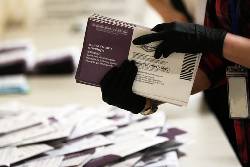
Voting has been underway in California, a largely Democratic state, since early October. All of the state’s roughly 23 million registered voters are mailed a ballot. Hundreds of thousands of ballots have already been processed. California election officials have said that finding and setting aside the challenged ballots now would be logistically impossible.
Lower courts swiftly sided with the state, with a district judge warning last week that segregating ballots would “wreak havoc” on the midterm elections and erode trust in the democratic process.
“If the Executive can discount votes and threaten an ongoing election due to unproven allegations, then our democracy is in danger,” wrote U.S. District Judge David O. Carter, who was nominated by President Bill Clinton, a Democrat.
A 2-1 appeals court panel upheld his order, with one judge appointed by Trump and another appointed by President Joe Biden, a Democrat, voting in favor. The third judge on the panel, also appointed by Trump, argued in a dissent that California’s unwillingness to separate the ballots encourages the “violation of federal law.”
___
Associated Press writers Sophie Austin in Sacramento, California, and Safiyah Riddle in Los Angeles contributed to this report.
___
Follow the AP's coverage of the U.S. Supreme Court at https://apnews.com/hub/us-supreme-court.
... Copyright © 1996 - 2026 CoreComm Internet Services, Inc. All Rights Reserved. | View our