

Iran says it has struck an oil tanker trying to transit the Strait of Hormuz, and hundreds of thousands of people rallied in Tehran in the largest showing of support for the government since the United States and Israel attacked in February.
Meanwhile, South Korea says it is considering expanding a naval operation in the Gulf of Aden off the Arabian Peninsula to protect its ships and oil routes, but it won't send troops to intervene in the Iran war.
Here’s a look at the latest news in the Middle East on Friday. Full coverage can be found here.
Iran says it struck an oil tanker in the Strait of Hormuz
Iran said it struck a Togo-flagged oil tanker, the Trend, for what it called an “illegal attempt” to pass through the Strait of Hormuz, the state broadcaster reported, citing the Revolutionary Guard Corps.
The Associated Press could not immediately confirm the report.
The Guard's navy warned that unauthorized passage through the strait would result in the “destruction” of offending vessels, the broadcaster said. Tehran has asserted control over the waterway since the U.S. and Israel launched the war on Feb. 28.
The United Kingdom Maritime Trade Operations (UKMTO) overnight reported a ship “security incident” 16 nautical miles northeast of Khasab, Oman, which lies on the other side of the strait. The crew was safe and no environmental impact was reported, the monitor said.
It was not clear whether the UKMTO report was describing the attack that Iran claimed.
The U.S. military has been guiding some commercial ships through the strait off Oman as the risk of Iranian attacks continues.
More attacks reported in the strait
Separately, the UKMTO reported that a tanker in the strait was hit by an “unknown projectile,” causing a fire that was later extinguished. The crew was reported safe, with no immediate indication of environmental damage, it said.
The AP could not independently confirm the incident, and there was no immediate claim from Iran.
The monitor also said another tanker was struck Wednesday by an “unknown projectile” while transiting out of the strait, with the crew reported safe. It was not clear why the report came later.
Tehran rally vows support for Iran
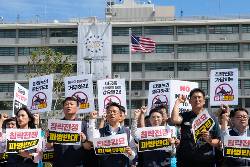
Hundreds of thousands of Iranians filled the streets of Tehran in the biggest rally since the war began in February, pledging to take up arms as “Janfaday-e Iran,” or the “ones who sacrifice their lives for Iran.”
Iran’s government has sought to rally the people and stress national unity, even as the economy worsens under a U.S. naval blockade of Iranian ports and new U.S. sanctions meant to increase Tehran’s economic pain.
Some participants trampled flags of the U.S. and Israel. Others chanted “Death to America” and “Death to Israel.”
Houthi supporters turn out in Yemen
Hundreds of people turned out in northern areas of Yemen in support of the Houthis and to protest Saudi Arabia’s accusation that the rebels targeted Islam’s holiest site, Mecca.
Houthi-controlled Al-Masirah TV showed protesters carrying pictures of the Kaaba, a landmark in Mecca, along with Yemeni, Iranian, Lebanese and Palestinian flags. A speaker reiterated the Houthis’ opposition to Saudi Arabia, which supports Yemen's internationally recognized government.
The Saudis said it intercepted a Houthi drone targeting Mecca earlier this week. The Houthi leadership has denied responsibility.
The Houthis are fighting Saudi-backed Yemeni forces, which lately has fueled mass displacement of more than 100,000 people.
South Korea says it might expand naval unit in the region
South Korean President Lee Jae Myung said his government is considering expanding the operations of a naval unit deployed in the Gulf of Aden off the coasts of Yemen and Somalia to protect his country’s vessels and oil shipping routes.
But he stressed that South Korea would not take action that would draw it into the U.S.-Iran conflict, pushing back against recent pressure from the Trump administration. South Korea has deployed the anti-piracy Cheonghae Unit for years.
The growing threat from Iranian-backed Houthis in Yemen to shipping in the region has alarmed countries and markets, even though the rebels have said they are only targeting the assets of neighboring Saudi Arabia, the world's top oil exporter.
“There will be no troop deployment that involves or intervenes in the war,” Lee said.
Threat level in the Bab el-Mandeb Strait remain high
A UKMTO update showed there have been no new attacks on shipping in the Red Sea in the week since Houthi rebels captured strategic islands on the Bab el-Mandeb Strait at its southern end.
The monitor noted increased Houthi control of parts of Yemen’s west coast and called the threat level for the southern Red Sea as “substantial.” But it said the latest recorded attacks, including near misses, was on Aug. 24, though northbound and southbound transits of the strait are down.
In the Strait of Hormuz, the update said ship transits facilitated by the U.S. military off Oman have averaged 24 a day over the past week but overall traffic remains about 90% lower than before the war.
___
This piece will be updated throughout the day as new developments emerge.
... Copyright © 1996 - 2026 CoreComm Internet Services, Inc. All Rights Reserved. | View our