

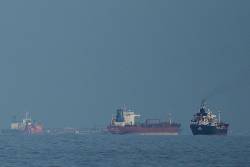
ISLAMABAD (AP) — The standoff between the United States and Iran deepened Tuesday as the U.S. declared it had blockaded Iran's ports, Tehran threatened to strike targets across the region, and Pakistan said it was racing to bring the sides together for more talks.
Though last week's ceasefire appeared to hold, the showdown over the Strait of Hormuz risked reigniting hostilities and deepening the region-wide war's economic fallout.
Talks aimed at permanently ending the conflict — which began Feb. 28 with U.S. and Israeli strikes on Iran — failed to produce an agreement last weekend, though Pakistan has proposed hosting a second round in the coming days.
Two Pakistani officials, who spoke on condition of anonymity because they weren't authorized to discuss the matter with the media, said that the first talks were part of an ongoing diplomatic process rather than a one-off effort.
Two U.S. officials, who spoke on the condition of anonymity to discuss sensitive diplomatic negotiations, said on Monday that discussions were still underway about a new round of talks. They said that the venue, timing and composition of the delegations hadn't been decided, but that talks could happen Thursday.
The war, now in its seventh week, has jolted markets and rattled the global economy as a great deal of shipping has been cut off and airstrikes have torn through military and civilian infrastructure across the region.
The fighting has killed at least 3,000 people in Iran, more than 2,000 in Lebanon, 23 in Israel and more than a dozen in Gulf Arab states. Thirteen U.S. service members have also been killed.
Blockade takes effect
The U.S. military said on Monday that the blockade applied to vessels going to and from Iranian ports. The blockade could restrict the passage of the few ships that Tehran considers friendly, which have been permitted to traverse the Strait of Hormuz, as Iran has curtailed maritime traffic since the start of the war.
Most commercial vessels have avoided the waterway amid Iranian threats, apart from the few allowed to pass through lanes between Iran's islands and coastline.
Both the nature of enforcement and the extent to which ships will comply remained unclear during its first full day in effect on Tuesday. But there were early signs of hesitation — at least two tankers approaching the strait on Monday turned around shortly after it took effect, vessel tracker MarineTraffic said in a Monday post on X.
Iran’s effective closure of the strait, through which a fifth of global oil transits in peacetime, has sent oil prices skyrocketing, pushing up the cost of gasoline, food and other basic goods far beyond the Middle East.
The blockade is intended to pressure Iran, which has exported millions of barrels of oil, mostly to Asia, since the war began. Much of it has likely been carried by so-called dark transits that evade sanctions and oversight, providing cash flow that's been vital to keeping Iran running.
U.S. President Donald Trump on Monday said that Iran's control of the strait amounted to blackmail and extortion as the U.S. blockade took effect. He said in a social media post that Iran’s navy had been "completely obliterated,” but still had “fast attack ships.”
He warned that “if any of these ships come anywhere close to our BLOCKADE, they will be immediately ELIMINATED."
Iran threatened to retaliate against Persian Gulf ports if attacked.
“If you fight, we will fight," Iran's parliamentary speaker, Mohammad Bagher Qalibaf, said in a statement addressed to Trump.
Israel and Lebanon scheduled for talks
Meanwhile, direct talks between Israel and Lebanon were set to begin in Washington on Tuesday, the first such negotiations in decades.
Israel has pressed ahead with its air and ground campaign since last week’s ceasefire in Iran, insisting that it doesn't apply to fighting in Lebanon. It has, however, halted strikes in the country's capital since April 8, after a deadly bombardment that hit several crowded commercial and residential areas in central Beirut. It sparked an international outcry and threats by Iran that it would end the ceasefire.
After more than a year of near-daily strikes in southern Lebanon, Israel escalated its offensive in the early days of the war following Hezbollah launching rockets into Israel. The fighting has carved a path of destruction from agricultural towns near the border to Beirut, killing more than 2,000 people and displacing in excess of 1 million others, according to Lebanese authorities.
The talks are expected to be preliminary, focused on setting parameters rather than resolving core issues. Lebanese officials have pushed for a ceasefire, while Israel has framed the negotiations around Hezbollah’s disarmament and a potential peace deal, without publicly committing to halting hostilities or withdrawing its forces.
Israel wants Lebanon’s government to assume responsibility for disarming Hezbollah, much like was envisaged in a November 2024 ceasefire. But the militant group has survived efforts to curb its strength for decades and said on Monday that it won't abide by any agreements that may result from the talks.
___
Sam Metz reported from Ramallah, West Bank. Aamer Madhani and Matthew Lee in Washington, and Farnoush Amiri at the United Nations, contributed to this report.
... Copyright © 1996 - 2026 CoreComm Internet Services, Inc. All Rights Reserved. | View our