

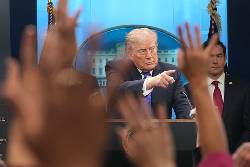
WASHINGTON (AP) — As concerns grow of a potential return to all-out war between the U.S. and Iran, President Donald Trump said Friday that Tehran wants a deal to end hostilities but not one that is “acceptable” to him.
“We want to make a real deal, not a fake deal,” he said at a White House news conference, adding that the Iranian government has been “bull——ing people for 51 years.” Later, he renewed his consistent vow that “Iran will never have a nuclear weapon, ever.”
Trump has oscillated between favoring an agreement that would end the fighting and saying the U.S. does not need to make any deal. Diplomats and analysts see the uncertainty about next steps, alongside the latest uneven back-and-forth hostilities, as reflective of the untenable position that both sides are in nearly nine months into the war.
Regional officials are concerned about escalation and are seeking a solution
A Middle Eastern diplomat said before Trump’s news conference that the Gulf Arab states are concerned about the potential for a resumption in full-scale hostilities and are working through existing communications channels to seek a sustainable, if only partial, solution.
Such a solution, the diplomat said, could remove all constraints from shipping in the Strait of Hormuz, a crucial thoroughfare for the global energy trade, in exchange for limited sanctions relief for Iran and paving the way for a resumption in broader negotiations to include Tehran’s nuclear program.
The diplomat, who spoke on condition of anonymity due to the sensitivity of the conversations, said those countries that are seeking to mediate put little confidence in public posturing from both the U.S. and Iran and took seriously only statements made in closed-door negotiations.
The Associated Press has reported that Israeli Prime Minister Benjamin Netanyahu has pushed for the U.S. to restart the war or allow Israel to launch airstrikes on Iran’s nuclear facilities and missile capabilities.
Iran has widened its attacks on its Gulf neighbors in the last week, targeting a U.S. air base in Kuwait and launching several attacks on Bahrain following a U.S. fighter jet striking a Revolutionary Guard missile launch site Tuesday on Qeshm Island in the Strait of Hormuz.
It had been about two months since Tehran had ordered such attacks targeting U.S. facilities in neighboring countries, and the country said it was in response to U.S. drone surveillance operations and an attack on Iranian communications towers.
Experts don't see a desire from either side to ramp up the war
Analysts described the tit-for-tat but somewhat measured attacks as part of a larger signaling from both sides that despite external pressure to reengage, there is little appetite or capability from either to return to the height of the war.
“The level of kinetic activity, the open threats both sides are leveling against the other, underscores that this is an incredibly volatile moment," said Mona Yacoubian, director of the Middle East program at the Center for Strategic and International Studies. "And yet, neither side, I don’t think, seems to be willing to just jump headlong back into renewed, all-out conflict.”
She noted that even Tehran's recent attempts to widen its attacks to some of its Gulf neighbors could be a signal of its reluctance.
“Who are they hitting? They’re hitting Bahrain and Kuwait. The two weakest of the (Gulf) countries,” Yacoubian added. “I mean, they’re not hitting the UAE. They’re not hitting Saudi. They’re not hitting Qatar.”
The Trump administration’s current approach, despite its shortcomings, is likely the most sustainable, said Michael Singh, a former senior Mideast director at the National Security Council during President George W. Bush’s tenure.
“It is the most sustainable of the options the president has to choose from and holds the best hope for getting a diplomatic deal more favorable to the United States,” said Singh, now the managing director of the Washington Institute for Near East Policy.
The risks of escalation “are pretty significant” while the “returns are uncertain,” he said, referring to the potential for casualties, damage to military hardware and steep increases in energy prices that are just beginning to stabilize.
“Strategic patience really looks like the most attractive approach — the surest course,” Singh said.
Trump keeps the blockade and economic pressure while deciding next steps
Iran's strikes kick-started days after Trump said the conflict “militarily is effectively over ” in the wake of Trump's Republican Party losing control of Congress. Voters cited the unpopularity of the war and the hit to their pocketbooks from its economic effects.
But thousands of U.S. troops remain off the waters of Iran, maintaining a naval blockade to stem the flow of Iranian oil into the global market.
The Joint Maritime Information Center, a coalition overseen by the U.S. Navy, issued an updated warning this week that ships may be violating the blockade if they have been transferred cargo from another vessel that is under restrictions or are carrying goods that were loaded in Iran even if the ships never entered an Iranian port.
The Trump administration also is maintaining an economic pressure campaign targeting Iran's few remaining international financial ties.
“Trump may have declared the war over, but Tehran is determined to show that Washington cannot declare victory while keeping Iran under economic siege,” said Ali Vaez, Iran director at the International Crisis Group.
While Iran’s actions have intensified lately, the Trump administration has appeared to show some restraint compared with how the U.S. military was retaliating over the summer.
It all leaves Trump with little wiggle room after he rejected the idea earlier this month that the U.S. even needs to make a deal with Iran. That could be reflective of Iran hardening the bargain leading up to the election, demanding so much more “in ways that are simply untenable for this administration,” said Yacoubian of CSIS.
“They basically have deprived President Trump of that face-saving off-ramp,” she added.
___
Amiri reported from New York.
... Copyright © 1996 - 2026 CoreComm Internet Services, Inc. All Rights Reserved. | View our