

HARRISBURG, Pa. (AP) — Democrats scored victories in governor’s races in states long controlled by Republicans, including Texas and Georgia, riding a wave of voter discontent in Tuesday’s midterm elections to deliver a rebuke to President Donald Trump and GOP policymaking.
The wins delivered a majority of governorships to Democrats for the first time in two decades, allowing them to put up a stronger defense against Trump's second-term agenda.
The number of states in play was surprisingly large — a reflection of Trump’s poor approval ratings dragging on his party, with Democrats rolling up victories in presidential battleground states, heavily populated states and states that Trump won easily in 2024.
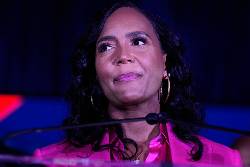
They landed a historic victory, as Keisha Lance Bottoms’ victory in Georgia — a presidential battleground state — made her the first Black woman to be elected governor in the U.S.
Democrats won in Iowa, Ohio and Texas, all states where Republicans have controlled state government for years, as well as all six presidential battleground states that Trump flipped in 2024 to win the White House.
Democrats also will preside over the nation's dozen most heavily populated states, except for Florida.
In the weeks leading up to Election Day, Trump traveled to heavily Republican areas to headline rallies attended by GOP gubernatorial candidates looking for a boost, in a sign of the impending losses.
All told, 36 states that are home to about 80% of the nation’s population were electing a governor Tuesday. In 19 states, the office was open. Heading into the elections, Democratic governors represented 60% of the nation’s population, but Republicans held 26 of the nation's 50 governors’ offices.
In 2027, Democrats will hold at least 28 governorships.
Democrats last gained a majority of governorships in 2006, flipping six governors’ offices in the last midterm under a second-term Republican president. Republicans recaptured the majority four years later.
More states under Democratic leadership could mean more governors fighting — or ignoring — Trump's agenda.
Trump has tested the power of states, clashing primarily with Democratic-led states over call-ups of National Guard troops, immigration operations, conditions on federal aid and efforts to assert federal control over election requirements, including restricting mail voting.
Democratic victories in Georgia, Texas, Iowa and Ohio
Bottoms, a former Atlanta mayor and onetime White House adviser to former President Joe Biden, overcame GOP attacks on her management of the city during the COVID-19 pandemic to defeat Rick Jackson, a billionaire who plunged more than $200 million of his own money into the race.
She accused him of getting rich off a broken healthcare system and profiting off pain.
Her victory breaks GOP control of state government in Georgia, as does Democrat Amy Acton’s victory in Ohio, in a campaign that made national headlines when Republican Vivek Ramaswamy, a biotech billionaire, aired a widely criticized attack ad featuring Acton’s estranged mother.
In two other GOP-controlled states, Democrat Rob Sand defeated Republican Zach Lahn in Iowa, while Democratic state Rep. Gina Hinojosa beat third-term Republican Gov. Greg Abbott in Texas, where no Democrat had been elected to statewide office since 1994.
Hinojosa was seen as a long shot after she emerged from a primary with a fraction of Abbott’s cash total and no statewide name recognition.
But as misgivings grew louder among rural Republicans over Abbott's policies on data centers, water rights and public schools, fellow Latino politicians and politicos wrote to the Democratic Governors Association to request $10 million in campaign aid, saying Hinojosa had made it a close race.
The DGA gave $1 million — far less than it spent in Arizona, Georgia, Iowa, Michigan, Nevada, Ohio and Wisconsin — and Hinojosa won despite being outspent 5-to-1 on ads, according to AdImpact data.
Notably, Abbott skipped Trump’s rally in Texas, a sign of the president’s unpopularity.
More races were seen as competitive
Democrats also saw an opportunity to pick up a governor’s office in Alaska, where the incumbent was term-limited. Like Georgia, Alaska hasn't elected a Democratic governor since 1998.
Republicans' best chance to pick up an executive suite was in Kansas, a normally deep red state where Democratic Gov. Laura Kelly was term-limited.
Republicans hung onto control in Florida, where U.S. Rep. Byron Donalds defeated David Jolly, a former Republican congressman-turned-independent who ran as a Democrat in the nation’s third-most populous state. Donalds will be Florida's first Black governor.
Republicans also had an eye on Oregon, but Democratic Gov. Tina Kotek fended off a second straight challenge from Republican state Sen. Christine Drazan.
Contests are in big states and swing states, too
Democratic Gov. Kathy Hochul of New York won reelection, and Democrat Xavier Becerra, a former U.S. health and human services secretary, cruised to victory in California.
Democrats also swept control of the executive branch in the six swing states from the 2024 presidential election: Arizona, Georgia, Michigan, Nevada, Pennsylvania and Wisconsin.
In Nevada, state Attorney General Aaron Ford knocked off Republican Gov. Joe Lombardo. Ford will be the state’s first Black governor after campaigning on his record of challenging the Trump administration in court and tying Lombardo to the president.
In Pennsylvania, Democratic Gov. Josh Shapiro won reelection, as did Democratic Gov. Katie Hobbs of Arizona. Democrat David Crowley, the Milwaukee County executive, won the open governor's job in Wisconsin, and Michigan’s secretary of state, Jocelyn Benson, won her state's open governor’s office.
The winners could have substantial influence over election administration during the 2028 presidential election. That could be important, considering Trump’s interest in expanding federal control over elections.
Meanwhile, three Democratic governors who are considered possible presidential candidates in 2028 all won reelection: Wes Moore of Maryland, JB Pritzker of Illinois and Shapiro, of Pennsylvania.
Demonstrating a big margin of victory, fundraising prowess and the electoral strength to help other Democrats win sends a strong signal to donors and party activists, analysts say.
The 2026 election produced some firsts
In Texas, Hinojosa will be the state's first Latina governor, while Deb Haaland 's victory in New Mexico made her the first Native American woman elected to lead a state.
More states elected Black governors, as well. Eight Black major party gubernatorial nominees were on ballots. In the past 250 years, only three elected governors have been Black, including Moore. Victories by Bottoms, Crowley, Donalds and Ford more than doubled that number in just one election.
Meanwhile, states were on course to possibly beat the record number of 14 female governors.
___
Follow Marc Levy at http://twitter.com/timelywriter
... Copyright © 1996 - 2026 CoreComm Internet Services, Inc. All Rights Reserved. | View our