

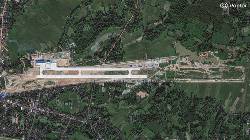
BANGKOK (AP) — China's new airfield in Laos is a work in progress, with satellite imagery showing many areas where construction appeared to be ongoing even as it was officially opened at a September ceremony.
The airport jointly run with Laos is China's first military facility abroad focused on air power and the latest project in Beijing's efforts to project force beyond its borders, which includes a base in Djibouti, the Ream naval facility in Cambodia, the rapid militarization and expansion of islands in the South China sea and a growing carrier fleet.
Neighbors of Laos, a poor and landlocked Southeast Asian nation of about 8 million people, and defense experts are now keeping a close eye on the airport, less for what it currently is, but what it might become.
Airfield especially concerning to Vietnam
Like the Ream navy base in Cambodia, the Ban Keun airport, which is about 50 kilometers (31 miles) north of the Laotian capital Vientiane and the Thai border, doesn't “radically alter any balance of power or give China much ability to project force toward the Strait of Malacca that it doesn't already have,” said Greg Poling, director of the Asia Maritime Transparency Initiative at the Center for Strategic and International Studies.
But the airport, with a potential for expansion, is certain to be a concern for neighboring Vietnam, which has competing territorial claims with Beijing in the South China Sea, said Poling, who suggested the Laos project was a “target of opportunity” for China, like the Ream naval base in Cambodia, which was renovated with Chinese money and now hosts a joint China-Cambodia training center.
“China's overseas basing strategy at the moment seems a lot more like playing roulette than poker,” he said. “Small bets over the board that occasionally pay off.”
Satellite imagery shows airstrip long enough for fighter jets
The Ban Keun airport currently has a runway of about 2,000 meters (6,560 feet), a parallel taxiway and an apron with spots for two dozen aircraft to park, according to an Associated Press analysis of satellite images from two weeks ago.
The runway is already long enough to accommodate fighter aircraft, and the satellite images indicate there is enough room to extend it at least another 1,000 meters (3,280 feet), which could allow use by bigger aircraft, including bombers.
In announcing the opening of the facility last month, China's Ministry of Defense said the “China-Laos Joint Support and Training Center and the China-Laos Friendship Aviation Academy” at Ban Keun are intended to “help Laos strengthen the training of its air force pilots” and “are not directed against any third party.”
China has not said whether it plans to permanently station aircraft and crews at the facility and did not immediately respond to questions. The state-run Global Times newspaper cited an expert saying there would be no independent Chinese garrison or exclusive use rights.
Laos' government did not respond to multiple requests for comment on how the airport would be jointly run or plans for its use.
For now, Laos' neighbors seem willing to take China's statement at face value, but also are watching closely to see how the facility takes further shape.
Vietnam closely watching Laos for Chinese military deployment
“Vietnam considers the Chinese military program as a training center primarily focused on training and humanitarian relief,” a Vietnamese official with knowledge of the internal discussions said.
“However, Vietnam also believes that China’s decision to establish a military program at this point is intended to strengthen its influence in Laos,” said the official, who spoke on condition of anonymity because they were not authorized to talk with the press.
“China’s deployment of military forces in Laos would naturally place a certain degree of additional military pressure on Vietnam as well,” the official said.
Vietnam’s Foreign Ministry and Cambodia’s Information Ministry did not respond to requests for comment. The military-run government of Myanmar, which neighbors Laos to the northwest and is embroiled in a bloody civil war, has not issued any statement.
The Institute for the Study of War said that while the Ban Keun facility is not yet equipped to provide the Chinese People's Liberation Army Air Force the ability to execute major combat operations like U.S. military bases overseas, its location alone already makes it a significant addition.
“The base would give the PLA alternate routes to access disputed areas of the South China Sea and strategic air routes around Vietnam,” the think tank said in a written analysis.
Thailand sees airfield as Laos' right, but also worth watching
Thailand, which is a treaty ally of the United States but also regularly conducts joint military exercises with China, does not see the establishment of the facility close to the border as a threat to Thai security, but will continue to watch the situation, Defense Ministry spokesperson Rear Adm. Surasant Kongsiri told the AP.
Laos has the “legitimate freedom to choose and consent to agreements with a partnering country under their own sovereign rights, and within the international law and norm,” he said. “However, Thailand will continue to monitor on the development concerned as part of our routine security assessment. This same response also goes for the Ream Naval Base.”
On a broader level, the airfield could complicate U.S. strategy for the defense of Taiwan, should China ever decide to take the democratically self-governed island by force, which President Xi Jinping has not ruled out for the territory that China claims as its own, said Evan Laksmana, a Singapore-based defense analyst with the International Institute for Strategic Studies.
The Laos airfield is much farther from Taiwan than considerably larger air bases in mainland China, but could provide an alternate landing strip for damaged aircraft and a place for repairs. The facility could conveniently be supplied by a new high-speed rail line connecting China's Yunnan province to the Laotian capital that was a signature project of Xi's Belt and Road initiative, Laksmana said.
Airfield could complicate US military thinking
“This complicates how the U.S. may have to think,” he said. “Does this mean the U.S. would have to attack a joint facility in Southeast Asia?”
Laos is one of Southeast Asia's poorest nations and deeply in debt to China for the new railway and many other infrastructure projects. While the airfield does improve Laos' strategic balance with its more powerful neighbors, Laksmana said, it may have also been an opportunity for China to use its leverage to build a facility where it can hone its abilities to operate an air base on foreign soil.
“For me, the opportunity is less about the war-fighting part but the familiarity with overseas engagements and activities,” he said.
Even though it is billed as a facility to train Laotian pilots, the Laos air force currently only has seven combat capable aircraft, according to the annual Military Balance report from the International Institute of Strategic Studies.
If the country plans to expand the air force, however, the joint agreement with China could help lead to a better deal for Chinese combat aircraft in the future, Poling said.
“But I suspect it's as much a target of opportunity for Laos as it is for China; not some major strategic vision driving the decision,” he said.
... Copyright © 1996 - 2026 CoreComm Internet Services, Inc. All Rights Reserved. | View our