

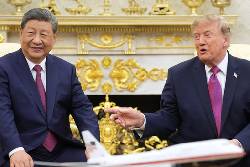
WASHINGTON (AP) — President Donald Trump on Thursday hailed the “truly great friendship” he has forged with Xi Jinping as the Chinese leader began his highly anticipated state visit by pressing for the world's two biggest economies to work more closely together to avoid friction as they compete.
While Trump has many thorny issues to discuss with the president of America’s biggest economic rival, he focused on his long relationship with Xi as the two gathered with aides for opening remarks before formal talks.
“From the time of my first election in 2016, President Xi and I have forged a friendship, a truly great friendship, actually, built on mutual respect and the vital interests of our people,” Trump said.
China has resisted the Trump administration's urgings — and economic threats — to use its considerable leverage to prod Iran to agree to U.S. terms to end the nearly seven-month war. Xi wants to see Trump permanently halt arms sales to Taiwan and loosen export restrictions on cutting-edge advanced chips. The two sides on Wednesday agreed to extend by two months a one-year trade truce that was set to expire Nov. 10 as they work to find a more durable agreement.
Xi presses Trump on Taiwan
In their private conversation, Xi also urged Trump to “prudently handle the Taiwan issue,” according to the Chinese state media outlet Xinhua.
China has made clear it views Taiwan as the most sensitive issue in the U.S.-China relationship. Beijing considers Taiwan to be Chinese territory and vows to annex the island by force if necessary. The United States is obligated by law to provide Taiwan with sufficient hardware to deter any armed attack from the mainland. The U.S. has said it opposes any unilateral changes to the status quo by either side.
China has repeatedly pressed Washington to permanently halt the arms sales, including when Trump and Xi met in Beijing in May.
After that meeting, Trump said he was holding off on final approval for a record $14 billion arms package that was in the pipeline. He also described arms sales to Taiwan as a “very good negotiating chip” with China.
Chinese president once more invokes the 'Thucydides trap”
Xi was also more pointed than Trump in his public remarks, saying Chinese and American interests are “deeply intertwined” and that the “competition should be a healthy one and should be kept within bounds."
He also reiterated his warning that the U.S. and China must avoid the “ Thucydides trap," referring to the idea that when a rising power threatens to displace an established one, the result is often war. Xi offered a similar warning when Trump visited Beijing in May.
“It should be a race of catching up with one another, not a wrestle in which one either wins or loses,” Xi added.
Xi also announced that China will invite 100,000 American youth to come to his country for studies and exchanges in the next five years and that China will send two pandas to the zoo in Atlanta. He called the beloved animals an “envoy of friendship" and that they will meet the American people in a “few days."
Xi says China and US should make sure AI is ‘always under human control’
Trump said in a social media post earlier Thursday that artificial intelligence — “superintelligence” as he is trying to rebrand it — will be high on the agenda amid growing global anxiety that the technology will kill jobs or potentially even wipe out humanity.
“I want to leave it exactly where it is,” Trump wrote. “That is China’s position also.”
Xi also touched on AI in his opening comments, saying that the two countries had a responsibility to ensure that humans always operate AI.
“We have both the capability and responsibility to develop and manage AI for good and ensure that a development of AI is always under human control and serves the well being of the people,” the Chinese leader said.
The two countries’ finance ministers met earlier this week, with the U.S. proposing a new “notification mechanism” for AI incidents between the two nations.
Trump rolls out the red carpet for Xi and faces criticism from some White House allies
Trump has made clear he wants to impress Xi with the visit. The Republican president made sure construction of a new helicopter landing pad on the White House's South Lawn was completed before the visit and he met Xi and his wife, Peng Liyuan, on Wednesday evening when they flew into Joint Base Andrews outside Washington.
The White House also arranged for an elaborate military review that the leaders and their spouses observed before the Oval Office talks. Following the military review, first lady Melania Trump accompanied Peng for a visit to the Smithsonian National Museum of Asian Art.
After about 90 minutes of talks, the leaders stepped out to the South Lawn so Trump could show off the new White House helipad and give Xi a tour of Marine One, the presidential helicopter. Trump and Xi also appeared to peer at the ballroom construction site from afar. Xi left the White House shortly after the quick tour and is to return in the evening for the state dinner.
“We had a great meeting,” Trump said in a brief exchange with reporters after the tour.
Later, the leaders will dine on sea bass at a black-tie dinner in the White House East Room, featuring red décor and a toast honoring the late President Richard Nixon, whose 1972 trip to China led to the establishment of diplomatic relations in 1979 and the parallel severing of formal ties with Taiwan.
Trump's decision to roll out the red carpet for Xi has spurred criticism from lawmakers in both parties and some White House allies.
“Quite frankly, had the White House asked me for advice, I would have suggested the president not invite Xi Jinping to Washington for such a lavish welcome here in the United States of America based on all of the troubling issues we have with President Xi and the Chinese Communist Party,” said Sen. Roger Wicker, R-Miss.
Xi urges US and Iran to return to interim agreement
The two sides also discussed the ongoing conflict in Iran, according to Chinese state broadcaster China Central Television.
Trump has argued to little effect that China, which is far more dependent on Gulf oil than the U.S., has plenty of incentive to use its sway with Tehran to help force an end to the conflict.
But Trump's war of choice has unnerved Beijing, with the government condemning the U.S. and Israeli military action and Xi previously expressing concerns the conflict signaled a return to what he called the “law of the jungle." The U.S. administration has warned China, Tehran's biggest trading partner, not to aid Iran’s military effort.
Xi, during Thursday's talks, said China supports the U.S. and Iran returning to a short-lived interim deal from the summer in an effort to wind down the war, according to CCTV. That agreement broke down soon after it was signed in June as the countries traded renewed fire over control of the Strait of Hormuz, a crucial waterway for energy shipments.
___
Associated Press writers Bill Barrow, Collin Binkley, Josh Boak, Kevin Freking, Seung Min Kim, Darlene Superville and Will Weissert and AP photographer Jacquelyn Martin contributed to this report.
... Copyright © 1996 - 2026 CoreComm Internet Services, Inc. All Rights Reserved. | View our