

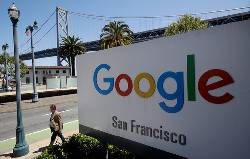
School districts are taking steps to block Google's artificial intelligence features and are considering dropping Google products entirely unless the company gives them a permanent AI workaround, pitting them against the tech giant whose Chromebook computers and learning tools are deeply embedded in America's classrooms.
In a major step, Los Angeles school officials have quietly disabled AI-generated summaries, known as AI Overview, in Google searches on school-issued devices. The move makes Los Angeles Unified the largest district to sideline the company, which has said it will not separate its search product from AI tools for education.
The LA district, which enrolls half a million students, has made no formal announcement, and the move caught parents and students by surprise, said Bridie Lee, a leader of Schools Beyond Screens LA, which has pushed for screen-time limits and tech oversight in the district.
The group had several members who weighed in at a meeting of the Los Angeles school board’s A.I. committee on Friday, Nov. 13. By that Monday, AI Overview was gone.
“It was the talk of the playground,” Lee said.
Google is the dominant provider of education technology for America’s classrooms. Beyond its low-cost Chromebooks, the most widely used student laptops, Google’s suite of education apps like Google Docs and Classroom has become integral to classwork, homework and communication among students and teachers.
But concerns about AI's impact on learning have ignited a battle between schools and Google. In September, the country’s two largest school districts — New York and LA — announced one-year moratoriums on student use of generative AI, and Google has said it's not possible to take AI out of its search products. Schools are considering other internet search providers.
LAUSD said in a statement it temporarily suspended AI Overview to ensure student experiences are “age-appropriate and safe.” It also said it continually evaluates its digital safeguards, including third-party tools. It was likely using such a tool that it was able to disable AI Overview.
Schools Beyond Screens LA asked parents to send videos of what laptop screens looked like and received clips showing that AI Overview was no longer an option in Google search on district devices. Then activists reached out to the district, which confirmed AI Overview was disabled. Lee said they had no other details on how it was done or how long it is intended to stay disabled.
“We’re thrilled LAUSD did this,” said Lee. “AI is seeping into everything. It’s dangerous. It’s hurting learning. And it’s a corporate overreach into public schools. It’s Big Tech attempting to strongarm tech policy without anyone’s consent.”
Other districts, such as Fairfax County Public Schools in Virginia, have developed plug-ins to remove AI summaries for students searching on Google, according to multiple published reports.
Google is increasingly at center of school tech backlash
Schools are seeing growing backlash against technology, starting with cellphones and screentime and now focusing on AI, amid concerns that students are using AI to think for them.
The Mountain View, California-based company in August found itself at the center of controversy. That's when it said it had turned on its Gemini chatbot for many K-12 students using Google Classroom, its learning management system. Weeks later, New York City and LA schools banned generative AI. In New York, the ban applies to all elementary and middle school students, and in Los Angeles all students K-12 are banned from using AI on school devices. Both districts said the ban would allow officials to develop AI policies this academic year.
Then, in early November, Google backtracked. It published a blog post saying it would instead turn off Gemini and all search tools by default for K-12 schools in the coming months. Administrators would have to turn on each tool if they wanted students to access them.
Google said this was to give schools more choice. But the choice to turn off AI altogether is not there.
While the blog post does not explicitly say search can’t be used without AI, Chris Phillips, vice president for education at Google, told The New York Times: “Search and AI are deeply integrated.” If schools ban AI, students “will not have access to search, and they’ll see a message from their school that indicates it’s not available.”
The integration of AI in search isn't new. Google introduced AI Overview in 2025, and anyone who uses Google search will get AI answers to many search results. Google insists AI Overview is an integral part of its search product now and cannot be separated.
Earlier this month, hundreds of Google employees signed a petition asking the company's leadership to allow schools to turn off AI features “without disrupting their ability to use search as a whole.”
“The way the decision has been reported in the press is poor, and makes Google, and our Education and Search products as a result, look like we’re punishing schools for not using AI,” the petition said. “Many students, educators and parents have concerns about AI in the classroom, as is shown by many school districts who have placed moratoriums or bans on such technology. It is our job as Googlers to respect the user, and listen to them when they have concerns about our products.”
Google has made some changes — but not enough, activists say
Google says it hears parents' and teachers' concerns about students using AI to “shortcut learning” and that it shares the same goal: helping students learn. But what many parents and teachers want — the ability to bypass AI entirely and allow students to use Google search like it was in, say, 2024 — is not something Google offers. This has forced districts across the U.S. to choose between restricting students’ access to AI and maintaining access to the popular search engine.
Instead of offering an AI-free search product for schools, Google announced a pilot “guided learning” tool that walks students “step-by-step through a range of complex problems, instead of just giving quick answers.”
“We are actively building these experiences in partnership with educators, listening closely to ensure our products support students and teachers,” the company said in a statement.
Currently, Google search offers AI Overview, which contains summarized answers resulting from general searches, and AI Mode, which is a chatbot interaction. Guided learning, which is not yet available, will walk users through steps intended to support critical thinking to get to the answer.
LA schools had already disabled Google’s AI Mode at the beginning of the school year on school-issued student devices, said Jack Kelanic, the district’s chief information officer, during a school board committee meeting on artificial intelligence last week. Educators and staff still have access.
“We understand this as a deeper embedding of AI into the education suite,” Kelanic said. He added, to applause, that the district is not bound to Google’s products if officials determine the changes are not in line with the district’s priorities.
“We have choices,” Kelanic said. “We can change the default search engine literally overnight.”
___
The Associated Press’ education coverage receives financial support from multiple private foundations. AP is solely responsible for all content. Find AP’s standards for working with philanthropies, a list of supporters and funded coverage areas at AP.org.
... Copyright © 1996 - 2026 CoreComm Internet Services, Inc. All Rights Reserved. | View our