

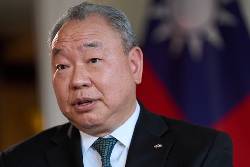
WASHINGTON (AP) — Taiwan needs to purchase American weapons to ensure its self-defense in the face of a growing threat from Beijing, the island's top diplomat in the U.S. said, adding that he has seen no change in Washington's policy toward the self-governing island that China claims as its own.
A $14 billion arms sale package to Taiwan is still in limbo after President Donald Trump returned from Beijing in May and said he had discussed the proposal “in great detail” with Chinese leader Xi Jinping, heightening anxieties in Taiwan and raising concerns among lawmakers on the Capitol Hill.
“We need those arms for defensive purposes,” Alexander Yui Tah-ray, who heads the Taipei Economic and Cultural Representative Office in the U.S., told The Associated Press in an interview Wednesday in Washington. “We're trying to increase our defense expenditure. We try to increase our ability to defend ourselves better and survive times of crisis.”
The Trump administration has not moved forward with the $14 billion weapons sale proposal after approved by senior lawmakers earlier this year. Trump has described the sale as a “very good negotiating chip” with China.
Washington is obligated by domestic law to provide Taiwan with sufficient hardware to deter aggression from China, which claims sovereignty over the island and vows to seize it, by force if necessary, to achieve what it considers to be unification. It has always opposed U.S. arms sales to Taiwan, which has never been under China's communist rule.
Taiwanese diplomat says the island won't wait for ‘the U.S. cavalry’
Yui said Taiwan is aware that it must defend its territory.
“This is our responsibility, so we will not wait and depend for the U.S. cavalry to come and save us,” he said. “That’s why we’re willing to acquire, to buy U.S. equipment and arms to make ourselves stronger.”
Yui said the weapons sales need to be “commensurate” to the threat level, which is “actually pretty high” from China.
“First and foremost, we’re not the aggressors. It is the People's Republic of China who is sending all the planes and ships,” he said. “They're the ones huffing and puffing. They are the ones who’s trying to annihilate our freedom and democracy in Taiwan.”
China sends warships and military aircraft near Taiwan almost daily and has conducted major military exercises around the island in recent years.
Beijing sees the island as a core interest and has criticized those supporting Taiwanese independence for causing instability in the Taiwan Strait. The Chinese Embassy in Washington didn't immediately respond to a message seeking comment.
Taiwan diplomat sees no change in the US position toward the island
Yui stressed that there had been no changes to the U.S. position on Taiwan and that the Taiwanese government will respect the Trump administration's “tempo” in making announcements.
The arms sale has broad support in Congress, with lawmakers raising concerns to Secretary of State Marco Rubio at a hearing this month. Rubio affirmed that U.S. policy on Taiwan has not changed and that Washington does not “consult with the Chinese on these arms deals.”
“We’re aware of their position. They talk about it all the time,” Rubio said of Beijing. “They are not negotiated, and they are not consulted.”
Rubio said the proposal was not held up but under review and that the administration had other factors to weigh.
“It includes the availability of the stocks in the short term,” Rubio said of U.S. weapons stockpiles, which have been drawn down during the Iran war. “We have to balance that with our own procurement process.”
The administration did approve a separate $11 billion arms sale package to Taiwan in December that included high-mobility artillery rocket systems, or HIMARS, and howitzers.
Yui deals with the second Trump presidency
Yui arrived in Washington in late 2023 during Joe Biden's presidency. Biden had said several times that he would send troops to the island if Beijing attacked.
Now, Yui is navigating the caprices of the second Trump administration, which has struck a more conciliatory tone with Beijing following an intense trade war marked by tit-for-tat tariffs.
As much as Trump has raised eyebrows by ignoring a Reagan-era promise not to agree to prior consultation with Beijing on arms sales to Taiwan, he also said he could call Taiwan President Lai Ching-te, breaking a decades-long practice that no sitting U.S. president has directly spoken with the leader of the island.
In its national defense strategy published in January, the Pentagon said it seeks to deter China through strength, not confrontation. It says the U.S. “will build, posture, and sustain a strong denial defense” along a strategic line of islands, including Taiwan, to keep China out of the wider Pacific Ocean.
Yui ascribed what appears to be mixed messages to Trump's outside-of-the-box style but expressed confidence in Taiwan-U.S. relations.
“It's important to look at the actions, what is happening, not just the rhetoric,” Yui said. “The big stick is still there.”
... Copyright © 1996 - 2026 CoreComm Internet Services, Inc. All Rights Reserved. | View our