

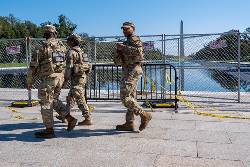
WASHINGTON (AP) — More than a year after National Guard members began patrolling the streets of the nation's capital, a federal appeals court on Wednesday opened a hearing by asking the government if there were any limits on a president's authority to call up the guard in D.C.
The hearing began with the three-judge panel collectively questioning the government’s attorney, Eric McArthur. Judge Cornelia T.L. Pillard asked how the government's argument about an administration's authorities was “not federalization and therefore running up against" the Posse Comitatus Act, an 1878 U.S. law forbidding the use of the federal military for domestic law enforcement unless authorized by the Constitution or Congress.
The hearing comes months after the court paused a lower court’s ruling that President Donald Trump's deployment of the guard was illegal.
Trump deployed the guard in August 2025 as part of what he said was a crime-fighting mission in Washington, D.C. The force, which rose to a peak of about 5,000 troops over the summer, has supported arrest operations, patrolled city streets and neighborhoods and participated in cleanup efforts.
Trump's Republican administration says the deployment has contributed to a decrease in crime in the city, where crime was already on the decline before the National Guard arrived. Officials and activists in the overwhelmingly Democratic city say the deployment is a waste of taxpayer money and has normalized the militarization of a major American city.
The three judges on the panel were nominated by Democratic presidents: Pillard by Barack Obama, Bradley Garcia by Joe Biden and Judith Rogers by Bill Clinton.
The case is about whether the president has the authority
At the heart of the court case, brought by D.C.'s attorney general, is whether the president has the authority to deploy the National Guard to the city, which, as a federal district, has limited autonomy over its own affairs. The U.S. Constitution gives federal lawmakers authority over the District of Columbia, while the Home Rule Act of 1973 lets residents elect a mayor, a council and neighborhood commissioners.
The city has argued that the mobilization is an illegal use of the military for domestic law enforcement.
Last December, the three-judge panel that paused the lower court's ruling said Trump might prevail in his argument that the president “possesses a unique power” to mobilize the guard in Washington.
The court went on to say in a unanimous 32-page ruling that other factors also favored the Trump administration, including the “disruption to the lives of thousands of service members,” as well as what it said was the president’s interest “in the protection of federal governmental functions and property within the nation’s capital.”
The judges found that the district “has not identified any ongoing injury to its statutory interests.”
Even if D.C. wins at the appeals court level, the Trump administration will undoubtedly go to the U.S. Supreme Court, which has already shown deference to the president in a number of cases.
Legal experts look at the arguments that could be made
Syracuse law professor William Banks said D.C. might have a slim argument under its home rule, questioning whether National Guard units can be deployed to the city when it isn’t authorized by local law.
But, he said, outside of that argument “there is no overarching federal principle that would bail out the district in this case."
Because D.C. is not a state and because the president is commander in chief, there’s a "tremendous amount of leeway and discretion for the president” to control or delegate control of the local National Guard and out-of-state units, Banks said.
Margaret Hu, a professor at the William and Mary School of Law, said one issue to look for was raised by states supporting the deployment in court briefs. They argued the president was reacting to an emergency. Hu said the open-ended manner of the deployment might allow a challenge to that.
“Some argue that the indefinite nature of the deployment means that there’s no emergency justification here,” she said.
A judge said Trump couldn't unilaterally deploy the DC National Guard
U.S. District Judge Jia Cobb concluded last November that Trump’s military takeover in Washington illegally intrudes on local officials’ authority to direct law enforcement in the district.
Cobb found that while the president does have authority to protect federal functioning and property, he can’t unilaterally deploy the D.C. National Guard to help with crime control as he sees fit or call in troops from other states. Cobb, who was nominated by Biden, put her order on hold for 21 days to allow the appeal by the Trump administration.
The appeals court stayed the order and has allowed the guard to remain in place while the case is pending.
The mobilization, extended until January 2029 by the Defense Department, has taken on a sense of permanence, despite the court case.
The federal government awarded a $292 million contract to a private company to provide members of the Joint Task Force-D.C. with apartments. The numbers have grown as well, ballooning to around 5,000 during the height of the semiquincentennial celebration. As of last week, that number had dropped to about 2,900.
... Copyright © 1996 - 2026 CoreComm Internet Services, Inc. All Rights Reserved. | View our