

BRUSSELS (AP) — European Union leaders agreed on Friday to provide a massive interest-free loan to Ukraine to meet its military and economic needs for the next two years.
The 27-nation bloc's heads of state had planned to use some of the 210 billion euros ($246 billion) worth of Russian assets that are frozen in Europe, mostly in Belgium. But despite working through the night into Friday morning, they failed to convince Belgium that the country would be protected from any Russian retaliation if it backed the “reparations loan” plan.
They settled on an alternative: borrowing $106 billion on capital markets.
After almost four years of war, the International Monetary Fund estimates that Ukraine will need 137 billion euros ($161 billion) in 2026 and 2027. The government in Kyiv is on the verge of bankruptcy, and desperately needs the money by spring to pay for everything from ammunition to infrastructure repairs.
Here's what to know about the loan.
EU to shoulder debt
European Commission President Ursula von der Leyen had brought to Thursday's summit two proposals to keep Ukraine afloat.
The first plan had been to use some of the 210 billion euros ($246 billion) worth of Russian assets that are frozen in Europe, mostly in Belgium. The money has been frozen under EU sanctions slapped on Moscow after its launched its full-scale war in 2022.
Leaders like German Chancellor Friedrich Merz and French President Emmanuel Macron backed this first option, especially since that method of funding would require support from two-thirds of the 27 EU nations.
That majority was expected to be far easier politically to reach than the total unanimity required by the EU foundational treaty for the second option: borrowing money from capital markets.
But throughout the long night, Belgium’s Prime Minister Bart de Wever refused to budge on the reparations loan. It was Hungary, whose leader Viktor Orbán has long objected to Brussels’ embrace of Ukraine, that compromised.
The European Council said it would use Article 20 of the Treaty of Europe to allow the EU to shoulder debt for a zero-interest loan to Ukraine.
It’s a simpler and possibly safer solution compared to the reparations loans. It is also akin to how the EU took on 750 billion euro in debt in the wake of the COVID-19 pandemic for a gigantic economic recovery fund. Large borrowing has become a hallmark of the administration of von der Leyen.
Outliers protected from financial burdens
Not all countries agreed to the loan package. Hungary, Slovakia and the Czech Republic refused to take on debt for Ukraine, but a deal was reached in which they did not block the loan package and were promised protection from any financial fallout.
Orbán, who is Russian President Vladimir Putin’s closest ally in Europe, claimed double victory at the summit in a post on X.
“We did not allow Europe to issue a declaration of war on Russia by using Russian assets” and “we succeeded in protecting Hungarian families” from additional debt, he said. He estimated the cost to Hungarians would have been 1000 billion HUF or $3 billion.
Orbán praised the cooperation of Hungary, Slovakia, and the Czech Republic, which were all excluded from financial burdens from the loan to allow for the unanimity required by the EU treaty.
But Czech Prime Minister Andrej Babiš distanced himself Friday from Slovakia and Hungary’s anti-Ukraine position during the summit, and said that Prague could simply not afford additional debt.
Use of Russian assets still on the table
The plan to use frozen Russian assets got bogged down at the summit as De Wever rejected it as legally risky. He warned that it could harm the business of Euroclear, the Brussels-based financial clearing house where 193 billion euros ($226 billion) in frozen assets are held.
Belgium was rattled last Friday when Russia’s Central Bank launched a lawsuit against Euroclear to prevent any loan being provided to Ukraine using its money.
But while the reparations loan was set aside, using frozen assets remains on the table.
The EU has said the assets will remain frozen until Russia has paid war reparations to Ukraine. Ukrainian President Volodymyr Zelenskyy has said that would cost over 600 billion euros ($700 billion.)
“If Russia does not pay reparations we will — in full accordance with international law — make use of Russian immobilized assets for paying back the loan,” Merz said.
EU leaders agreed that “this loan would be repaid by Ukraine only once Russia compensates Ukraine for the damage caused by its war of aggression. Until then, Russia’s assets will remain immobilized and the EU reserves the right to use them to repay the loan, in accordance with EU and international law,” according to a statement.
Council president Costa said that the EU “reserves its right to make use of the immobilized assets to repay this loan.”
Few believe Russian President Vladimir Putin will pay reparations, so the assets could well remain in Europe and make their way to Ukraine.
What the loan will be spent on
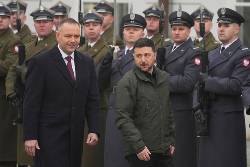
At a press conference on Friday in Warsaw, Zelenskyy said the loan gives Ukraine “financial certainty for the coming years” and said it would be spent on either reconstruction or arms.
“If Russia drags out this war — and that is exactly the signal the entire world hears from Moscow, as they continue to threaten us — we will use these funds for defense, if the war continues,” he said. "If the world compels Russia to make peace, we will use these funds exclusively for the reconstruction of our country.”
___
Associated Press writers Karel Janicek in Prague, Justin Spike in Budapest, and Illia Novikov contributed to this report.
... Copyright © 1996 - 2025 CoreComm Internet Services, Inc. All Rights Reserved. | View our