

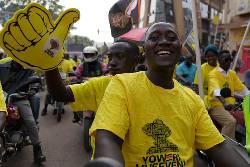
KAMPALA, Uganda (AP) — Ugandan President Yoweri Museveni won his seventh term with 71.65% of the vote, according to official results Saturday, in an election marred by a days-long internet shutdown and rigging claims by his youthful challenger, who rejected the outcome and called for peaceful protests.
The musician-turned-politician best known as Bobi Wine took 24.72% of the vote, the final results showed.
Wine, whose real name is Kyagulanyi Ssentamu, has condemned what he described as an unfair electoral process and alleged abductions of his polling agents before voting had even started in parts of the East African country. He said he rejected the “fake" results and urged Ugandans to peacefully protest until the “rightful results are announced.”
Wine said he had to escape to avoid arrest by security forces who stormed his house Friday night. Police spokesperson Kituuma Rusoke said Wine was “not under arrest” and was free to leave his house, but there was “controlled access” for others trying to go into the property to prevent people from using the premises to incite violence.
Electoral officials face questions about the failure of biometric voter identification machines on Thursday that caused delays in the start of voting in urban areas — including the capital, Kampala — that are opposition strongholds.
After the machines failed, in a blow to pro-democracy activists who have long demanded their use to curb rigging, polling officials used hard-copy registers of voters.
The failure of the machines is likely to be the basis for any legal challenges to the official result.
Wine has not said whether he would launch a legal challenge with the courts, which previously have refused opposition efforts to nullify Museveni's victories while recommending electoral reforms.
Museveni said he agreed with the electoral commission’s plan to revert to paper records of voters after the biometric machines failed, but Wine alleged fraud, claiming that there was “massive ballot stuffing” and that his party’s polling agents were abducted to give an unfair advantage to the ruling party.
The head of the observer mission for the African Union, former Nigerian President Goodluck Jonathan, told journalists Saturday that the mission did not find “any evidence of ballot stuffing” in the polling stations the team observed. He urged electoral authorities to test biometric machines in advance to prevent the failures and delays witnessed on election day.
But some local observers were more critical, calling the failure of biometric machines a red flag. In addition, the election climate was characterised by “fear and tension among the electorate, and some people just chose not to participate in the process,” said Livingstone Sewanyana, head of the Foundation for Human Rights Initiative, a civic group in Kampala.
Voter turnout stood at 52%, the lowest since the country's return in 2006 to multi-party politics.
Museveni, 81, has stayed in power over the years by rewriting the rules. The last legal obstacles to his rule – term limits and age restrictions – have been removed from the constitution, and some of Museveni’s possible rivals have been jailed or sidelined. He has not said when he will retire and has no rivals in the upper ranks of his party.
Veteran opposition figure Kizza Besigye, a four-time presidential candidate, remains in prison after he faced treason charges he says are politically motivated.
Yusuf Serunkuma, an academic and columnist for the local Observer newspaper, told The Associated Press on Saturday that Wine “didn’t stand a chance” against the authoritarian Museveni, who appoints the electoral commission.
“He has quite successfully emasculated the opposition,” Serunkuma said of Museveni.
Even with Wine’s challenge, Museveni faced “one of the weakest oppositions” in recent times, in part because opposition figures are not united while the president is the undisputed leader of his party and enjoys authority over the armed forces, Serunkuma said.
To implement the internet shutdown, which remained in force from Tuesday to late Saturday, the Uganda Communications Commission directed internet service providers to suspend access over an unspecified threat to national security.
The service providers obliged, even though the directive lacked legal weight without a declaration of a state of emergency. The shutdown devastated a range of businesses, from sports betting shops to Uber drivers.
The security forces were a constant presence throughout the election campaign, and Wine said authorities followed him and harassed his supporters, using tear gas against them. He campaigned in a flak jacket and helmet due to his security fears.
Uganda has not witnessed a peaceful transfer of presidential power since independence from British colonial rule six decades ago.
... Copyright © 1996 - 2026 CoreComm Internet Services, Inc. All Rights Reserved. | View our