

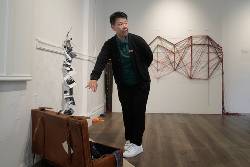
SAN FRANCISCO (AP) — On one side of the world, Xiangqi Chen can be punished for her LGBTQ+ activism. But on the other, the activist and artist is lauded as a trailblazer — the architect behind the first of its kind Chinese queer art museum.
The irony that she left her home in China and found a public platform for her LGBTQ+ artistic expression in San Francisco’s Chinatown — the country’s oldest — is not lost on her.
“Here in San Francisco Chinatown, I still continued my journey and met so many like-minded community members and friends,” Chen told The Associated Press through an interpreter. "It kind of actually encouraged me and gave me lots of strength to do what I know is my mission, my calling.”
The OUT Museum opened with a rainbow-ribbon cutting at the end of May — between Asian American Pacific Islander Heritage Month and Pride Month. Situated across from the Chinese Historical Society of America Museum, the bilingual museum is giving recognition to a demographic that has long felt invisible. It seems like an ideal fit in the progressive city at a time when some cities, states and the federal government are restricting or banning certain LGBTQ+ rights.
To start, the museum is only open on Saturdays and is one room with fewer than a dozen artworks by artists from China and the Chinese diaspora. But there is hope to expand the museum's exhibits and days of operation.
Museum allows Chinese artists to fully tell their stories
While still living in China, Chen launched a Kickstarter for a proposed museum six years ago — more than 2,000 donated on the platform. But she knew it likely wouldn't be built there. In 2022, she came to the U.S. on a J-1 visa as a visiting scholar at Georgetown University. By 2024, Chen gained attention in San Francisco for her role in an exhibition at the Asian Art Museum. That led to a residency with the Chinese Culture Center of San Francisco.
The organization was “proud to be the incubating space for the OUT Museum prototype,” executive director Jenny Leung said in an email.
The level of support that followed amazed Chen.
“I got so many chances to connect with the local Asian American queer community and even the Chinatown community in general,” she said.
Interest soon followed from longtime collaborators and younger artists who reached out via Instagram. They are represented in the inaugural exhibition, which includes photography, zines and an interactive installation where visitors use thread to trace their self-discovery journey with gender and sexuality.
For Hong Kong-born artist Dixon Ngai, this museum offers an outlet to tell his story as mainstream media typically overlook the Chinese LGBTQ+ community. He contributed a hand-painted, Chinese porcelain wine pot inspired by the Cantonese opera “Di Nü Hua,” or “The Flower Princess.”
Ngai said the OUT Museum, unlike other exhibitions, is very specific to the experience of the Chinese queer community, allowing “more people to see our voice.”
Museum affirms evolving attitudes toward LGBTQ+ presence
Since the museum's opening, Chen has been “one hundred percent moved" by unexpected feedback from one particular demographic: Chinese immigrants, both queer and straight, who have lived in California for decades.
A 60-year-old transgender man who visited shared how he immigrated to the U.S. in the 1970s for crucial gender-affirming care. There was also a mother looking to connect with her gay adult son.
“She later emailed me saying that she’s so grateful for all the events the art museum has organized," Chen said. “Her son came out to her, and she’s very proud of her son and she wants to express gratitude.”
These reactions are proof the museum is elevating the visibility of Chinese, Chinese American and Asian American LGBTQ+ people, said author and activist Helen Zia, a museum advisory board member. It also shows how attitudes have shifted, she said, as it would have been difficult to mount even 20 years ago,.
“There were Asian churches who would have demonstrations week after week with thousands of people just condemning same-sex couples,” Zia said, recalling the response from the Chinese community in 2008 when she handed out pro-gay marriage flyers in Oakland's Chinatown. “We got people yelling at us, spitting.”
Later that year, Zia and her wife were among many couples who wed after the California Supreme Court rejected a same-sex marriage ban. Even today, she says the museum's presence sends a needed message.
“See our humanity,” Zia said. “Here's the beautiful art that we create and imagine and contribute to the world.”
LGBTQ+ life in mainland China
versus the US
Being homosexual in China means living under the radar and discriminatory policies. In 2001, the Chinese Psychiatric Association stopped listing homosexuality as a mental disorder But LGBTQ+ couples still cannot marry or adopt. They are also limited in their right to publicly advocate. When Chen lived in Shanghai, she ran a grassroots center for lesbians. One of the reasons she left was because during the pandemic the government started cracking down on spaces for LGBTQ+ activism.
She likely could not even put on an art show, let alone a museum.
“From 2013 to 2015, that kind of art exhibition by queer artists (could) exist, but only if you don’t explicitly show or tell the audience that your work or yourself identify as queer or LGBTQ,” Chen said. “But not nowadays.”
That Shanghai center is how Zia met Chen a decade ago. Zia was doing research for a book and toured the center.
“She's been just incredibly brave in China, creating a center that attracted a lot of state attention," Zia said.
A key difference Chen has noticed among American-born Chinese LGBTQ+ people versus those in China is they are more educated about gender and sexual identity and have more access to support.
Under the second Trump administration, LGBTQ+ rights are increasingly under threat. President Donald Trump's administration has targeted gender-affirming care and sought to ban transgender people in the military. Some anti-Pride lawmakers recently proposed “Nuclear Family Month.”
San Francisco also recently dealt with shifting LGBTQ+ attitudes after Giants baseball players wrote Bible verses on Pride Night hats.
Nevertheless, the Chinese artists say the social landscape here is a breath of fresh air.
“Here in San Francisco, in California, we enjoy the air of freedom, there is equal human rights, there is security,” Ngai said. "So, we are very proud to be ourselves.”
This Sunday, Chen will proudly walk in her first San Francisco Pride Parade. She will plug the museum while dressed fittingly as a woman warrior from a Cantonese opera.
“I think completing this opening will be a start for me. It’s not the end,” Chen said. “We still have a long way to go.”
___
Tang reported from Phoenix.
... Copyright © 1996 - 2026 CoreComm Internet Services, Inc. All Rights Reserved. | View our