

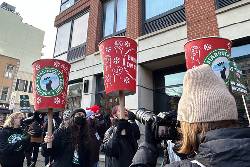
NEW YORK (AP) — Starbucks will pay about $35 million to more than 15,000 New York City workers to settle claims it denied them stable schedules and arbitrarily cut their hours, city officials announced Monday, hours before Mayor-elect Zohran Mamdani and U.S. Sen. Bernie Sanders visited striking baristas on a picket line.
The development came amid a continuing strike by Starbucks' union that began last month at dozens of locations around the country.
The workers want better hours and increased staffing, and they are angry that Starbucks hasn't agreed on a contract nearly four years after workers voted to unionize at a Buffalo store. Union votes at other locations followed, and about 550 of Starbucks' 10,000 company-owned stores are now unionized. The coffee giant also has around 7,000 licensed locations at airports, grocery stores and other locales.
Workers and the company dispute the extent and impact of the strike, but Mamdani, Sanders and some state and city officials sought to amplify the baristas' message by mingling with scores of strikers and supporters outside a Starbucks shop in Brooklyn.
“These are not demands of greed — these are demands of decency,” Mamdani, a democratic socialist who ran on pledges to aid working-class people, told the crowd. Some workers carried giant mock-ups of Starbucks takeout cups, bearing the union's logo instead of the coffee chain's insignia.
Four years after the first shop's union vote, “Starbucks has refused to sit down and negotiate a fair contract,” said Sanders, a Vermont independent who supported Mamdani's campaign.
A message seeking comment on the progressive politicians' picket-line visit was sent to Starbucks.
Striking baristas described a harried workplace with chronic short-staffing, online orders so complex that the ticket is sometimes longer than the cup, and last-minute calls to come in.
“It is the company's issue to give us the labor amount to schedule partners fairly, and they are not scheduling us fairly, no matter how much money we are making them,” said Gabriel Pierre, 26, a shift supervisor at a store in suburban Bellmore.
Starbucks has been trying to bounce back from a period of lagging sales as inflation-conscious U.S. customers questioned whether its coffee concoctions were worth the money. The Seattle-based company recently reported the first increase in nearly two years in same-store sales — a term for sales at locations open at least a year — but restructuring costs, store redesigns and other changes took a bite out of profits in its July-September quarter.
Under the agreement announced Monday with New York City's Department of Consumer and Worker Protection, Starbucks will pay $3.4 million in civil penalties, in addition to the $35 million it is paying workers. The company also agreed to comply with the city's Fair Workweek law going forward.
The company said it's committed to operating responsibly and complying with all applicable local laws and regulations everywhere it does business, but Starbucks also noted the complexities of the city’s law.
“This is notoriously challenging to manage," spokesperson Jaci Anderson said.
Most of the affected employees who held hourly positions will receive $50 for each week worked from July 2021 through July 2024, the department said. Workers who experienced a violation after that may be eligible for compensation by filing a complaint with the department.
“I sure hope that it gives Starbucks an awakening,” said Kaari Harsila, 21, a Brooklyn store shift supervisor who was picketing Monday.
The settlement also guarantees that employees laid off during recent store closings in the city will get an opportunity for reinstatement at other Starbucks locations.
The city began investigating in 2022 after receiving dozens of worker complaints against several Starbucks locations. The investigation eventually expanded to hundreds of stores. The city said the probe found, among other things, that most Starbucks employees never got regular schedules, making it difficult for staffers to plan other commitments, such as child care, education or other jobs.
The company also denied workers the chance to pick up extra shifts, so they remained part-timers even when they wanted to work more, according to the city.
___
Associated Press writer Bruce Shipkowski contributed from Toms River, New Jersey.
... Copyright © 1996 - 2025 CoreComm Internet Services, Inc. All Rights Reserved. | View our